

.png) Jacob Peenikaparambil
Jacob Peenikaparambil
Many political observers are questioning why the Modi government introduced the highly controversial Foreign Contribution (Regulation) Amendment Bill, 2026, just ahead of assembly elections in four States and one Union Territory.
According to media reports, the bill was deferred to the next session of Parliament following persuasion from the Kerala BJP, which feared a backlash from the Christian community. In recent years, the BJP has made sustained efforts to woo sections of this community in Kerala. The results of the upcoming elections will reveal the extent to which these efforts have succeeded.
It has been widely reported why the Christian community opposes the bill. Beyond concerns about the potential takeover of assets and a wide range of institutions—such as schools, colleges, universities, hospitals, orphanages, and nursing homes—the amendments may carry deeper, less explicit motives.
As envisaged by MS Golwalkar, the ideologue and second Sarsanghchalak of the RSS, Muslims and Christians would occupy a subordinate status in a Hindu Rashtra, without full citizenship rights. From this ideological standpoint, the BJP appears to have longstanding reservations about constitutional provisions safeguarding minority rights, particularly Articles 29 and 30 of the Indian Constitution.
At present, the BJP does not command the two-thirds parliamentary majority required to amend these provisions, which form part of the Constitution's basic structure. Articles 29 and 30 guarantee minorities the right to preserve their language, script, and culture, as well as to establish and administer educational institutions. In this context, critics argue that the government may be pursuing an indirect route—amending the FCRA—to gain control over minority-run institutions.
The proposed amendments empower the Union government to appoint an authority to take control of assets—such as land, buildings, and equipment—when an organisation's FCRA registration is cancelled, surrendered, or not renewed, even in cases of procedural delay. Assets created using foreign contributions may then be transferred to the government or a local authority.
Many Christian institutions have been built with full or partial support from foreign contributions. Yet, under the amended provisions, even institutions with partial support could be taken over. For instance, if a school constructed at a cost of ?5 crore received less than ?1 crore in foreign funding, it could still be subject to takeover if its FCRA registration lapses.
Concerns are compounded by the lack of transparency in the granting, renewal, and cancellation of FCRA registrations. Decisions are often made without publicly stated reasons. CPI(M) Rajya Sabha MP John Brittas has pointed out that the FCRA division website of the Ministry of Home Affairs does not provide detailed data, such as the number of registered organisations, rejected renewals, or cancelled registrations. He has also alleged that parliamentary questions on these matters are being disallowed on the grounds that the information is "secret in nature."
While the cancellation of FCRA registration on national security grounds may be justifiable, the subsequent takeover of assets created through legally received foreign contributions raises serious constitutional and ethical concerns. If funds were received in compliance with the law, it is unclear why institutions built with those funds should be appropriated by the state.
The government has not clearly explained the rationale for such asset takeovers. This lack of clarity has fuelled suspicions about its intentions, particularly given the ideological influence of the RSS on the BJP. With many ministers, including the Prime Minister, having associations with the RSS—an organisation that describes itself as one of the largest voluntary bodies in the world—critics question whether these amendments could facilitate the transfer of control over institutions to RSS affiliated organisations.
Critics also argue that the central government has been gradually withdrawing from sectors such as education and healthcare, leaving greater space for private players. Data from 2014 to 2022 indicates a decline in the number of government schools alongside a rise in private institutions. Over 78% of colleges in India are now privately managed. Similarly, schemes such as Ayushman Bharat are viewed by some as promoting a health insurance model rather than strengthening public healthcare infrastructure.
Against this backdrop, the prospect of the government taking over educational and healthcare institutions does not necessarily inspire confidence in improved management. Under the proposed amendments, the assets of organisations that lose their FCRA registration may be transferred to government agencies or sold, with the proceeds credited to the Consolidated Fund of India. Critics speculate that operational control could eventually be handed over to organisations such as Seva Bharati or Vidya Bharati, even if ownership formally remains with government departments.
Historical context also informs these concerns. Shortly after the adoption of the Indian Constitution, the RSS mouthpiece Organiser published an editorial on November 30, 1949, criticising the Constitution as lacking "Bharatiya" content and describing it as a patchwork of Western laws, while praising ancient texts such as the Manusmriti.
Critics contend that the ideological vision associated with the BJP and RSS emphasises a hierarchical Hindu Rashtra, which they argue is at odds with the Constitution's commitment to secularism, equality, and social justice. They also point to discomfort within these circles regarding affirmative action policies for Dalits, Adivasis, and other backward classes, even if such policies continue due to political considerations. NCRB data indicating a rise in crimes against the Scheduled Castes further adds to these concerns.
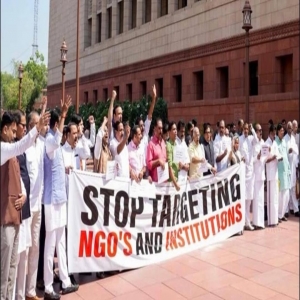
In this broader context, many critics suspect that increasing restrictions on NGOs—particularly those engaged in charitable work, human rights advocacy, and the empowerment of marginalised communities—are intended to weaken these efforts.
Reports from states such as Madhya Pradesh suggest that several hostels run by Christian organisations have closed due to difficulties in obtaining or renewing registration with the Women and Child Welfare Department, leading to increased school dropouts, especially among girls.
Organisations working on human rights and social justice are often labelled as "anti-national" or otherwise discredited, further shrinking civic space.
The intentions behind the proposed amendments to the FCRA remain a matter of significant debate and suspicion. Critics argue that existing regulatory mechanisms are already sufficient to prevent misuse of foreign funds. The Central Government holds full discretion over granting organisations permission to receive foreign funding. Once permission is granted, the government closely monitors the receipt and utilisation of these funds.
Furthermore, the decision to renew or deny registration remains entirely at the government's discretion." Hence, the necessity of additional powers is questioned. Ultimately, many fear that the amendments could weaken the NGO sector and, by extension, undermine the constitutional values of secularism, democracy, justice, equality, liberty, and fraternity.
.jpeg)
 A. J. Philip
.jpg) Jacob Peenikaparambil
Jacob Peenikaparambil
.jpg)
.png) John Dayal
John Dayal
.jpg)
 Pachu Menon
.jpg)

.png)
.png)
.png) Robert Clements
Robert Clements
.jpg)