

.png) Jacob Peenikaparambil
Jacob Peenikaparambil
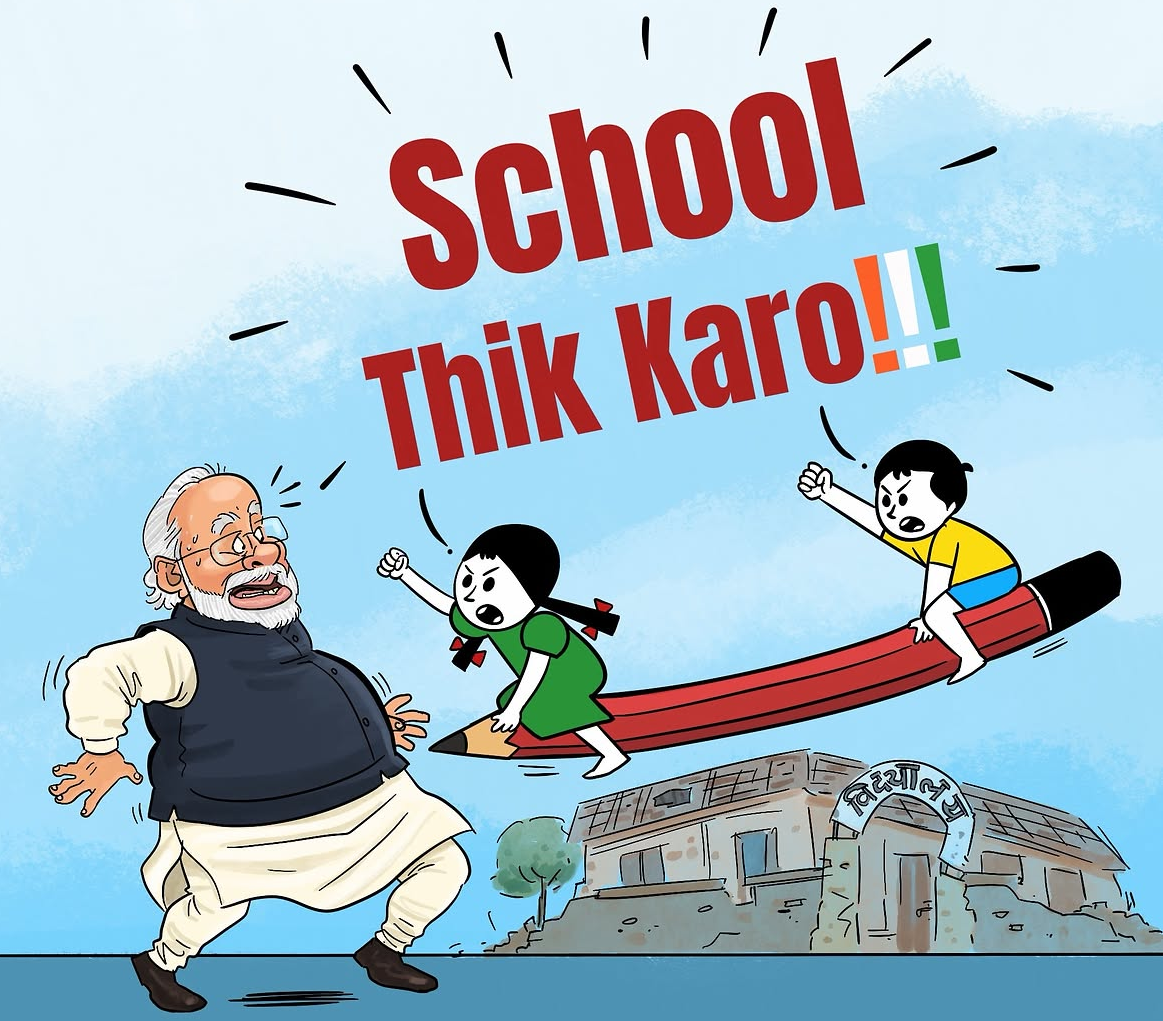
One of the consequences of the Gen Z protest at Jantar Mantar against question paper leaks and the government's lack of accountability has been a wave of protests by schoolchildren across India against the neglect of basic facilities in government schools. The School Thik Karo (Fix the Schools) campaign, launched by the Cockroach Janta Party (CJP), appears to have played a significant role in empowering younger schoolchildren to take to the streets and demand their basic rights.
In Hamirpur, Uttar Pradesh, around 300 schoolchildren marched six kilometres to the district collectorate carrying the national flag. They demanded a properly paved road to their school, citing severe waterlogging and muddy conditions that made commuting during the monsoon highly unsafe.
Students of Jodhavas Government Higher Secondary School in Thanagazi, Alwar district, Rajasthan, locked down their campus in protest. In addition to unsafe infrastructure, they pointed out that students had to cross a river to reach their classes because there was no safe road or bridge connecting the school.
Over 1,500 students from Classes 6 to 12 boycotted classes in Fatehpur, Uttar Pradesh, and locked the gates of Sarvodaya Inter College. They staged a six-hour sit-in, demanding clean RO drinking water, alleging that worms had been found in the existing water supply; functional fans; safe electrical wiring; and usable toilets. The protest compelled the local education authorities to give a written assurance that immediate repairs would be carried out.
More than 100 hearing and speech-impaired students in Jaipur, Rajasthan, organised a rally to protest cracked walls, leaking roofs, and unhygienic, non-functional toilets. Their protest ultimately led to the principal's suspension on charges of negligence.
Tribal students in Dahanu, Palghar district, Maharashtra, staged demonstrations demanding basic school infrastructure, separate toilets for boys and girls, and safe drinking water.
More than 200 schoolgirls from Jai Prakash Narayan Sarvodaya Vidyalaya in Lucknow, Uttar Pradesh, blocked a major highway bypass in pouring rain. They formed a human chain to protest the acute shortage of teachers in core subjects, particularly mathematics and physics, as their board examinations approached.
Frustrated by a year of administrative neglect, primary and secondary school students in Mangalwa, Jalore district, Rajasthan, organised a complete school lockdown and a road blockade. A viral video showed a young schoolgirl leading the demonstration and explaining that the school had no second-grade teachers and only two first-grade teachers to manage hundreds of children.
Hundreds of students of a residential government school in Unnao, Uttar Pradesh, staged a sit-in at a busy traffic intersection, disrupting local traffic. They were protesting against teacher shortages, poor-quality hostel food, and an uncooperative administration.
Such protests by young schoolchildren would have been almost unthinkable before the Gen Z protest at Jantar Mantar. That movement appears to have removed, at least to some extent, the fear that prevented ordinary people, especially young people, from raising their voices. They are now prepared to struggle for their basic rights.
The response of the state governments has generally been positive. At the same time, some BJP-ruled state governments appear concerned about the erosion of the positive image of a welfare state they have cultivated through the godi media and the personality cult surrounding Prime Minister Narendra Modi. Consequently, the governments of Uttar Pradesh and Rajasthan have recently issued strict directives restricting journalists, YouTubers, and social media creators from entering government schools.
Lalit Kumar, Secondary Education Director of the Rajasthan Directorate of Education, issued a strict circular stating that no media personnel, independent journalists, or civil society representatives could enter school premises without prior written approval from the principal or the competent authorities.
Similarly, Basic Education Officers in districts such as Ayodhya, Azamgarh, Ballia, Sultanpur, and Balrampur in Uttar Pradesh issued orders strictly prohibiting the entry of unauthorised outsiders, including YouTubers and digital influencers, into government-run schools.
In Maharashtra, police in Latur district filed an FIR against Cockroach Janta Party (CJP) founder Abhijeet Dipke and others for allegedly entering a government school in Jawali village, near Ausa, during the School Thik Karo campaign, without authorisation.
Past governments have not given adequate attention to education, especially public education. The BJP regime, too, is gradually encouraging the privatisation of education, thereby making quality education increasingly inaccessible to poor children. Annual public education spending has remained at around 4.2 per cent of GDP, while the National Education Policy recommends raising it to 6 per cent of GDP. It is indeed a matter of shame that governments are unable to provide decent school buildings with essential facilities such as toilets, safe drinking water, and quality mid-day meals.
Many schools also lack an adequate number of trained and qualified teachers. Around 10 lakh teacher positions are reportedly vacant in India's government-run schools. A Parliamentary Standing Committee report noted that roughly 7.5 lakh of these vacancies are concentrated at the primary and elementary levels. According to Unified District Information System for Education Plus (UDISE+) data, approximately 10 to 12 lakh working teachers lack the professionally recognised qualifications, such as a B.Ed. or D.El.Ed., required for their respective teaching levels. Official data shared by the Ministry of Education also show that India has 1,00,843 schools functioning with only a single teacher.
Another serious issue disturbing young people of India is joblessness. A recent report by NITI Aayog states that around 8.9 crore youngsters in India aged 15 to 29 are "not studying, working or receiving training," as reported by the Economic Times.
The BJP governments, however, appear to have money to spend lavishly on erecting statues, renovating temples, publicity through advertisements, religious programmes such as the Kumbh Mela, lighting lakhs of diyas in Ayodhya during Diwali, and hiring helicopters to shower flower petals on Kanwariyas during the month of Sawan. In the face of strong opposition from opposition parties, the BJP government at the Centre spent an estimated ?1,200 crore on the construction of the new Parliament building.
These lavish expenditures raise a fundamental question: Is education really a priority for the BJP governments? Otherwise, at least a part of the enormous amounts spent on projects of questionable public importance could have been used to improve education and healthcare.
Our Honourable Prime Minister, Narendra Modi, often speaks about Viksit Bharat by 2047. However, the Modi government's vision of a developed India appears to focus primarily on GDP growth. The Prime Minister and BJP leaders often proudly proclaim that India will be the third-largest and one of the fastest-growing economies in the world. But GDP growth alone does not make a country developed. No country can become truly developed without substantial human development, and education and healthcare are among the most important foundations of human development.
The Human Development Report 2025, published by the United Nations Development Programme (UNDP), places India at 130th position among 193 countries on the Human Development Index (HDI). The HDI is a composite measure based on three fundamental dimensions of human development: a long and healthy life, knowledge, and a decent standard of living.
The protests by Gen Z and Gen Alpha could compel governments, both at the Centre and in the states, to give greater priority to education, healthcare, and job creation. It appears that the BJP's strategy of remaining in power by pandering to majoritarian religious sentiments while ignoring issues that directly affect the daily lives of the majority of Indians is beginning to falter.
A developed India cannot be built on hatred towards minorities or by merely pandering to the religious sentiments of the majority community. A genuine Viksit Bharat can be built only on the core values and principles enshrined in the Indian Constitution: justice, liberty, equality, fraternity, and the dignity of the individual.
.jpg)
.png) Cedric Prakash
Cedric Prakash
 ICPA
ICPA
 ICPA
ICPA
 ICPA
ICPA
 ICPA
ICPA
 ICPA
ICPA
 ICPA
ICPA
.jpg)
 A. J. Philip
.jpg) Jacob Peenikaparambil
Jacob Peenikaparambil
.jpg)
.png) John Dayal
John Dayal