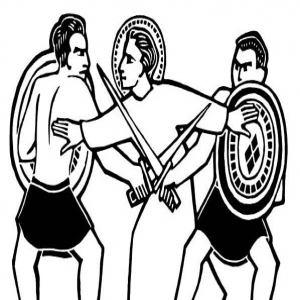


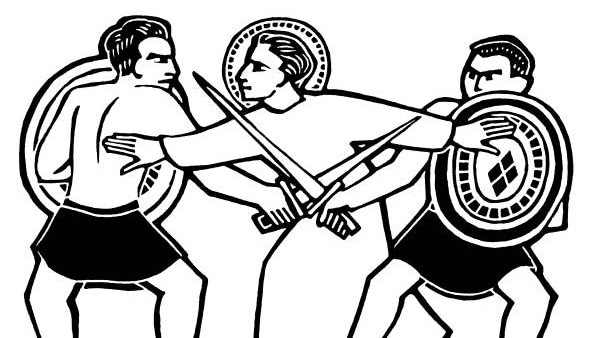
The phrase "just war" and "just a war" differ profoundly. A single article "a" changes the entire meaning. One seeks moral justification; the other suggests indifference. Across centuries, wars have often been justified in the name of religion and power, raising a troubling question: can violence ever truly be justified?
Historically, religion has frequently been used to legitimise violence. In the first century, Jews faced persecution under the Roman Empire, culminating in the destruction of the Jerusalem Temple by Emperor Titus. Early Christians, too, were persecuted, tortured, crucified, beheaded, or thrown to wild animals, because they were seen as a threat to Roman authority.
This pattern continued in the 11th century during the Crusades (1095–1291), a series of religious wars fought under the slogan Deus vult ("God wills it"). Pope Urban II proclaimed that those who died fighting "pagans" would receive remission of sins. While the Crusades contributed to expanded trade, cultural exchange, and the strengthening of the Papacy, they also raised a disturbing question: how can killing in the name of religion be morally justified?
Similarly, the concept of jihad, understood by some as a struggle to defend the Islamic community, has at times been interpreted in ways that justify violence. As Glenn E. Robinson explains in Global Jihad: A Brief History, modern jihadist movements have evolved through several phases, such as creating a global jihadist movement to free Muslim lands, expelling American influence from the Muslim world, establishing a new caliphate, eliminating apostasy and finally, promoting a decentralised, leaderless global jihad to sustain the cause. Yet again, the question remains: how can the killing of innocent people ever be justified?
The same moral dilemma appears in contemporary conflicts such as Israel–Palestine, where violence is often framed in religious or ideological terms. Likewise, in India, a country known for its religious diversity, incidents of mob violence, such as lynchings in the name of cow protection, highlight how religion can be misused to justify harm. Reports indicate that dozens have been killed and many more injured in such attacks, often targeting minorities. Such actions are not war in the formal sense, but they reflect the dangerous potential of religious extremism.
War is also justified in the name of power. History offers many examples, from Alexander the Great to the World Wars. The rise of Adolf Hitler, with his slogan "Ein Volk, ein Reich, ein Führer" ("One People, One Nation, One Leader"), demonstrates how political ideology and the pursuit of dominance can lead to catastrophic violence. Today, global powers, including the United States, Russia, China, and others, continue to assert their influence, sometimes at great human cost. In these struggles, civilians often suffer the most. For these reasons, some may argue that it is A JUST WAR.
However, for many others, especially those not directly affected, it becomes "just a war," something distant and abstract. In a globalised, technologically connected world, we are aware of conflicts everywhere, yet often remain emotionally detached. Even so, wars have far-reaching consequences.
The Guardian news reports highlight global disruptions:
1. In response to the gas shortage in India, Sagar Daryani, president of the Restaurant Association of India, commented, "fighting today to survive tomorrow."
2. Cancellation of hotel pre-bookings affected Thailand's tourism.
3. A QR system for petrol rationing in a seemingly faraway Sri Lanka.
4. Security fears in Europe.
5. Airfare surge pricing in South Africa amid soaring jet fuel costs.
6. Repercussions far beyond energy, with food and vital chemicals stuck in the Gulf.
7. 'Shock after shock' for Asian food production after fertiliser crisis.
8. Claims of bus ticket price-gouging in Bangladesh.
While these effects may seem indirect, they demonstrate that no one is truly untouched by war. The attitude, "as long as I am safe, it is just a war," is one of indifference, deeply dangerous and allowing injustice to persist unchecked. The words of Pastor Martin Niemöller, who, after initially supporting the Nazi regime, later warned against silence in the face of injustice, are appropriate here:
First, they came for the Communists
And I did not speak out
Because I was not a Communist
Then they came for the Socialists
And I did not speak out
Because I was not a Socialist
Then they came for the trade unionists
And I did not speak out
Because I was not a trade unionist
Then they came for the Jews
And I did not speak out
Because I was not a Jew
Then they came for me
And there was no one left
To speak out for me
His words remind us that indifference enables oppression.
So, is it a just war or just a war? The answer is neither. War is not merely a concept to justify or ignore; it is a human tragedy that affects us all. As theologian Felix Wilfred reminds us, "everything affects everything." Voices for peace continue to challenge the justification of war and indifference towards it. Pope John Paul II publicly acknowledged the Church's past wrongs and sought reconciliation.
More recently, Pope Leo has strongly condemned war, calling for peace, dialogue, and global cooperation.
1. "Brothers and sisters, this is our God: Jesus, King of Peace, who rejects war, whom no one can use to justify war. He does not listen to the prayers of those who wage war, but rejects them, saying: "Even though you make many prayers, I will not listen: your hands are full of blood" (Is 1:15; In his Palm Sunday Homily on May 20, 2026).
2. "Enough of the idolatry of self and money! Enough of the display of power! Enough of war!" (In his prayer vigil for peace on April 11, 2026).
3. "I will continue to speak out loudly against war, looking to promote peace, promoting dialogue and ?multilateral relationships among the states to look for just solutions to problems" (His remarks after the attack from Trump)
Therefore, war is neither morally justifiable nor emotionally dismissible; it is a shared human tragedy that demands responsibility, not indifference. All the more, it concerns our own brothers and sisters, who are created in the image and likeness of God, and are affected. For everything affects everything. While commemorating the Year of St. Francis of Assisi on the occasion of the 800th anniversary of the saint's Transitus to Heaven, let us pray along with him, "Lord, make me a channel of thy peace."
.jpg)
.png) Cedric Prakash
Cedric Prakash
 ICPA
ICPA
 ICPA
ICPA
 ICPA
ICPA
 ICPA
ICPA
 ICPA
ICPA
 ICPA
ICPA
.jpg)
 A. J. Philip
.jpg)
.png) Jacob Peenikaparambil
Jacob Peenikaparambil
.jpg)
.png) John Dayal
John Dayal