

 A. J. Philip
.jpg)
Knowledge is a vast ocean. Scholars merely dive into its depths, retrieve a few pearls of knowledge and wisdom, and, in the process, inspire others to dive deeper. My friend Dr RB Sreekala has done precisely this. She has delved deep into the work of Arnos Pathiri and emerged with Koodashappana (Sacramental Song), a painstaking attempt to revisit one of the remarkable works of early Malayalam Christian literature.
Arnos Pathiri was the Malayalam name by which Johann Ernst Hanxleden, a German Jesuit priest who came to Keralam in the early eighteenth century, became known. Born in 1681, he spent most of his life in Keralam and became a remarkable scholar of Sanskrit and Malayalam.
He was not merely a missionary. He was a poet, grammarian, lexicographer and linguist whose works left an enduring mark on Malayalam literary history. His Puthen Pana, along with his grammatical and lexicographical works, established him as one of the earliest European scholars to immerse himself so completely in the linguistic and cultural world of Keralam.
Dr Sreekala makes no claim that her edition is the final word on Koodashappana. On the contrary, her humility is one of the most attractive features of the work. There are several versions of the poem in the public domain, and she hopes that her research will encourage others to examine Arnos Pathiri and his writings more deeply. A scholar, after all, does not close a door by publishing a book; the best scholarship opens several new ones.
It is difficult to believe that a European born more than three centuries ago could come to Keralam, master Sanskrit and Malayalam and compose a long Malayalam poem about the life of Jesus that a Malayali today can read, recite and enjoy.
The work is known by several names, most popularly Puthen Pana—literally, the "New Song." Composed in the early eighteenth century, it narrates the story of Christ from the biblical account of creation and the Fall to the life, crucifixion, resurrection and ascension of Jesus.
It is divided into 14 padams and was written in Malayalam poetic metres. The twelfth padam, dealing with Mary's lament at the foot of the cross, has acquired a special place in the literary and devotional tradition surrounding the poem. But to understand why Arnos Pathiri wrote it, one must understand the Keralam into which he came.
The Jesuit priest had arrived in India with the intention of preaching the Gospel. He soon realised, however, that he did not possess the tools he needed to communicate effectively with the people among whom he had chosen to live. The problem was not merely theological. It was linguistic and cultural.
There are enough historical accounts to suggest that a large section of the Syrian Christian community in Keralam had little access to the contents of the Bible. Christianity was deeply rooted in Keralam, but for many ordinary believers, participation in religious life could become more a matter of ritual than an informed engagement with the life and teachings of the risen Christ. The Bible itself was not readily available to the masses.
Printing had already transformed Europe by then. Gutenberg's movable-type revolution had begun more than two centuries earlier, and printed Bibles were circulating in Europe. But the existence of printing technology did not mean that books were easily available everywhere. Printing in India was still in its infancy; books were expensive, and literacy was limited. A Malayalam-speaking commoner in eighteenth-century Keralam could hardly be expected to possess a printed Bible and read it at home.
Arnos Pathiri initially had little reason to regard Malayalam as the language through which serious intellectual or religious work should be done. To him, it was largely the language of the local population outside the learned elite. Sanskrit, on the other hand, was the language of learning and prestige. The elite spoke and wrote it, the sacred texts of Hinduism were preserved in it, and mastery of Sanskrit was a mark of scholarship.
So he turned his attention to the sacred language. This was no small undertaking. Sanskrit learning was closely associated with the Brahminical scholarly tradition, and there were differences of opinion over whether a European and, more particularly, a Catholic priest, should be taught the language of the Hindu gods. When some refused to teach him, Arnos Pathiri did not give up. He searched for those who were willing to become his teachers.
He was extraordinarily gifted at languages. He learned Sanskrit to a degree that enabled him to read, write and converse in it. He did not merely acquire a ceremonial familiarity with Sanskrit verses, as many modern enthusiasts do. He studied it seriously enough to produce scholarly works and later drew upon its literary resources in his Malayalam poetry. His linguistic achievements were extraordinary for a European missionary of his time.
Yet Sanskrit presented him with another problem. If his purpose was to reach ordinary people, preaching in Sanskrit would defeat the very purpose of preaching.
Jesus, after all, had not come merely for the learned and the powerful. In the words attributed to him in the Gospel, "It is not the healthy who need a doctor, but the sick." And in another passage, he speaks of being sent "to proclaim good news to the poor." Arnos Pathiri understood that a message intended for ordinary people had to be conveyed in the language they understood.
The Malayalam of his time was very different from the Malayalam we speak and write today. Malayalam was still evolving as a literary language. Yet Arnos Pathiri recognised something that many scholars might have missed: this was the language of the future.
A major transformation had already taken place in Malayalam literature through Thunchaththu Ramanujan Ezhuthachan. His Adhyatma Ramayanam, generally dated to the early seventeenth century, became one of the foundational works of Malayalam literature. Ezhuthachan retold the Adhyatma Ramayana in the kilippattu form, giving the great Sanskrit narrative a Malayalam voice. He helped demonstrate the extraordinary power of Malayalam to carry ideas, philosophy, devotion and epic narratives to people who might never have approached the Sanskrit originals.
Perhaps, Arnos Pathiri saw in this the model he was looking for. He realised that if his writings were to fulfil their purpose, they could not remain on the shelves of scholars. He needed a Malayalam that people could hear, understand, remember and repeat. There was another inspiration close at hand.
Poonthanam's Jnanappana (The Song of Wisdom) had already demonstrated the extraordinary power of simple Malayalam. Written as a devotional and philosophical poem centred on Guruvayoorappan, it spoke in language that ordinary people could understand.
Unlike a learned Sanskrit text requiring specialised knowledge, Jnanappana conveyed profound reflections on life, human frailty, devotion, death and salvation in simple, direct Malayalam. Its literary strength lay precisely in its accessibility. It became one of the great works of Malayalam devotional literature and won a permanent place in the hearts of Malayalis.
Poonthanam had shown that wisdom need not wear the robes of scholarship. Ezhuthachan had shown that an epic could speak Malayalam. Arnos Pathiri now wanted to show that the Gospel could do the same.
That is how the idea behind Koodashappana—better known as Puthen Pana—began to take shape. Even the name suggests the influence of the Malayalam pana tradition. Pathiri would tell the entire biblical story in Malayalam poetic form.
He had already mastered Sanskrit. He knew its metres and literary traditions. He therefore brought the discipline of Sanskrit prosody into Malayalam, using metres to give the poem a lyrical quality. The result was not a dry translation of biblical narratives. It was a work of poetry designed to be heard, remembered and sung.
For the first time, many Kerala Christians could encounter the Christian story not as something distant and inaccessible, but as something expressed in the language of their homes and communities. At the same time, Hindu scholars and Malayalam literary circles could appreciate the work not merely as Christian instruction but as poetry.
That, perhaps, was Arnos Pathiri's greatest achievement: he did not simply translate a faith into another language. He helped make Malayalam itself a meeting ground between faith and literature.
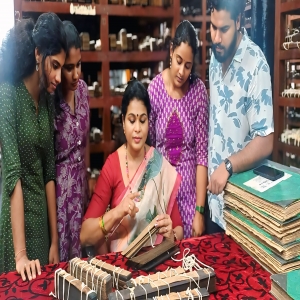
Sreekala's research takes us one step further into that fascinating story. She has based her edited version on a manuscript she examined at the Oriental Research Institute and Manuscripts Library of the University of Kerala. The institution, with its remarkable collection of Indian manuscripts, has long been an important centre for the preservation and study of Keralam's textual heritage.
What makes her discovery particularly interesting is that she also came across a paper copy of the work. The manuscript in the library, she found, had come into its possession from a Brahmin family. There is something deeply symbolic about that provenance. A Christian priest's poem about Jesus had travelled beyond the boundaries of the Christian community and found its way into the custody of a Brahmin household and eventually into a major repository of Kerala's literary heritage.
It is another indication that Puthen Pana was never merely a religious text meant for Christians. It had entered the wider Malayali literary imagination.
And this was not the first time the library had published the work. In 1960, when K Raghavan Pillai was associated with the institution, an edition of Koodashappana was brought out. Pillai, a scholar of Sanskrit and Malayalam and a close friend of my late friend Omchery NN Pillai, played an important role in the preservation and publication of Kerala's manuscripts.
But Dr Sreekala's work has revealed another fascinating layer. The older edition apparently did not have access to the paper manuscript that she discovered—a manuscript that is almost a copy of the original palm-leaf text. There were portions missing from the earlier version. Among them was the controversial twelfth Padam, which some scholars have regarded as a separate work of Arnos Pathiri. Dr Sreekala does not accept that view.
Her study of the original manuscript convinced her that the twelfth Padam belongs to Koodashappana. The chapter begins with a deeply moving invocation:
"Amma Kanyamani tante nirmala dukhangal ellam…"? (All the pure sorrows of the Virgin Mother…)
It is a voice of intimate compassion, where the poet imagines Mary's anguish at the foot of the cross. The passage continues in a spirit of surrender and poetic daring:
"If the Mother herself wills this way, I can make an attempt…"
Here, imagination and devotion merge, as the poet enters the emotional world of Mary, giving voice to what the Gospel leaves unspoken.
The Koodashappana then moves towards its closing vision, where the poet turns from sorrow to hope and redemption:
"Priyathode Messiah ye theruvin?Kan thurannu kondiduvan kaalamayi?Cheytha dosham ippol arachu kolvin?Kaarunyathinu kaalam ippolundu"
This may be translated as:
"Lovingly, let us now turn to the Messiah;?It is time to open our eyes and see Him.?Let the sins we have committed be washed away;?For now is the time of mercy."
The poem thus ends not in despair, but in an invitation to awakening, repentance and grace.
My friend and poet Vazhayil Joy, better known as VP Joy, IAS, did something similar when he wrote Mathruvilapam—the mother's lament. He had to imagine the emotions of Mary because the biblical narrative leaves much unsaid. Arnos Pathiri, centuries earlier, had done the same.
And perhaps that is where the scholar's manuscript becomes more than an old text. It becomes a window into the imagination of a poet who crossed continents, languages, religions and centuries to make one of the world's greatest stories speak in the language of Keralam.
In bringing this forgotten layer of Koodashappana back into scholarly attention, she has performed a service of immense value. Her painstaking research, careful editing and deep sensitivity to both language and tradition have illuminated a text that belongs not only to literary history but to the cultural memory of Keralam itself.
Scholars like Dr RB Sreekala, Professor of Malayalam at the Oriental Research Institute and Manuscripts Library, University of Kerala,
ensure that voices from the past are not lost in silence, but continue to speak to new generations with clarity and grace.
.jpg)
.png) Cedric Prakash
Cedric Prakash
 ICPA
ICPA
 ICPA
ICPA
 ICPA
ICPA
 ICPA
ICPA
 ICPA
ICPA
 ICPA
ICPA
.jpg) A. J. Philip
A. J. Philip
.jpg)
.png) Jacob Peenikaparambil
Jacob Peenikaparambil
.jpg)
.png) John Dayal
John Dayal