

.png) Robert Clements
Robert Clements
.png)
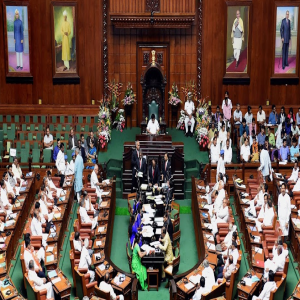
I read the news and blinked twice. Then I rubbed my glasses. Then I read it again. The Prime Minister was advised not to attend Parliament because the Speaker could not guarantee his safety inside the House.
I nearly spilt my morning coffee.
Not because of terrorists. Not because of a missile threat. Not because the building was on fire. But because of elected women Members of Parliament.
Imagine the scene. The world's largest democracy. The sanctum sanctorum of debate. The very place where arguments are supposed to be exchanged, voices raised, questions asked, tempers flaring and logic flying. And we are told safety cannot be guaranteed there.
One is tempted to ask, guaranteed from what exactly? Flying sandals. Sharp questions.
Or dangerously intelligent sentences?
When I was young, Parliament was described as the temple of democracy. Today, it seems to be treated like a haunted house. Enter at your own risk. Protective gear advised. Perhaps in the future, members will be issued helmets, elbow pads and riot shields along with their ID cards.
But the real comic gold lies in the word safety. Physical safety from women MPs who are known more for sharp tongues than flying fists? Or emotional safety from questions that require answers without a teleprompter?
Because when you have spent years speaking to friendly crowds who clap at the word Bharat, clap at the word culture, and clap even when nothing is said, the idea of facing actual questions can feel hazardous.
Questions are dangerous creatures. They do not bow. They do not chant slogans. They do not come with background music. They stand there quietly and wait. That silence can be terrifying.
What makes this episode even more questionable is the implication. If the Prime Minister is unsafe inside Parliament, what hope is there for the rest of us outside?
Should we all stop stepping out? Should vegetable vendors demand Z-plus security? Should aunties refuse to enter society meetings?
There is also something strangely ironic about being afraid of women MPs in a country where women are routinely told to adjust, be quiet, be patient, and not make a fuss. Suddenly, they are so powerful that they can endanger the Prime Minister.
That alone deserves a standing ovation.
In old movies, the hero walks into danger. He does not ask if the coast is clear. He does not send an advance party. He straightens his shoulders, fixes his collar, and walks in.
This was one such moment. Walk in. Face the women. Face the questions. Face Parliament. Democracy is not a spa. It is a wrestling arena.
When leaders start avoiding the House because debate feels unsafe, what they are really saying is that silence feels safer than accountability.
And that, dear reader, is not a security issue.
It is a courage issue...
.jpg)
.png) Cedric Prakash
Cedric Prakash
 ICPA
ICPA
 ICPA
ICPA
 ICPA
ICPA
 ICPA
ICPA
 ICPA
ICPA
 ICPA
ICPA
.jpg)
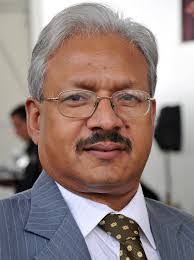 A. J. Philip
.jpg)
.png) Jacob Peenikaparambil
Jacob Peenikaparambil
.jpg)
.png) John Dayal
John Dayal