

.png) Joseph Maliakan
Joseph Maliakan
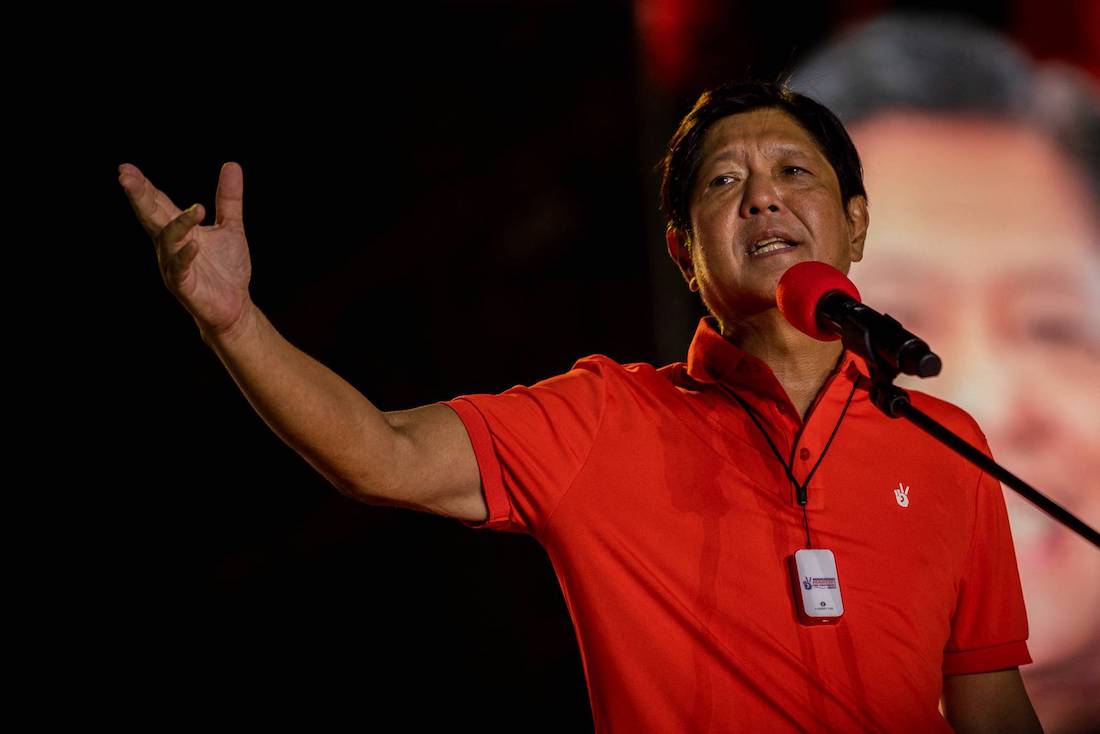
Ferdinand Marcos Jr., commonly called Bongbong Marcos, the second child and the only son of former dictator and kleptocrat Ferdinand Marcos Sr., is all set to become the President of the Philippines, 36 years after the brutal, corrupt despot was overthrown in a bloodless revolution on 25 February, 1986. Ironically, Marcos Jr. will be entering the Presidential palace on the 50th anniversary of the declaration of Martial Law by his father in 1972.
The Filipino revolution had no parallel. It was the civilian population which came to the defence of the military personnel who defected from the brutal Marcos regime. The revolution had even stunned the underground movement in the Philippines which had been fighting the dictatorship for more than a decade. The Marcos regime was overthrown in less than four days by the power of unarmed millions who were armed with only rosaries, flowers and religious statues.
The Catholic Church in the Philippines led by Cardinal Sin had played a pivotal role in moving the millions of civilians to the streets of Manila to oppose the Marcos regime. Marcos Sr. was a brilliant lawyer and scion of a Filipino political family. He was first elected President in 1965 on a slogan to make Philippines “great again”. His regime is also known and mocked at for first lady Imelda’s vanity projects such as the 25-million-dollar Manila Film Center as a rival to Cannes Film Center.
Marcos declared Martial Law in September 1972 using the threat of communist rebellion as a pretext. At that time, he had only less than a year for completing his second and final constitutionally permitted four-year term as President.
During his rule with an iron fist from 1972 to 1986, there were more than 11,000 victims of human rights violation. There were also some 2,300 deaths and 1900 torture cases. Under the martial law, free speech was banned and hundreds of opposition leaders were jailed. More than 50,000 people had been jailed during the martial law regime.
In fact, the chain of events that led to the overthrow of Marcos started with the murder of opposition leader Sen Benyno Aquino Jr. in 1983 on the tarmac of the main airport at Manila, on his return from exile in the USA. Three years later, millions took to the streets after a snap election marked by fraud.
The sudden and dramatic turn of events catapulted Corazon Aquino, wife of the slain opposition senator, to the Presidency. First the Filipino Army defected, then the Air Force and the United States withdrew support to the Marcos regime. The Marcos family, with the help of the United States, fled to Hawaii on 25 February 1986. Bongbong Marcos also joined the great Marcos in their great escape.
The Marcos family had amassed 10 billion dollars’ ill-gotten wealth, according to a report by the Presidential Commission on Good Governance (PCGG). The money though ordered to be recovered has not yet been paid back. In 1989, Marcos Sr. died in exile and in 1991 Aquino permitted the Marcos family to return to the Philippines.
In 2010, Marcos Jr. won a Senate race. He lost the race for Vice-President in 2016 but in the opinion polls on the 2022 Presidential race, he is the front runner with 56 percent voter preference. Leni Robredo of the Liberal Party who narrowly defeated Marcos in the Vice-Presidential race in 2016 is trailing with 24 percent voter preference.
How has Marcos Jr. managed to lead the Presidential race? His campaign is painting the martial law era of his father as “the golden era” of the Philippines! The campaign has been able to cleverly bury the ills of the father, and at the same time the son inherits whatever achievements of the father.
The demographic profile of the Philippines has favoured Marcos Jr. More than 65 million voters are between the age of 18 and 41, a group that did not experience the brutality of the martial law regime. The bloody drug war unleashed by the incumbent President Duterte and the violent language he employs and his autocratic style have become the new normal in the Philippines, according to political observers.
However, victims of Marcos Sr.’s martial law rule are fighting for Marcos Jr.’s disqualification from the Presidential race. The Election Commission has rejected the petition. The case, which is presently in appeal, will be considered by the Supreme Court even if Marcos Jr. wins the election scheduled for May 9.
Hundreds of pairs of shoes from former first lady Imelda’s infamous wardrobe are on show in a Shoe Museum in Manila, but most voters no longer consider the shoes as a matter of shame.
.jpg)
.jpg) Stanislaus Alla
Stanislaus Alla

 Adv. Rev. Dr George Thekkekara
.jpg)
 A. J. Philip

.jpg)
.png) John Dayal
John Dayal
.jpg)
.png) Jacob Peenikaparambil
Jacob Peenikaparambil
.jpg)
 P. A. Chacko
.png)
.png) Robert Clements
Robert Clements