

.jpg)
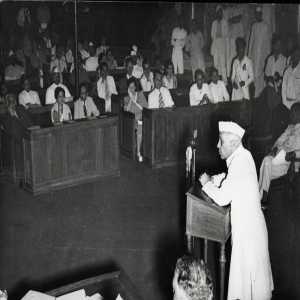
The general election of 1951-52 was the first major test of political Democracy in the new Republic of India. India passed that test with high honours because of the benevolent leadership of Pandit Jawaharlal Nehru. India opted for Parliamentary Democracy, the Cabinet system of government, based on the British model. The Cabinet is responsible to the House of the People. It functions on the principle of joint responsibility and remains in office as long as it maintains the confidence of the House of the People.
Nehru's Cabinet was surrounded by persons who did not share his ideology. They were retained mostly out of a sense of loyalty to old colleagues, persons who fought side by side for Independence. Until the death of Sardar Patel on December 15, 1950, Nehru and Patel made all the decisions of substance. The only other person whose counsel was regularly sought was Maulana Azad, the dean of India's nationalist Muslims.
Nehru and Patel, known as Panditji and the Sardar among friends, ruled India during the transition period from 1947 to 1950. No two leaders of any Asian nationalist movement in the 20th century differed more than the duumvirs of the new India, in background, education, temperament, ideology, sources of power, and qualities of leadership. According to Michael Brecher, author of Nehru: A Political Biography, "The two men did not get on well together and, the rivalry was genuine. Nehru often felt that, Patel was trying to usurp his power; Patel was jealous of Nehru's prestige and popularity. Patel could have ousted Nehru from the Prime Ministership; the party would have backed him. But a severe heart attack in March 1948 ended the possibility of change."
Following the assassination of Gandhi, Patel felt guilty that as the Home Minister he failed to protect the Mahatma. There was public demand for his resignation. On February 3, 1948, taking moral responsibility for security lapses, he wrote a letter to Nehru offering to resign. Nehru persuaded him to stay, emphasising their need to work together to build the nation. This is what Nehru had said in his letter to Patel written on the same day:
"When Bapu was alive, we had hoped to meet him together and discuss various matters that had troubled us somewhat. Now, with Bapu's death, everything is changed and we have to face a different and more difficult world. It is over a quarter of a century since we have been closely associated with one another and we have faced many storms and perils together. Even our differences have brought out the far greater points of agreement between us and the respect we bear to each other. We have even learnt to differ and yet carry on together. In the crisis that we have to face now after Bapu's death, I think it is my duty and, if I may venture to say, yours also for us to face it together as friends and colleagues ... in full loyalty to one another and with confidence in each other."
During its first decade, the functioning of the Indian Parliament was remarkable. Despite the Congress majority, debates were often vigorous, providing ample opportunity for the ventilation of grievances - spirited Question Periods, Adjournment Motions, Halt-an-Hour Discussions, and debates on Demands for Grants. The discussion of Bills brought out the main issues and allowed the Opposition to express their views.
The experiment with Parliamentary Democracy was successful, and parliamentary institutions were more firmly established in the way of life of the Indian people than they were in many a European country. This achievement owed to Nehru and to his pre-eminence in post-independence India. He had declared his faith in the democratic process. He was present in the House every day during the session. He was active during the debates. He was tolerant and very courteous to the Opposition, and he encouraged them as he tried to build up healthy parliamentary practices and conventions. His pre-eminence could only be compared with that of Winston Churchill at Westminster during the Second World War.
The Parliament in India was a symbol of the method of government which Nehru tried to establish as an instrument to educate those who would wield power in the future. It was a unifying force, representing different regions, castes, creeds, and social and economic groups. Nehru had fashioned the habit of looking to Parliament to solve disputes and reduce divisions in Indian society, with conflicts often operating at cross-purposes.
Nehru offered to resign on a few occasions, only to withdraw under popular demand. In April 1958, he wanted to relinquish his office. He met President Rajendra Prasad and offered to resign. The Congress party and the nation felt orphaned, and begged him to withdraw the offer. World leaders appealed to him to stay in office at a crucial juncture in history, when his presence was most required for securing international peace and cooperation. Eisenhower and Khrushchev urged him not to resign. The US President Eisenhower, in his letter of April 5, 1958, addressed to Prime Minister Nehru, wrote:
"I have just received news reports from New Delhi that you are thinking of laying down your official and heavy responsibilities. You, if anyone, Mr. Prime Minister, deserve a long and restful vacation after all these years that you have guided your vast country toward economic, political, and social progress. However, I and countless others hope that you will not go too far away or for too long a time. Are there not at least faint indications that the world may be at a turning point when some important problems can be solved, when perhaps the sharpness of conflict between the Soviet Union and the West may be sufficiently moderated to become tolerable. It would indeed be a misfortune, perhaps for all of us, if at what may prove to be a critical, formative period, your own influence were not actively present over any really protracted period."
Nehru wrote to Khruschev on May 10:
"I was happy to receive through your ambassador your letter and I am very grateful to you for your personal interest and your good wishes. All I wished was to go away to some quiet place and have an opportunity not only to rest but to think quietly about the many problems of our country and the world. These problems are, as you well know, of vital importance and, as I wish to utilise such energy as I have in serving my country and the cause of world peace, I wanted to refresh myself, and my mind especially, for these tremendous tasks. My colleagues, however, were insistent that I should not resign even for a short while, and I have submitted to their wishes."
Nehru relented to the pressure and withdrew the offer to resign.
This background is given to make the detractors of the first Prime Minister of free India understand what Nehru meant to India and the world of his time, and how Nehru's India is in tatters today under the Modi Raj, and how the Democracy that he built is defiled. Nehru's golden era of Democracy is being defamed and destroyed by the people whose ancestors collaborated with the British, who never participated in the freedom movement; nor believed in Democracy and the Constitution of India.
All the democratic institutions are captured: the Parliament, a temple of Democracy, is reduced to a heckling house; the Opposition not allowed to perform its legitimate role; no dissent tolerated; the Presiding Officers failing to prevail on the government; the Bills passed without discussion by bulldozing the established procedures and conventions; the government choosing silence over a plethora of burning national issues, toppling the elected governments and engineering defections and splitting rival political parties, in gross violation of the people's mandate; the misusing of central agencies and using coercive methods and money power; and the election commission' partisan role in the vote theft to benefit the ruling party - all these demonstrate the Democracy defiling in India.
Political Democracy per se has no meaning unless accompanied by social and economic Democracy. The education system, the backbone of nation-building and an instrument of bringing about social and economic equality in a vast, diverse, heterogeneous society, has totally collapsed. The massive privatisation of education has destroyed the future of the youth, Gen Z, the middle class and the poor. Unemployment is at an all-time high; 80% of the unemployed are in the 15-24 age group; 29% of graduates find no jobs after spending lakhs of rupees on education, with their parents mortgaging land and taking loans; and as large as 82% of the workforce is employed in the unorganised informal sector.
Faced with an uncertain, bleak future, the students are forced onto the streets, protesting against the political ecosystem that doesn't address their grievances. It is an ex
Sonia Gandhi, in an article "An education system's collapse, young India's trauma" (The Hindu, July 24, 2026), writes: "The Narendra Modi government has responded to their courage with cowardice and wanton cruelty, treating them not as inheritors of the future but as enemies of the nation. Only the government and its captive media are spinning stories around this spontaneous rising tide of protest; unleased the repressive power of the state on them."
The first fundamental issue is the Modi government's retreat from public education. It has reduced the proportion of its Budget spent on school education by 50% and on higher education by 33%. Over the past 12 years, the Modi government has shut down nearly one lakh public schools, while overseeing the opening of 43,000 private schools—a large chunk of which are run by the RSS, which, along with its affiliate organisations, presides over the largest private school network. Even most of the Sainik Schools are run by them, thus indoctrinating and politicising the future armed forces.
The impact of the shutdown of government schools is devastating. They are the schools of the poor - SCs, STs and the poorer strata of backward class communities. India is home to 60% of the world's below-the-poverty-line population, and it is their children who need the government schools, if they have to see any future for them. What is the meaning of Democracy and its lofty ideals to these unfortunate people, whose children are deprived and denied quality public education?
As Sonia Gandhi says, "the cost of pursuing a private education deters lakhs of talented students who come from humble backgrounds but have immense potential. Equally critical is that these expenses also put a crushing burden of impossibly high expectations on our students. The acute desperation of our students is a direct consequence of the privatisation and commercialisation of education. The appointment of feckless Vice-Chancellors chosen for their partisan loyalty, and the consequent recruitment of politically connected but unqualified faculty, has created a crisis in teaching in our public universities."
The education system has become increasingly expensive, prone to corruption, and difficult to succeed in. The Modi government deliberately cleared the National Education Policy 2020 without seeking consensus or subjecting it to parliamentary deliberations; all the present evils in the education system stem from this arbitrary policy decision.
And unless the present education system is totally revamped and liberated from the clutches of the RSS – an organisation whose ideology is inspired by Mussolini's fascism and Hitler's Nazism - and its political ecosystem, and the public education is restored for the children to have a safe and secure future, devoid of social and economic discrimination, there is no future for India, and there can be no safety valve for Democracy.
The defiling of Democracy is a symptom of an authoritarian regime. What could be more disgraceful than the Home Minister, fearing the Opposition, refusing to come to Parliament and make a statement on the crackdown on the students, and the Prime Minister who thinks that he is not accountable to Parliament in a parliamentary democracy? It is disrespect and an insult to the nation and the people who elected them. Nowhere in a democracy could Modis and Shahs survive in power.
.jpg)
.png) Cedric Prakash
Cedric Prakash
 ICPA
ICPA
 ICPA
ICPA
 ICPA
ICPA
 ICPA
ICPA
 ICPA
ICPA
 ICPA
ICPA
.jpg)
 A. J. Philip
.jpg)
.png) Jacob Peenikaparambil
Jacob Peenikaparambil
.jpg)
.png) John Dayal
John Dayal