

.png) Jacob Peenikaparambil
Jacob Peenikaparambil
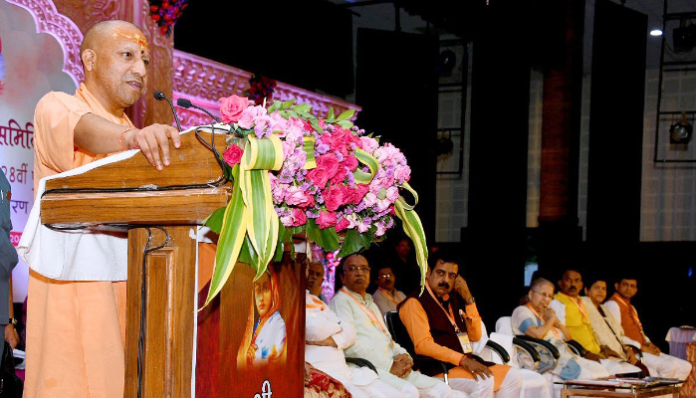
It was shocking news when the Uttar Pradesh Chief Minister, Yogi Adityanath, on Sunday, January 26, declared that "Sanatan Dharma" is the "national religion." He also stated that the ongoing Maha Kumbh in Prayagraj was not meant for any single caste or religion. However, by denying entry to Muslim and Christian traders and service providers in the area designated for the Kumbh Mela, Adityanath contradicted his own statement. His proclamation regarding a "national religion" constitutes a blatant violation of the constitutional framework of India. It is deeply unfortunate that such an appalling statement was made while India celebrated its 76th Republic Day.
Republic Day is a solemn occasion when Indians recommit themselves to the ideals, principles, and provisions of the Indian Constitution. It is not merely a day to showcase India's military strength or cultural diversity but also a reminder for all Indians, especially those in positions of power, that the country must be governed in alignment with the Constitution. It is disheartening that a Chief Minister who has sworn an oath to uphold the Constitution has repudiated one of its core principles—secularism.
The Supreme Court has repeatedly clarified that secularism in the Indian context signifies equal treatment of all religions. No religion is superior to another. In the landmark Kesavananda Bharati v. State of Kerala (1973), the Supreme Court declared secularism a fundamental part of the Constitution's basic structure, asserting that "India is a secular state in which there is no state religion." This principle was further elaborated in the Bommai v. Union of India (1994) case, where the Court underscored that secularism prohibits the encroachment of religion into the secular activities of the state. Against this constitutional backdrop, Yogi Adityanath's statement as a constitutional functionary is a serious violation of the oath he has taken.
The Bharatiya Janata Party (BJP) has often alleged that the inclusion of the terms "Socialism" and "Secularism" in the preamble of the Indian Constitution through the 42nd Constitutional Amendment in 1976 was an act of fraud. However, on November 25, 2024, the Supreme Court decisively put an end to this allegation. While hearing petitions filed in 2020 challenging the validity of these inclusions, the Court categorically upheld that secularism is an inalienable part of the Constitution's basic structure.
Despite episodes of religious strife, religious coexistence has been a hallmark of India's civilisational ethos. Historically, India was never a theocratic state with a state religion, making it inaccurate to claim that secularism is a Western import. Emperor Akbar's reign is a shining example of harmonious religious coexistence in India's history.
However, the Hindutva ideology espoused by the BJP-RSS Combine starkly opposes secularism and religious pluralism.
The BJP, with the strong backing of its ideological mentor, the Rashtriya Swayamsevak Sangh (RSS), appears determined to convert India into a Hindu Rashtra, relegating Muslims and Christians to second-class citizens. According to Shashi Tharoor, Congress MP from Thiruvananthapuram, Hinduism represents the union of diverse Indian cultures and traditions, with no single founder, while Hindutva is a homogeneous racial-territorial ideology propagated by Vinayak Damodar Savarkar.
As the BJP lacks the two-thirds parliamentary majority required to amend the Constitution, it has instead pursued a strategy of gradually diluting constitutional provisions through acts of omission and commission over the past decade. This approach validates BR Ambedkar's assertion: "However good a constitution may be, if those who are implementing it are not good, it will prove to be bad. However bad a constitution may be, if those implementing it are good, it will prove to be good." The BJP's most significant constitutional transgressions have pertained to the principle of secularism.
Both at the central and state levels, BJP governments have promoted the religion of the majority community by allocating substantial funds to renovate worship centres, erect statues, and subsidise pilgrimages. For instance, the BJP government in Madhya Pradesh erected a 108-foot statue of Adi Shankaracharya in Omkareshwar at a cost of ?2,200 crore. Similarly, the first phase of the Kashi Vishwanath Corridor in Varanasi cost ?339 crores, with the total project budget estimated at ?800 crores. Prime Minister Narendra Modi's participation in the project's inauguration—where he appeared in the garb of a priest—was a direct affront to secularism. Furthermore, the Prime Minister's involvement in the consecration of the Ram Temple in Ayodhya showcased the central and state governments' patronage of a religious event under the guise of promoting tourism.
The BJP has also enacted draconian anti-conversion laws, imprisoning hundreds of Christians on charges of religious conversion. Cow vigilantes have lynched innocent individuals with impunity under the pretext of cow protection. Meanwhile, Hindu right-wing groups have attacked prayer meetings and Christian institutions, alleging forced conversions. These incidents indicate the gradual emergence of a Hindu Rashtra without formally altering the Indian Constitution.
Secular-minded Indians experienced some relief when the BJP failed to secure an absolute majority in the 2024 Lok Sabha elections, compelling it to form a coalition government with two major regional parties. However, the BJP's robust victories in subsequent Haryana and Maharashtra state elections emboldened its efforts to undermine secularism. RSS Chief Mohan Bhagwat's statement that India achieved "true independence" on the day of the Ram Temple consecration not only denies historical truth but also challenges India's secular Constitution.
Alarmingly, anti-secular rhetoric is not limited to BJP politicians and RSS leaders; it has also infiltrated the judiciary. For example, Allahabad High Court Judge Shekhar Kumar Yadav's statement that "Hindustan would run as per the wishes of the majority people" and his refusal to apologise for this anti-national remark reflects the extent to which Hindutva ideology has penetrated India's democratic institutions. Additionally, the Supreme Court's refusal to halt the Archaeological Survey of India's "scientific investigation" of the Gyanvapi Mosque premises in Varanasi has exacerbated communal tensions. Many legal experts argue that this decision contradicts the Places of Worship Act of 1991, which prohibits altering the religious character of any place of worship as it existed on August 15, 1947.
Opposition parties have accused the BJP of exploiting the Kumbh Mela in Prayagraj for political gain. The UP cabinet's participation in a ritual bath at the Sangam during the Kumbh Mela received widespread media coverage. According to political commentator Nilanjan Mukhopadhyay, the BJP used the event as an opportunity for outreach, particularly to build ties with communities that did not vote for the party in the Lok Sabha election 2024. Holding a state cabinet meeting at a religious site and taking a ritual bath "for the purification of sins" amount to official endorsement of what should be personal acts of devotion.
On January 28, 2025, The Telegraph (Online) reported that a "Constitution" of the proposed "Akhand Hindu Rashtra" has been finalised and is ready to be unveiled at the Mahakumbh. It will be forwarded to the Centre on the occasion of Basant Panchami on February 2. The 501-page document, prepared by a 25-member committee of scholars, draws inspiration from the Ramayana, Mahabharat, Manu Smriti, and Chanakya's Artha Shastra.
There is an urgent need to counter the movement toward transforming India into a theocratic state by reaffirming the vision of India as articulated in the Constitution's preamble. Mahatma Gandhi, Jawaharlal Nehru, and BR Ambedkar, who collectively constitute a trinity of secular thought, contributed immensely to the development of secularism as enshrined in the Indian Constitution.
Every year on January 30, Indians commemorate the martyrdom of Mahatma Gandhi, who sacrificed his life for truth, non-violence, equality, and the harmonious coexistence of all religions. Gandhi's belief in religious pluralism held that all religions are essentially true and deserving of mutual respect. He promoted interfaith harmony by encouraging the study of other religions, practising interfaith prayer, and celebrating diverse religious festivals. He emphasised that all religions teach love and kindness.
However, there is a concerted effort to vilify Gandhi as the person responsible for India's partition. In reality, Gandhi opposed the two-nation theory and tirelessly worked to foster unity among India's diverse communities.
Promoting the legacy of Gandhi, Nehru, and Ambedkar by disseminating their vision of an inclusive India rooted in the millennia-old heritage of "unity in diversity" is the most effective way to counter attempts to transform India into a theocratic state. Imposing uniformity in religion, culture, or language undermines India's pluralistic democracy and must be resisted for the nation's progressive development.
.jpg)
.png) Cedric Prakash
Cedric Prakash
 ICPA
ICPA
 ICPA
ICPA
 ICPA
ICPA
 ICPA
ICPA
 ICPA
ICPA
 ICPA
ICPA
.jpg)
 A. J. Philip
.jpg) Jacob Peenikaparambil
Jacob Peenikaparambil
.jpg)
.png) John Dayal
John Dayal