

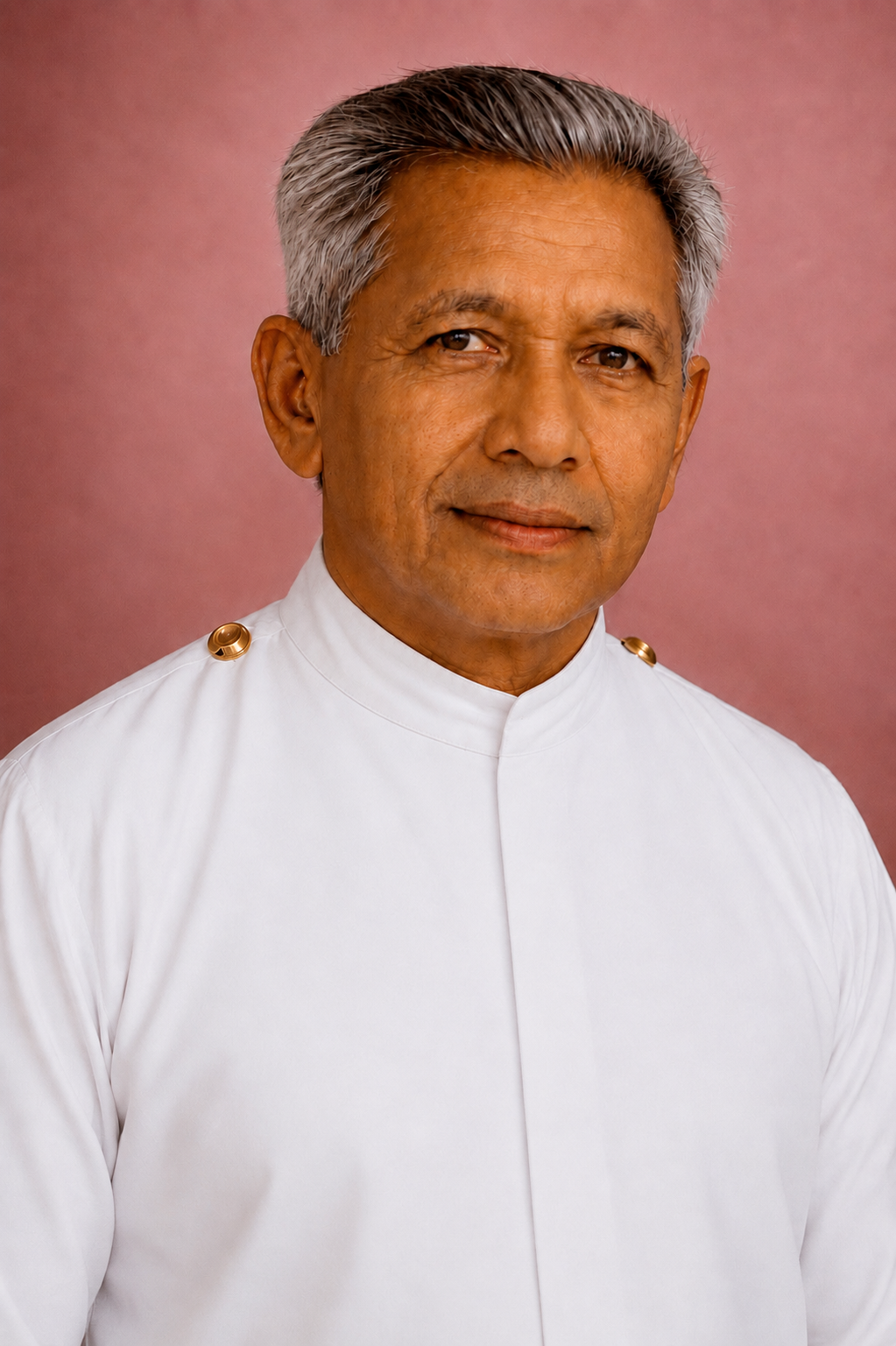
 A. J. Philip
If you ask me which was the greatest news story I reported or commented upon during my 53 years in journalism, I would answer without batting an eyelid: the eradication of smallpox from India.
I still remember the excitement I felt when Dr Karan Singh, then Union Minister for Health and Family Planning, made the announcement at a press conference at Shastri Bhavan in New Delhi. I had reported many important events before and many more afterwards. But some news stories are bigger than the headlines they generate. They become part of the lives of people. The eradication of smallpox was one such story.
The World Health Organisation's declaration came after an extraordinary campaign to identify every possible case, isolate patients and prevent the disease from spreading. The strategy that made the final assault possible was known as surveillance-containment.
It had been pioneered by Dr William Foege, an American physician who had worked as a medical missionary in Nigeria. Instead of trying to vaccinate everybody indiscriminately, health workers concentrated on finding cases, tracing contacts and vaccinating people around each outbreak.
The approach was spectacularly successful and was later adopted on a wider scale by the WHO. It transformed smallpox eradication from an almost impossible dream into a practical public-health strategy.
The task in India was formidable. The country was vast, densely populated and, in many places, poorly served by roads and medical facilities. Villages were scattered across difficult terrain. Many cases went unreported. Some people were too frightened to seek medical attention; others were unaware that the disease could be contained.
Yet smallpox had one unusual vulnerability. Only human beings could carry and transmit the virus. There was no animal reservoir from which it could return. If every case could be found and the chain of transmission broken, smallpox could, in principle, be defeated.
The health workers went from village to village, house to house and family to family. They searched for patients, traced contacts, vaccinated people and returned repeatedly to places where an outbreak had occurred. The campaign was not merely a medical exercise. It was an enormous human effort involving persuasion, persistence, courage and, often, physical hardship.
When the last cases disappeared from India, it was more than a public-health achievement. It was a victory over fear. I had a deeply personal reason to celebrate it. My grandfather, Ambikulangara Philipose Kathanar, also known as Rev. A. V. Philipose, had died of smallpox in 1934.
When I told Dr Karan Singh about this, he was touched. He invited me to his office for a personal meeting. For a young journalist, it was a moment I could never forget. I did not know then that smallpox would return to my life many decades later, through another priest.
His name was Kachukuzhiyil Achen, Rev. K. T. Bahanan. He was born on June 14, 1863. Until recently, he was little more than a mysterious name in my family history. Now I know why he came into my grandfather's life and why, nearly a century later, his story has come into mine.
The discovery was made by Rev. Jacob Mathew, who had served a full term as Vicar of Salem Mar Thoma Church, Kayamkulam. My grandfather had been the first and founding vicar of that church. There is no visible tomb or memorial to my grandfather in the Kayamkulam church cemetery.
When I first visited the church with my grandmother, Rahelamma Philipose, the widow of Ambikulangara Achen, in the 1960s, she showed me the church vestry. She told me that my grandfather had been buried close to the Madbaha, the sanctum sanctorum of the church. Later, the vestry was built over that place.
My father and his two brothers and one sister had moved away from Kayamkulam. Nobody apparently thought of putting up a tomb or even a memorial plaque.
So, for much of my life, that was all I knew: my grandfather had died of smallpox and had been buried somewhere close to the Madbaha.
Then, last month, I went to the home of Jacob Mathew Achen at Pullad, near Maramon, to invite him personally to the first Ambikulangara Achen Memorial Lecture on August 23. The lecture was delivered by Very Rev. Daniel Thomas, Vicar General of the Delhi Diocese, and inaugurated by Rt. Rev. Zacharias Mar Aprem, Bishop of the Delhi Diocese.
During our conversation, Jacob Mathew Achen told me something I had never known. The funeral ceremony of my grandfather had been conducted by Kachukuzhiyil Achen. I was stunned.
Jacob Mathew Achen is a historian by temperament. He wants evidence before he accepts a story. In a recent book, he has written pen-portraits of those who addressed the world-famous Maramon Convention in its early years.
He went through the old church records and found the details of my grandfather's burial. The records had been lying in the church attic, gathering dust. He brought them down and shifted them to the vicar's office at the parsonage.
This week I approached the present vicar, Rev. Shaji K. Thomas, and requested that he look for the relevant entry. He searched the records. He found it within minutes. I was thrilled to see the old register.
For decades, my grandfather had served as a priest and recorded the deaths and burials of generations of parishioners. He had stood beside the graves of others and entered their final details in the church register.
Now I was looking at the entry recording his own burial. There was something almost uncanny about it. The handwriting was strikingly similar to mine and that of his sons. Of course, my grandfather could not have written this final entry. It was most probably written by Kachukuzhiyil Achen, who had come from Vennikulam to conduct his funeral.
The entry recorded that my grandfather was buried on Meenam 8, 1109, in the Malayalam calendar, corresponding to March 21, 1934, in the Gregorian calendar. Since he was a priest, no burial fee was charged.
There was something profoundly moving about that simple entry. A man's life reduced to a few words in an old register. A date. A burial. No fee. And the name and signature of the priest who performed the final rites.
The register also told me something else. Only a few days before his own death, my grandfather had conducted the funeral service of Padinjarethalackal Mrs R. K. Kurian, Mariamma, who had died of asthma at the age of 67.
The records also showed that several people, young and old, had died of smallpox in Onattukara, the region of which Kayamkulam was a part. Suddenly, the world in which my grandfather lived became clearer.
Smallpox was not merely the disease that killed him. It was all around him. Then came the question that had been waiting for an answer all these years.
Ordinarily, the funeral service of a priest would be conducted by a bishop. That was the custom then, as it is now. Why, then, was a priest from distant Vennikulam brought to Kayamkulam to conduct my grandfather's funeral? I did not have to search far for the answer.
Rev. Shaji K. Thomas lent me a slim biography of Kachukuzhiyil Achen, written and published by K. E. Oommen, BA, LT, in 1989. Seventy pages. Price: ?8.
I read it in one sitting. When I finished, I was almost at a loss for words. It was difficult to believe that a man of such talent, courage, dedication and compassion had once walked this earth.
Today, the office of President of the Suvishesha Prasanga Sangham of the Mar Thoma Church is regarded as prestigious. Kachukuzhiyil Achen was its President for 31 long years.
He was offered the position of bishop but declined it when the Orthodox group in the church wanted to retain him in its fold during the Reformation movement in the Syrian Church of Keralam. He remained a bachelor throughout his life. But it was not his ecclesiastical position that impressed me the most. It was his courage.
Kachukuzhiyil Achen had contracted smallpox himself. There was a time when people who heard that he had died cried aloud in grief. Providence had other plans. He recovered. And having survived the disease, he did something extraordinary.
He began looking after smallpox patients whom others were afraid even to approach. Their religion or caste did not matter to him.
My grandfather had contracted smallpox while administering the sacrament of unction to a dying faithful. Kachukuzhiyil Achen understood the danger better than most. He had himself faced death from the disease. Yet he did not turn away.
He was also known in the region for treating eye diseases and had developed his own method of treating smallpox patients. His interests went far beyond medicine and pastoral work. He was a skilled carpenter and made beautiful wooden candle stands, which he gifted to fellow priests and bishops.
Long before the idea of Skill India was conceived, he had understood the importance of giving young people skills with which they could earn a livelihood. He organised training in occupations such as thread-making and honey production.
He was a people's man in the truest sense, someone who rose to the occasion whenever people needed him.
The biography contains reminiscences by people who knew him, including Alexander Mar Thoma and his successor. Their recollections reveal a man whose greatness lay not merely in the positions he held but in the lives he touched. The poet Vennikulam Gopalakurup recalled how Achen once gave him a substantial loan against gold. When the money was returned as promised, Achen charged no interest.
It was a small act, perhaps. But such small acts often tell us more about a person than great public achievements do.
At a time when smallpox had turned the human touch into something frightening, Kachukuzhiyil Achen entered the world of the infected and the dying. And when my grandfather died, he came and stood beside the body of a priest who had spent nearly 38 years standing beside the bodies of others.
He conducted the funeral. He ensured that Ambikulangara Philipose Kathanar was given the final rites of his faith. There is something deeply moving about the symmetry. My grandfather spent his priestly life accompanying other people to their final resting places. When his own turn came, another priest accompanied him.
And that priest was a man who knew smallpox not from books but from his own body. For nearly a century, I knew my grandfather only through family memories and a few stories.
I knew that he had died of smallpox. I knew that my grandmother had pointed out the place where he was buried. But I had no grave to visit and no memorial to remember him by. Now I have something more precious. I have the old church register. I have the date of his burial. I have the record of his final journey.
And I have the name of the man who came to conduct his funeral when fear might have kept others away. My 53 years in journalism have taken me to newsrooms, Parliament, press conferences, elections and countless events that once seemed important. I have reported history as it unfolded.
But one of the most moving discoveries of my journalistic life came not from Parliament or a press conference. It came from a dusty church register and a small, inexpensive biography. The eradication of smallpox was the greatest news I ever reported because it brought an end to a disease that had killed millions.
The story of Kachukuzhiyil Achen has made that history intimate for me. It has connected a global public-health triumph to a family tragedy that occurred more than four decades before I entered journalism. I cannot repay Achen for what he did for my family. I can only remember him. And tell his story.
My grandfather's grave may have disappeared beneath a vestry. There may be no stone bearing his name. There may be no plaque to tell a visitor that the first vicar of the Salem Mar Thoma Church, Kayamkulam, lies beneath the building.
But somewhere in the old church records is a simple entry that survives. And behind that entry stands a fearless priest from Vennikulam who came to Kayamkulam in March 1934 and gave my grandfather, Ambikulangara Philipose Kathanar (1880–1934), something that even the absence of a tomb cannot erase: a dignified funeral.
.jpg)
.png) Cedric Prakash
Cedric Prakash
 ICPA
ICPA
 ICPA
ICPA
 ICPA
ICPA
 ICPA
ICPA
 ICPA
ICPA
 ICPA
ICPA
.jpg) A. J. Philip
A. J. Philip
.jpg)
.png) Jacob Peenikaparambil
Jacob Peenikaparambil
.jpg)
.png) John Dayal
John Dayal