

.jpg)
In a democratic governance system, public offices are established to function according to principles of fiduciary responsibility and public trust. Independent recruitment mechanisms, comprehensive anti-corruption measures, and judicial oversight serve to prevent the concentration of authority in unchecked personal hands.
However, contemporary Indian public administration has increasingly been characterised by corruption. This deterioration undermines public confidence in governmental institutions and compromises the effectiveness of constitutional safeguards and institutional equilibrium.
The administrative records of Gyanesh Kumar and his daughter, Medha Roopam, have drawn considerable public and political scrutiny.
In the 2000s, when Gyanesh Kumar was the district collector in Ernakulam, TH Musthafa, a former Kerala minister, openly accused Gyanesh Kumar of maintaining shady deals with illegal sand miners in the Periyar River. Local representatives also said they received several public complaints about administrative bias toward riverbed mining and land-conversion interests.
Before he was appointed Chief Election Commissioner, Gyanesh Kumar served as Secretary of the Public Works Department (PWD) in Kerala in 2006, where he faced allegations of administrative mismanagement and institutional irregularities.
The department oversaw a ?215-crore infrastructure initiative financed by the World Bank to enhance the State Highway (MC Road) connecting Angamaly to Thiruvananthapuram. The project contract was awarded to a Malaysian infrastructure corporation.
After significant implementation difficulties, the principal project engineer, Lee See Been, alleged systematic corruption, extortionate practices, and administrative persecution by senior officials. Subjected to substantial institutional coercion, Lee See Been departed from India and subsequently died by suicide in Malaysia. In his suicide note, Lee See Been specifically identified Gyanesh Kumar and documented a pattern of severe psychological distress, unjustified administrative persecution, and institutional coercion.
The resulting scandal led the government to remove Gyanesh Kumar from his Public Works Department position. Despite the Vigilance and Anti-Corruption Bureau's preliminary investigations, the inquiry process deteriorated under dubious administrative conditions. Observers contended that institutional self-interest had shielded a high-ranking civil servant from comprehensive examination.
In 2024, he was appointed to the Election Commission of India and later became Chief Election Commissioner. His tenure as Chief Election Commissioner was marked by significant political discord and allegations of institutional degradation.
In 2026, Gyanesh Kumar faced political dissatisfaction over the administration of electoral operations and serious allegations of partisan bias in favour of the BJP during elections, along with criticism for disregarding dissenting views within the multi-member election commission.
On October 12, 2026, the Kerala Legislative Assembly took the extraordinary step of passing an official resolution demanding the immediate removal of Chief Election Commissioner Gyanesh Kumar. Supported across party lines by both the ruling and the opposition. The resolution stated that the ECI under Gyanesh Kumar had compromised its constitutional neutrality and demanded immediate structural reforms.
Concurrently, the Kerala administration initiated a renewed Vigilance and Anti-Corruption Bureau preliminary investigation into the 2006 Public Works Department corruption and misconduct allegations connected to the death of Lee See Been.
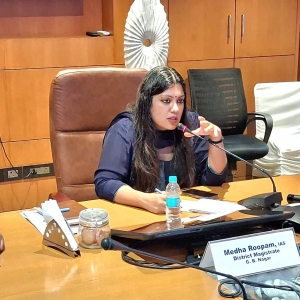
The apprehensions about Gyanesh Kumar's administrative record take on broader institutional significance when one examines the conduct of his daughter, Medha Roopam, an IAS officer who held key administrative roles in Uttar Pradesh, including District Magistrate of Gautam Buddha Nagar, Noida.
In 2026, during a series of labour protests in Noida, district authorities under Medha Roopam's leadership circumvented established criminal procedures to suppress political dissent. Student activist Akriti Chaudhary was apprehended, and District Magistrate Medha Roopam invoked the National Security Act (NSA)—a stringent preventive detention mechanism designated exclusively for substantial threats to national security.
Akriti Chaudhary remained in detention for more than five months. Upon judicial review by the Allahabad High Court, the tribunal issued a forceful judgment quashing the detention order, determining that the District Magistrate had demonstrated "manifest arbitrariness" and complete disregard for individual liberty under Article 21 of the Constitution, issuing severe censure to the administration for misappropriating national security legislation against routine political ex
In response to this administrative transgression, the court mandated that the aggrieved party be awarded ? 5 lakh in compensation, specifying that the amount be recovered directly from the personal salaries of Medha Roopam and complicit local officials.
The controversy escalated when Medha Roopam challenged the High Court order before the Supreme Court of India. The appeal sparked immediate outrage among legal professionals. The Lawyers' Association for Financial Accountability and Transparency submitted formal complaints alleging that Medha Roopam's petition received "out-of-turn" listing and priority treatment because she is the daughter of the sitting Chief Election Commissioner.
The combined administrative records of Gyanesh Kumar and Medha Roopam present a troubling picture of executive power detached from democratic accountability. They reveal that when executive power is exercised without robust constitutional friction, it breeds a culture of impunity that can pass from one generation to the next.
The arbitrary use of the National Security Act against student protesters in Noida shows a recurring tendency to treat public power as absolute rather than bound by statutory restraint.
Lingering questions over the 2006 PWD corruption in Kerala show how senior bureaucrats can insulate themselves from investigation for years, undermining public trust in administrative integrity.
When institutional heads face state assembly resolutions seeking their removal, and their family members benefit from perceived procedural shortcuts in higher courts, the foundational ideal of equal justice under the law is severely compromised.
To restore faith in governance and protect democratic fidelity, civil servants, government officials, and elected members, regardless of rank or lineage, must remain strictly answerable to the law and the public. If your commitment to your office is called into question, you must demonstrate your fidelity.
Mr Gyanesh Kumar, given diminishing public confidence in the neutral execution of your duties and your failure to demonstrate integrity and fidelity to your office as Chief Election Commissioner of India, you must step down to preserve the sanctity of the office. To protect democratic values and ensure uninterrupted administration, constitutional propriety and the peace of the nation mandate that you vacate your post.
The convergence of the 2006 Lee See Been suicide note, the legislative pushback against electoral roll manipulation, and the judicial reprimands faced by Medha Roopam paints a sobering portrait of modern Indian governance.
Authority, when separated from responsibility and becomes biased, cultivates an environment where wrongdoing goes unpunished. For democratic systems to flourish, constitutional institutions and governmental structures must remain open, subject to rigorous examination by impartial courts and public scrutiny, and free from the presumption of inherited administrative advantage.
.jpg)
.png) Cedric Prakash
Cedric Prakash
 ICPA
ICPA
 ICPA
ICPA
 ICPA
ICPA
 ICPA
ICPA
 ICPA
ICPA
 ICPA
ICPA
.jpg)
 A. J. Philip
.jpg)
.png) Jacob Peenikaparambil
Jacob Peenikaparambil
.jpg)
.png) John Dayal
John Dayal