

 A. J. Philip
.jpg)
The Pope is not only the leader of Catholic Christians. His appeal cuts across denominations and reaches a broad cross-section of Christians worldwide. My grandfather, an Orthodox Syrian Christian from Ranny in Kerala, understood this instinctively.
In 1964, he travelled all the way to Bombay to see Pope Paul VI, the first pontiff to visit India. It was the first time he boarded a train. For years afterwards, he would regale us children with vivid stories—how close he managed to get to the Holy Father, and how tens of thousands had gathered from across the subcontinent, drawn by the magnetic pull of the man they believed sat on the throne of Saint Peter.
There was something in my grandfather's voice when he told those stories—a quiet awe that went beyond his own Orthodox tradition. The Pope, for him, was not a rival but a symbol, a living link to an apostolic past that all ancient Christian churches share.
That memory stayed with me. In the eighties, when I heard that Pope John Paul II was visiting India, I decided I would see him, à la my grandfather, PV Chacko. My editor, RK Mukker, at The Searchlight readily assigned me to cover the Pope's visit to Ranchi, now in Jharkhand. Unlike my grandfather, however, it was not a spiritual journey for me. I had to compete with a planeload of journalists accompanying the pontiff from Rome, scrambling to file my report before the deadline.
The romance of pilgrimage gave way to the pragmatism of the Press pass. Still, I felt a connection across generations—grandfather walking through Bombay's crowds, grandson racing through Ranchi with a notebook. Both of us, in our own ways, were trying to touch something larger than ourselves.
Years later, I attended his Holy Communion service in Delhi, held against the backdrop of the Gujarat earthquake—a moment of national grief that the Pope's presence made easier to bear. During the same visit, I shook hands with him at Vigyan Bhavan, Delhi's largest hall, where he addressed an interfaith gathering.
Only afterwards did someone gently advise me that I should have kissed his ring rather than offer a secular handshake. I have often thought about that small embarrassment. It reflects a deeper truth: the gap between how we approach power and how we approach holiness. A handshake is between equals. A ring kissed acknowledges something else—a chain of succession, a lineage of grace, and a weight of history that no election or appointment can fully confer.
I began to study him closely after that. I not only read his authorised 1,000-page biography by George Weigel but also interviewed Weigel at his office at the Centre for Policy Research in Washington. I still return to that book from time to time.
No Pope in recent history influenced the world as much as this first Polish-born pontiff. His interventions in Poland and the momentum they gave to the Lech Wa??sa movement helped bring down the wall that divided Europe. He is rightly credited with helping to dismantle the Communist empire led by the former Soviet Union.
When he died, even his fiercest critics admitted that the world had lost a moral giant. That is the peculiar power of the papacy: it can move history without armies, budgets, or sanctions—only with words, presence, and a stubborn refusal to remain silent.
His successors, Pope Benedict XVI and Pope Francis, also fascinated me. When Francis's autobiography was released in India, I took pride in reviewing it first in this journal. I was at the Vatican when he canonised Mother Teresa, giving her the name Saint Teresa of Kolkata.
Barring a few evangelical Christians who see the Pope as the Antichrist, most people listen to him with respect. Popes are measured in their speech. That is what makes their occasional directness so striking. Like Jesus, they usually speak in parables and generalities. When they suddenly name names, the world pays attention.
As a columnist in The Economist recently wrote, for nearly a thousand years, a quiet rule governed relations between temporal power and the papacy: however much a pontiff might annoy you, keep your insults to yourself. In 1077, the Holy Roman Emperor Henry IV learned this lesson the hard way. He stood barefoot in the snow for three days, wearing a penitent's shirt, begging Pope Gregory VII for forgiveness after calling him a "false monk."
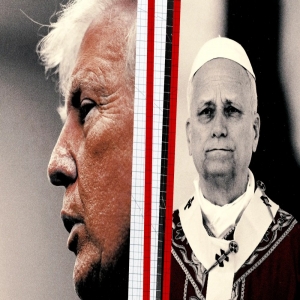
That image of imperial humility became a cautionary tale for rulers "from the Baltic to the Mediterranean." Then came Donald Trump.
On April 12, the American president looked at the leader of 1.4 billion baptised Catholics and told him to "get his act together." Pope Leo XIV, Trump thundered on social media, was "weak" on crime and "terrible on foreign policy." He implied that the Pope needed a tutorial in theology, diplomacy, and even basic manhood.
Within days, Trump had also posted—and then deleted—an AI-generated image of himself as Jesus. If Henry IV's humiliation was a masterpiece of medieval penance, Trump's outburst is a masterclass in modern political self-immolation. The contrast could not be sharper: one ruler kneeling in snow, another posing as the Saviour; one begging forgiveness, the other demanding it.
Funnily enough, Trump had praised the election of Pope Leo just last May. Though the Pope was born in Chicago, he spent most of his adult life in Peru. To see him only as an American is to misunderstand the office he holds. John F. Kennedy and Joe Biden were both Catholic presidents. It made little difference to either the papacy or the presidency.
Trump's deputy, JD Vance, is a neo-Catholic. He, too, fell in line and criticised the Pope, though one suspects he did so with less enthusiasm than the performance demanded. Trump, who once took credit for the Pope's very elevation—as though papal conclaves were subsidiaries of the White House—now finds himself at odds with the moral authority he claims to have helped install.
The immediate cause of this war of words is the Trump administration's attempt to justify American attacks on Iran as a "just war" backed by the will of God and Jesus Christ. Pope Leo, who usually speaks in general terms about peace and migration, broke precedent on April 7. He directly criticised the president, calling the threat to obliterate Iranian civilisation "truly unacceptable."
No sensible person would support a threat to wipe out an entire civilisation—one that includes children, families, schools, institutions, art, and culture built over millennia. Such a loss would erase everything associated even with biblical figures like Ruth. It was one of the most reckless statements ever made by a political leader.
Ironically, Trump had claimed he wanted to liberate Iranians from the control of the Ayatollahs. That is the tragedy: the road to hell is paved with good intentions, and the road to war is paved with them, too.
That was the spark. The fire has been fed by everything that followed. Leo did not back down. In Cameroon, during a tour of four African nations, he told a crowd in Bamenda: "Woe to those who manipulate religion and the very name of God for military, economic, and political gain, dragging what is sacred into darkness and filth."
He blessed peacemakers and condemned "the masters of war," who pretend not to know that "it takes only a moment to destroy when a lifetime is not enough to rebuild." Though he never named Trump, the force of his words reached Washington.
The Trump administration responded by doubling down. Vance advised the Pope to be more careful when speaking about theology, and later suggested that the Vatican should stick to morality. The administration seems to believe it can outflank the Pope on theological grounds. That is like trying to out-swim the fish. You cannot defeat a man at his own game when he shaped that game centuries before your country existed.
What is Trump trying to do? One charitable explanation is that he felt provoked. Popes usually speak in safe universals—end war, welcome migrants, feed the poor—without naming leaders. Leo broke that pattern by criticising Trump's Iran policy directly.
For a president who treats criticism as betrayal, this was intolerable. A less charitable explanation is that Trump sees a political opportunity. Attacking the Pope appeals to a segment of his evangelical base, which has long distrusted the Vatican. Never mind that many of them cannot name a single encyclical or explain the difference between a consistory and a conclave. What matters is the spectacle.
However, Trump has managed to unite America's Catholics in disapproval. Not only liberal nuns and Jesuit activists, but also the conservative Catholic establishment has turned against him. One even demanded a presidential apology. When a pope-bashing campaign alienates bishops who usually defend you, it is not a political victory—it is an own goal.
For the Pope, this confrontation carries risks as well. The more he engages Trump, the more he risks being seen not as a spiritual leader but as a global anti-Trump figure. His words in Cameroon, partly aimed at President Paul Biya, also served as a broader critique of strongmen who confuse power with providence.
"Public authorities are called to build bridges, not divisions," Leo said. "Authentic peace arises when people feel protected, heard, and respected, and when the law restrains the whims of the powerful." It is a universal message. But in the age of Trump, universals are read as partisan statements.
The deeper irony is that Leo has done exactly what popes are meant to do: speak truth to power without fear. "I do not see my role as political," he insisted. But when a president wraps war in religion and attacks the Pope for dissenting, the Pope must respond. He said he had "no fear" of the Trump administration.
He will continue to oppose war and speak "loudly about the message of the Gospel." That is not politics. That is his job. His job description has not changed since Gregory VII faced Henry IV in the snow—only the costumes have changed.
Last week, the Punjab Assembly passed a law banning sacrilege. It prescribes a minimum of ten years' imprisonment, extendable to life, along with fines from ?5 lakh to ?25 lakh for acts deemed sacrilegious. The Bill is still awaiting the Governor's assent.
Under such a law, Trump could have been punished for sharing an AI-generated image of himself as Jesus, had he been living in Punjab. The irony would likely be lost on him. Laws against sacrilege aim to protect the sacred from the profane. But what happens when the profane does not recognise itself as profane? What happens when a man sees himself wearing a crown of thorns and mistakes it for branding?
A thousand years ago, a ruler knelt in the snow. Today, a ruler posts a selfie as the Saviour. Some lessons take more than a millennium to learn. Perhaps they cannot be taught at all. Perhaps they must be lived—or, in Trump's case, endured.
The papacy has outlasted empires, revolutions, dictatorships, and plagues. It will outlast this presidency as well. The rest of us, however, must first endure the spectacle. And spectacle, as Trump understands better than anyone, is a form of power. Whether it can match the quiet authority of a man who answers to a higher throne remains to be seen.
.jpg)
.png) Cedric Prakash
Cedric Prakash
 ICPA
ICPA
 ICPA
ICPA
 ICPA
ICPA
 ICPA
ICPA
 ICPA
ICPA
 ICPA
ICPA
.jpg) A. J. Philip
A. J. Philip
.jpg)
.png) Jacob Peenikaparambil
Jacob Peenikaparambil
.jpg)
.png) John Dayal
John Dayal