

.jpg)
The Union Home Ministry, out of panic and insecurity, moved to fortify Delhi against the protest called on October 10, 2026, at Jantar Mantar by the Cockroach Janta Party (CJP), the All-India Students' Association (AISA) and others to demand the resignation of Chief Election Commissioner (CEC), Gyanesh Kumar, for vote chori.
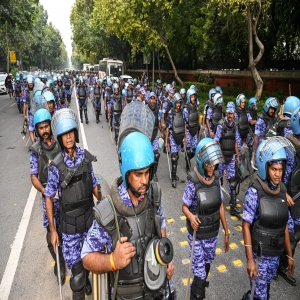
The previous day, the national capital was locked down by deploying more than 40,000 Delhi policemen and central forces, including the Border Security Force and the Rapid Action Force, to pre-empt the protest march; and with Jantar Mantar and Delhi borders sealed; hundreds of outstation trains reaching Delhi halted; Metro stations closed; checkpoints every hundred metres, multiple layers of concrete barriers and spike strips laid across the roads, internet shutdown, shops and hotels closed, Central Delhi—the seat of power—looked like a war zone as if preparing to fight an invading enemy.
The State was fighting against its own people. The unarmed youth were treated like the enemy of the nation. They were not allowed to protest peacefully, despite the Constitution's guarantee of the fundamental right to protest, causing ordinary people more hardship than the protest would have otherwise. However, state forces could not stop the flash protests as people took to the streets in different locations, chanting slogans and demanding Gyanesh Kumar's resignation. The might of the State machinery cannot silence the people's voice; nor can it silence the dissenters.
A ten-member INDIA bloc delegation, led by the LoPs Rahul Gandhi and Mallikarjun Kharge, met President Droupadi Murmu on October 9 and presented a Memorandum demanding Gyanesh Kumar's resignation over vote chori under his supervision. The Memorandum says: "We have incontrovertible proof that vote chori has taken place on a massive scale in election after election. Assembly elections in Haryana, Maharashtra, Madhya Pradesh, Chhattisgarh, Bihar, Delhi and West Bengal have been stolen." They also demanded the suspension of the ongoing SIR of electoral rolls and returning to paper ballots for all elections, replacing the EVMs; and repealing the Chief Election Commissioner and other Election Commissioners (Appointment, Conditions of Service and Term of Office) Act 2023 that provides life-long immunity to the CEC and ECs, with a mala fide intent.
On the day of the protest, thousands of people were detained illegally, in violation of the law; thousands were confined to their homes, and any person suspected of marching towards Jantar Mantar was detained. The police and the right-wing goons and goondas were beating and bashing the young protesters. The CJP trio—Abhijeet Dipke, Ashutosh Ranka and Saurav Das—were detained at the IGI Airport on their landing from Mumbai. The next day, the Executive Magistrate at Delhi Cantonment released them after they signed a ?50,000 surety bond and an undertaking to maintain peace and good behaviour for one year.
On October 10, Rahul Gandhi and Mallikarjun Kharge, Opposition Leaders in the Lok Sabha and the Rajya Sabha respectively, wrote a letter to the Chief Justice of India (CJI) Surya Kant seeking an appointment on October 12 to present him a Memorandum demanding the resignation of the CEC, rollback of the SIR exercises, return to paper ballots and abandonment of EVMs, and annulment of recent State Assembly elections. The CJI refused the appointment, stating that the meeting would be "incompatible with judicial propriety and the constitutional principle of separation of powers." Instead, he suggested in his letter to them that they could file a Petition listing these issues, which he assured would be heard at the earliest.
The campaign against the CEC got escalated. On October 11, Rahul Gandhi gave a call for Chalo Dilli, urging students, civil society organisations and opposition parties to join the march to the Supreme Court to save democracy: "Tomorrow, we will march to the Supreme Court as Indians, united beyond party, gender, caste, community and state. The youth, all opposition parties, civil society groups, all those who believe in democracy and stand by the Constitution of India will walk with us. There is nothing to fear. These cowards cannot intimidate us. They will have to step aside. We will march together with love, brotherhood, and patriotism." Referring to the protests on October 10, he said the youth, with love in their hearts, had hit the streets of Delhi to protest peacefully, but were beaten by the police and BJP goons.
Earlier on October 10, in his interaction with the students at the Chhatron Ki Goonj event in Chennai, its sixth edition, he lent his support to the students protesting in Delhi: "I want to make it very clear to every single student who is protesting not only in Delhi but across the country: You have nothing to fear. We are with you, and we are going to make sure that Mr Narendra Modi, Amit Shah, Mohan Bhagwat, Ajit Doval and this group of conspirators who have destroyed Indian democracy, who are using Gyanesh Kumar to steal elections, are brought to justice."
The INDIA bloc MPs' march to the Supreme Court started from the Constitution Club and reached the Court late evening; 13 Opposition leaders filed a petition in the apex court raising demands related to election conduct, vote chori, and the partisan functioning of the CEC. An estimated crowd of 2.5 lakh people, including students, opposition parties and their workers, journalists, advocates, civil society groups, and ordinary citizens across party lines, expressed solidarity and took part in the historic March for Democracy. This is unprecedented in Delhi's history: for the first time, so many people marched to the Supreme Court for a larger national cause.
That an elected government of the world's largest democracy turned the national capital into a Fortress, just to stop a peaceful protest by the youth, is highly condemnable—using a hammer to kill a fly. The right to organise, assemble, and speak is at the core of democracy. Denying this fundamental constitutional right is denying democracy. Delhi was under siege as if under martial law. Trains were cancelled and stopped, passengers waylaid, and journalists, activists, academics, and lawyers assaulted and detained, in a shocking, brazen misuse of power and weaponisation of the very law that is meant to safeguard and protect democracy. In the heart of Delhi, police personnel without identification badges were seen in action. There should be some accountability for the abuse of power.
The editorial in The Hindu, October 12, is quite revealing:
"What Delhi witnessed on Saturday (October 10) was a repeat of the police high-handedness in July against youth protesters ... months later, neither the government nor the Supreme Court has held anyone accountable for the law enforcement excesses. On October 9, the Court had said that a blanket ban on travel or assembly could not be allowed. But that is exactly what was done in Delhi, as people, including former Chief Ministers, senior politicians and lawyers, were rounded up from around the city. On Sunday (October 11), the Court, in its hearing, acknowledged the urgency and seriousness of the issue, and repeated its directives.
But piecemeal orders and half-hearted lamentations by the Court have had no restraining impact on a government that seems to be doubling down on its practice of branding critics as foreign agents and anti-nationals instead of coming clean on its record. The BJP government is going this far in defence of an official—the Chief Election Commissioner of India, Gyanesh Kumar. Instead of calling for accountability from the Election Commission of India, which has disenfranchised millions of Indians in a clear act of illegality, the BJP and its central and state governments are deploying the strong arm of the state to defend him. That itself suggests that Mr Kumar's relationship with the BJP is different from his relationship with all other parties. The Modi government should play by the rules and not misuse power against citizens."
We can now only hope the Supreme Court will rise to this historical occasion and act without fear or favor in exercising its power of judicial review, as an independent constitutional authority of the State, while hearing and deciding the fundamental issues raised in the plethora of Petitions filed by the concerned citizens, including the one jointly filed by the Leaders of the Opposition in the Parliament and other Opposition leaders, who represent nearly 65% of the electorate, about the functioning of the Election Commission of India, under Gyanesh Kumar, and its failure to ensure free and fair elections – a sine qua non for the success of democracy. Only the Court can protect and safeguard democracy in India. It cannot ignore the massive, first-of-its-kind national movement against the partisan role of the Election Commission of India and the Chief Election Commissioner, nor sidestep its constitutional responsibility to uphold the people's faith in the judiciary and democracy.
.jpg)
.png) Cedric Prakash
Cedric Prakash
 ICPA
ICPA
 ICPA
ICPA
 ICPA
ICPA
 ICPA
ICPA
 ICPA
ICPA
 ICPA
ICPA
.jpg)
 A. J. Philip
.jpg)
.png) Jacob Peenikaparambil
Jacob Peenikaparambil
.jpg)
.png) John Dayal
John Dayal