

.png) Jacob Peenikaparambil
Jacob Peenikaparambil
.jpg)
What BJP-RSS leaders say when they are abroad, especially in democratic countries, is often very different from what is happening in India under the BJP regime. In their speeches and press conferences, they highlight ideals such as unity in diversity, inclusiveness, and pluralism as part of India's heritage and integral to the Indian way of life. At the same time, they are often silent about what is actually happening in India and how these ideals are being practised by BJP governments at the Centre and in the states.
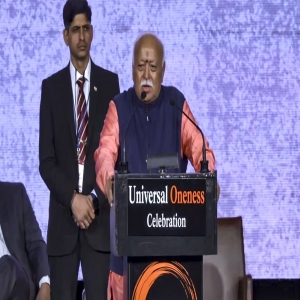
The same dichotomy, or doublespeak, was reflected in the keynote address delivered by RSS chief Mohan Bhagwat at the Universal Oneness Celebration at Madison Square Garden in New York. Writing in The Wire on August 30, Sanjay Jha described Bhagwat's US sermons as "nothing but hypocrisy and deception."
The central message of Bhagwat's speech was that "unity and diversity are both embedded in Bharat's DNA." He stated that diversity does not divide people but instead serves as a "decoration of oneness." Citing Swami Vivekananda, he remarked that every nation has a specific mission and that India's destiny is to internalise the concept of unity in diversity and remind the world of it. Addressing the gathering at Madison Square Garden, he said that diversity must be accepted, respected and protected.
The crucial question, however, is: Is diversity really being accepted, respected and protected in India under BJP rule?
Nine days before Mohan Bhagwat began his foreign visit, the parents of an eight-year-old girl were attacked by members of a local right-wing group identified as the Samast Hindu Bandhav Army. Their offence? The girl was wearing shorts. A woman associated with the group claimed that the dress "disrespected Hindu culture." If even a Hindu girl is not free to wear a dress of her own or her parents' choice, what does this say about respect for individual freedom and diversity? This is only one of hundreds of examples that illustrate attempts by Hindutva groups to impose cultural uniformity.
On August 27, 2026, a peaceful book-reading gathering at AUDA Garden in Vastrapur, Ahmedabad, was disrupted and attacked by individuals claiming affiliation with the Vishwa Hindu Parishad (VHP) and Bajrang Dal. According to media reports, the Student and Youth Collective Ahmedabad (SYCA) and Gujarat Reads Anyway (GRA) had organised the public reading.
Citizens had gathered to read books after a controversy in which a local private school removed memoirs such as Malala Yousafzai's I Am Malala and Anne Frank's The Diary of a Young Girl from its reading lists due to opposition from right-wing groups. Around 18 to 20 people, carrying sticks and wearing saffron scarves, reportedly arrived at the park, shouted slogans, and questioned participants about their book choices. The confrontation turned into a physical altercation, resulting in injuries to some participants and damage to books.
Since the BJP came to power in 2014, there have been several instances of restrictions on food choices and attempts to impose cultural uniformity, including pressure on schools to celebrate Hindu festivals. Local administrations in BJP-governed regions have frequently ordered the closure of meat shops during major Hindu festivals such as Navratri. Municipal authorities in Delhi and Uttar Pradesh, and towns in Madhya Pradesh, including Maihar, have at various times imposed temporary restrictions on the sale of non-vegetarian food, such as fish and eggs, citing the religious sentiments of devotees observing fasts.
In Chhattisgarh, the state school education department directed government schools to conduct daily recitations of Hindu prayers, including the Gayatri Mantra, Saraswati Vandana and a pre-meal Bhojan Mantra. Opposition parties criticised the directive as an attempt to impose a particular religious orientation on students belonging to a diverse society.
In Madhya Pradesh, the government issued directives mandating the celebration of Janmashtami, the birth anniversary of the Hindu god Krishna, in state schools and colleges. The move was defended by the government as a reflection of the state's historical and cultural heritage.
There have been numerous instances in which minority traditions have faced restrictions. In some districts of Madhya Pradesh, education officials reportedly issued directives prohibiting schools from dressing students as Santa Claus or organising Christmas celebrations without explicit prior written permission from parents.
The enactment and implementation of stringent anti-conversion and cow-slaughter laws, incidents of lynching by cow vigilantes, hate speech against religious minorities by BJP leaders and politicians, including the Prime Minister, and the increasing number of attacks on Christian prayer meetings by right-wing groups under the cover of loosely defined anti-conversion laws are examples of the denial of diversity and freedoms guaranteed by the Constitution of India.
The Question of Inclusiveness
Another significant theme emphasised by Bhagwat was inclusiveness. He stressed that the concept of Hindu Rashtra does not mean excluding Muslims or denying them a sense of belonging. He described Hindutva as a philosophy of "Indianness and inclusivity." He reportedly said: "If any Hindu thinks that there should be no Muslim in Bharat, he will not remain Hindu."
These are undoubtedly powerful words. But Bhagwat appears to have overlooked the experience of exclusion and marginalisation faced by many Muslims in India during the past twelve years of BJP rule. Examples are numerous:
1. Citizenship Amendment Act (CAA): The law provides a fast-track route to Indian citizenship for certain non-Muslim refugees from neighbouring countries, while excluding Muslims from this provision.
2. Anti-conversion laws: Several BJP-ruled states have enacted anti-conversion laws that have been used particularly in cases involving interfaith relationships and marriages, often in the name of combating the unverified concept of "love jihad."
3. Bulldozer justice: In several BJP-governed states, authorities have demolished Muslim-owned homes, shops and other properties on administrative grounds following communal disputes or protests. Such demolitions have taken place without adequate due process.
4. Political underrepresentation: There is currently no Muslim representative in the Union Cabinet and no Muslim MP representing the BJP in Parliament. The BJP did not field a Muslim candidate in Uttar Pradesh in the 2014, 2019 or 2024 Lok Sabha elections. Muslims constitute about 14–15 per cent of India's population and roughly 19–20 per cent of Uttar Pradesh's population, according to the 2011 Census.
5. Changes in textbooks and place names: School textbooks have been revised to remove or reduce content on Mughal history, an attempt to diminish the Islamic contribution to India's history. Several place names associated with the Muslim past have also been changed. Hoshangabad in Madhya Pradesh, for example, was renamed Narmadapuram.
While Mohan Bhagwat speaks of unity in diversity, the political strategy of the BJP, which is closely associated with the RSS, has involved polarising Hindus by portraying Muslims as anti-national or anti-Hindu. Election speeches by BJP leaders, including Prime Minister Narendra Modi, are examples of such divisive rhetoric.
During the 2024 election campaign, for instance, Prime Minister Modi claimed that if the Congress came to power, it would conduct a wealth survey and redistribute people's assets, land and gold, including women's mangalsutras (a necklace signifying marital status), to "infiltrators" and those "who have more children." These remarks were an attempt to portray Muslims as a threat to the property and security of Hindus.
While criticising Bhagwat's speech, senior advocate Kapil Sibal questioned its credibility. According to Sibal, Bhagwat had hesitated to say in India what he said in New York. When atrocities were committed against minorities, when BJP leaders indulged in hate speech against minorities, and when convicted rapists were released from prison and publicly felicitated by BJP politicians, Bhagwat did not speak out, Sibal argued.
If diversity is truly part of Bharat's DNA, every Indian, irrespective of religion, caste, language, food habits, dress, culture or political belief, must have the freedom to live with dignity and without fear. If inclusiveness is truly at the heart of Hindutva, Muslims, Christians and other minorities must not merely be told that they belong; their equality, dignity, freedom and security must be visibly protected.
.jpg)
.png) Cedric Prakash
Cedric Prakash
 ICPA
ICPA
 ICPA
ICPA
 ICPA
ICPA
 ICPA
ICPA
 ICPA
ICPA
 ICPA
ICPA
.jpg)
 A. J. Philip
.jpg) Jacob Peenikaparambil
Jacob Peenikaparambil
.jpg)
.png) John Dayal
John Dayal