

.jpg)
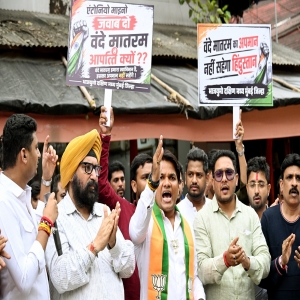
The controversy over Vande Mataram presents a remarkable irony: the British understood its power and tried to suppress it because it had become a potent symbol of resistance to colonial rule. More than a century later, its political use is being reversed by the BJP-RSS: the objective is no longer to silence the song but to appropriate its meaning, elevate its explicitly Hindu elements, deepen communal division and turn it into an instrument of political mobilisation.
But to begin with, the National Song, in the form adopted during the freedom struggle, does not belong exclusively to either the BJP-RSS or Hinduism, and this form of the song was never an issue in public debate until the BJP introduced a Bill last month to make the full version mandatory.
Bankim Chandra Chattopadhyay wrote it around 1875, fifty years before the RSS was founded, and by the early twentieth century it had become one of the defining sounds of India's anti-colonial struggle. The British clearly understood it as a political threat — dangerous to the Raj because it helped Indians imagine themselves as a united political community resisting foreign domination. At the Bengal Provincial Conference in Barisal in April 1906, colonial authorities prohibited its public chanting, and restrictions were imposed in educational institutions as well.
Today, though, the song's substance and intent have been flipped by the BJP-RSS, fostering division, despite the freedom movement having deliberately set aside portions that did not unite all citizens.
In its complete form, the poem's later stanzas invoke Hindu goddesses, while Anandamath is set against a conflict involving Hindu ascetics and Muslim rulers. But as Indian nationalism expanded, these elements became contentious. In 1937, the Congress Working Committee, following talks involving Tagore, Nehru and Bose, decided that only the first two stanzas should be used at national gatherings.
The remaining stanzas were not excluded arbitrarily; they moved beyond an invocation of the motherland into explicitly Hindu imagery embedded in the communal context of Anandamath. The decision to use just two stanzas of the song preserved a powerful symbol of anti-colonial nationalism while making nationalism large enough for India, unconstrained by any single religious identity.
The present insistence on the complete version, on the other hand, reverses that judgment and seeks to bind religious identity to patriotism. To call this a restoration of the "original" song leaves out the fact that the freedom movement itself decided that the complete original was not appropriate as a common, all-inclusive national ex
The more insidious damage caused by the attempt to appropriate the National Song is highlighted by its implications for the National Anthem, Jana Gana Mana.
The two songs are not competing brands of patriotism but different dimensions of India's national history. Vande Mataram became the song of the anti-colonial struggle — a cry of resistance, sacrifice and attachment to the motherland.
Jana Gana Mana, composed by Tagore, has a different character: it speaks to India's geographical and cultural breadth without invoking a particular religious mythology.
Nehru recognised the special historical place of Vande Mataram while explaining why Jana Gana Mana was better suited to ceremonial use. On January 24, 1950, the Constituent Assembly settled the matter: Jana Gana Mana became the National Anthem, while Vande Mataram was to be honoured equally, each given its appropriate place.
In this context, the political gimmickry that implicitly seeks to disturb that balance raises two larger issues. One is the struggle over the meaning of the nation. If the full Vande Mataram is elevated as the superior ex
Of course, there is nothing objectionable about Hindus finding profound meaning in the complete version, but it cannot be allowed to become a political monopoly over the meaning of India. Vande Mataram did not become national by forcing every Indian to accept its entire religious content, but by finding a way for it to coexist with India's diversity. To turn the two songs into rivals is itself deliberate political manoeuvring by the BJP-RSS.
The second is the attempt to falsely place the RSS and Hindutva at the centre of India's independence.
Founded in 1925, decades after the anti-colonial movement had already produced mass mobilisation, the RSS's principal objective was the consolidation of Hindu society and a Hindu national consciousness. A few individual members did take part in anti-colonial resistance: Hedgewar, for instance, in the 1930 Jungle Satyagraha. But that is not evidence that the RSS as an organisation played any consequential role in the freedom struggle.
Importantly, the RSS did not lead the Non-Cooperation Movement, the Civil Disobedience Movement or the Quit India Movement. All three were led by the Congress across caste, religious and regional lines. By contrast, the Hindu Mahasabha, a political party rooted in the same Hindu nationalist ideology as the RSS, worked in tandem with it on various Hindu mobilisation efforts during the 1930s and 1940s and opposed the Quit India movement, while its leaders remained in British provincial governments.
Hence, an effort by the BJP-RSS to claim and promote a symbol created by a much broader movement, in which the RSS's own role is highly questionable, is an attempt to retrospectively place itself at the centre of a freedom struggle in which it has no locus standi, while simultaneously seeking to make that spurious historical association relevant to contemporary politics.
The timing is not incidental. After twelve years of Modi-led rule, the BJP-RSS's Hindu-oriented narrative has weakened, and its political fortunes have suffered. The 2024 Lok Sabha election deprived it of its single-party majority, reflecting growing questions about governance and accountability amid allegations of scams and the failure to deliver on promises.
The political motive becomes all the more evident following the 2026 student protests over the NEET examination crisis, which grew into a broader demand for accountability over long-standing issues.
Young Indians were not protesting about religion. They were demanding fair examinations, competent governance, jobs, freedom of speech, an economy in decline and accountability. These are questions that Hindu nationalism cannot answer and that the government must answer on its own record after twelve years in power. These are difficult questions for a government whose mainstay remains Hindu nationalism, albeit at the expense of communal peace and unity.
In such a situation, the BJP-RSS expects the attempt to appropriate Vande Mataram and create drama around it to serve it well through a politically risky sleight of hand: the song can be claimed as both an anti-colonial symbol and, for political purposes, a Hindu nationalist one. The first claim is legitimate; the second is a politically motivated ideological position out of step with a democratic and inclusive India.
Under such circumstances, the anticipated political benefit from creating a controversy over Vande Mataram is twofold: by shifting public attention from poor performance, public anger, student protests and governmental accountability to a dispute about patriotism, the government hopes it can deflect public anger; its political opponents, on the other hand, are required to explain why they are not patriotic enough.
Whether this attempt to salvage the fortunes of the BJP-RSS succeeds is a moot question, but this is nothing but the weaponisation of a national song, a symbol deployed to create a political battlefield on which the ruling party believes it has the advantage.
.jpg)
.png) Cedric Prakash
Cedric Prakash
 ICPA
ICPA
 ICPA
ICPA
 ICPA
ICPA
 ICPA
ICPA
 ICPA
ICPA
 ICPA
ICPA
.jpg)
 A. J. Philip
.jpg)
.png) Jacob Peenikaparambil
Jacob Peenikaparambil
.jpg)
.png) John Dayal
John Dayal