

The Rashtriya Swayamsevak Sangh (RSS) is in the midst of a centenary-year international outreach campaign, with its chief, Mohan Bhagwat, travelling abroad to meet political figures and address diaspora audiences. The stated purpose is to explain the RSS, counter what it calls "misconceptions" about itself, India and Hindu society, and strengthen ties with Indian-origin communities.
But the fact is that the West has no shortage of information about the RSS. The organisation is facing increasing public exposure and scrutiny, particularly from civil society, religious bodies, journalists and human-rights organisations.
Earlier visits to the United States by RSS general secretary Dattatreya Hosabale and former RSS functionary Ram Madhav exposed the organisation to openly uncomfortable questions about its political role and record. Bhagwat's current campaign comes against that background. The RSS seeks to do damage control and present itself abroad as merely a cultural organisation rather than a political and ideological force with a contentious record in India.
Therefore, the present outreach is, firstly, an attempt to get ahead of existing scrutiny, pre-empt further scrutiny, remake its image and build political legitimacy.
The second, more crucial objective: if not to expand, then to protect its foreign sources of money.
The scale of the RSS's overseas financial infrastructure is documented in research. A paper titled The Hindu Right in the United States, by Rutgers University historian Audrey Truschke, examines the RSS network in the US, including the Hindu American Foundation (HAF), Hindu Swayamsevak Sangh (HSS), Hindu Students Council (HSC) and Vishwa Hindu Parishad of America (VHPA), among others. Her research also documents the complex organisational and financial relationships within this network.
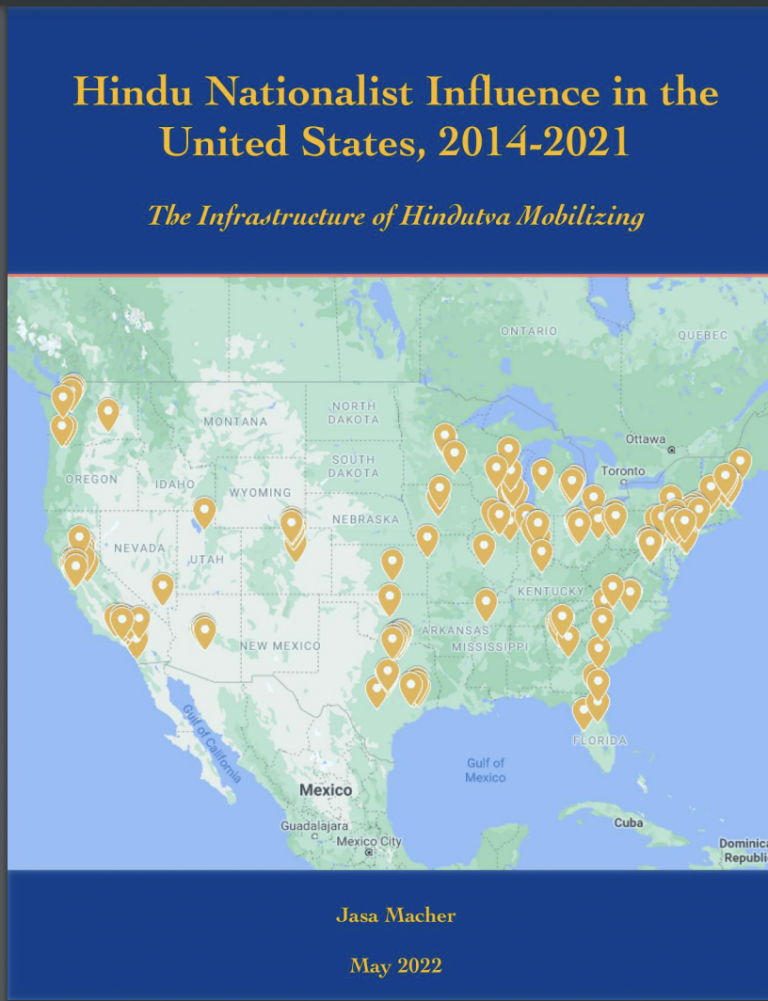
According to another paper, Hindu Nationalist Influence in the United States, by independent researcher Jasa Macher, seven Sangh-affiliated charitable groups in the US spent at least $158.9 million between 2001 and 2019, sending much of it to groups in India.
These studies indicate that the RSS network already has a substantial overseas financial base and fundraising infrastructure. Its present effort is also aimed at preserving and consolidating that base, giving the organisation greater financial autonomy from political changes in India and strengthening its capacity to pursue its ideological project beyond the Modi government, which has given the RSS its greatest political influence and reach.
Crucially, the RSS's international network of charities, cultural organisations, religious institutions and diaspora donors is central to that objective. It provides the financial infrastructure through which the organisation and its affiliates can sustain their activities despite political changes in Delhi. That infrastructure and the activities it supports are now coming under mounting scrutiny in the West.
The most significant recent warning came from the US Commission on International Religious Freedom (USCIRF), a bipartisan federal body. During Bhagwat's US visit, it urged Washington to consider targeted sanctions against RSS members and Indian officials implicated in religious-freedom violations, including revoking Bhagwat's visa. The commission has cited violence by RSS-linked actors against Christians, Dalits, Muslims and Sikhs.
This is not an Indian opposition party making the allegation. It is a bipartisan US federal commission.
There was political opposition to Bhagwat's New York appearance, with Mayor Zohran Mamdani calling the RSS ideology incompatible with the city's pluralistic values. Civil-rights and interfaith groups also protested. But political opposition is not government action.
Canada presents a similar picture. Civil society groups and faith leaders called for scrutiny of the RSS and its affiliates, including a ban on Bhagwat's entry into the country.
Yet neither Washington nor Ottawa acted on the measures recommended by USCIRF or demanded by civil society.
The pattern extends across the Five Eyes. Britain has allowed Hindu Swayamsevak Sangh UK to operate as a registered charity despite longstanding scrutiny of its links to the RSS. Australia has also seen substantial scrutiny of the RSS network. In 2024, the ABC's Four Corners examined HSS Australia's relationship with the RSS, and the ABC's Ombudsman subsequently upheld the programme's accuracy and impartiality. Yet the Australian government has imposed no comparable restrictions on HSS or the wider RSS network.
The pattern is consistent: scrutiny without consequence. Importantly, the reluctance of Western governments to act is particularly difficult to understand given the RSS's record.
The organisation has been banned three times since independence — in 1948 after Gandhi's assassination, during the Emergency in 1975, and after the demolition of the Babri Masjid in 1992. Its affiliates and the wider Sangh Parivar have repeatedly been associated with campaigns and violence directed at religious minorities. Sangh-linked organisations have also been involved in political mobilisation and intimidation directed at opponents and dissenters.
The harm extends across minority and subaltern communities. Muslims, Christians and Sikhs have faced othering, discriminatory laws, attacks and intimidation; Dalits and Adivasis have been affected by Hindutva campaigns and anti-conversion politics; and political opponents have faced intimidation from organisations associated with the wider Sangh network.
This matters because it makes it impossible to view the RSS abroad through the lens of a merely cultural organisation. It is the ideological parent of the BJP. Its cadres campaign for BJP candidates, its functionaries move between the organisation and the party, its leadership intervenes directly in public policy questions, and the organisation has repeatedly been at loggerheads with the opposition and human rights groups. Such an organisation is political in substance, whether or not it contests elections under its own name.
What Western governments have been slow to examine is not merely what these organisations teach or say, but the ideology they pursue, how the network is financed, how money moves through it, and what that financial infrastructure enables the RSS and its affiliates to do.
The contradiction is striking. The RSS and its affiliates seek to build and sustain overseas sources of funding, while the government supported by the RSS has progressively tightened control over foreign-funded civil society in India through changes to the Foreign Contribution (Regulation) Act. These changes have imposed greater restrictions on the transfer and use of foreign contributions and increased government scrutiny of foreign-funded organisations. Critics say the cumulative effect has significantly narrowed the operating space for independent civil society, including humanitarian and rights organisations.
Why should foreign money supporting independent humanitarian and rights organisations in India face increasingly stringent regulation while the RSS and its affiliates are able to maintain an expanding overseas financial and organisational infrastructure with comparatively little examination?
More importantly, when Western governments fail to act on what their own institutions already know about the RSS and its affiliates abroad, that inaction costs India. The issue is not whether the organisation can survive changes in political power, but whether the financial and political space available to it abroad will enable it to pursue its exclusionary ideological project with greater independence, permanence and reach.
That ideological project deserves greater scrutiny because it sits uneasily with the principles of democracy, equality, fraternity, liberty and peace. The RSS's record of communal mobilisation, hostility towards minorities and caste-based hierarchies, and the violence associated with sections of its wider network are precisely what have repeatedly brought the organisation under scrutiny — and why its growing international financial base and political outreach should concern Western governments.
Western governments do not have to take sides in India's politics. They do, however, have a responsibility to examine organisations operating within their jurisdictions, particularly where foreign funding, charitable structures and political activity intersect. The same standards applied to other ideological or political networks should apply to the RSS and its affiliates. Yet scrutiny of the RSS and its network has rarely translated into meaningful regulatory action.
That gap matters beyond the RSS itself. When, through acts of omission and commission, Western governments confer legitimacy on and financial space to an organisation pursuing an exclusionary ideological project, they are not simply accommodating a diaspora organisation. They are helping strengthen a political infrastructure whose values are fundamentally at odds with the democratic principles those same governments profess to defend.
Rigorous scrutiny would not be anti-India or interference in India's internal affairs. It would simply require Western governments to apply their own laws concerning foreign funding, charitable status, political activity, foreign influence and transparency. It would also help protect the democratic, plural, cohesive and constitutional India that Indians themselves are entitled to defend.
The RSS has every right to seek support abroad within the law. At the same time, it is the legitimate responsibility of Western governments to ensure that such support is transparent, properly regulated and used for the purposes for which it is raised.
The question is no longer whether Western governments are in the know about the full scope of the RSS. They are. What is missing is action. It is in the interests of both India and the West that they act.
.jpg)
.png) Cedric Prakash
Cedric Prakash
 ICPA
ICPA
 ICPA
ICPA
 ICPA
ICPA
 ICPA
ICPA
 ICPA
ICPA
 ICPA
ICPA
.jpg)
 A. J. Philip
.jpg)
.png) Jacob Peenikaparambil
Jacob Peenikaparambil
.jpg)
.png) John Dayal
John Dayal