

Last Sunday, at a parish church in Piramadam, something happened inside the sanctuary — the sanctum sanctorum, the space set apart in every Christian tradition as the dwelling-place of the Real Presence — that no believer, and indeed no person of conscience, whether of faith or none, can pass over in silence. Two young priests, ordained to stand at that altar as servants of the Word and the Sacrament, were drawn into an unseemly confrontation within its walls.
What troubles me more than the act itself is what appears to lie behind it: reports that these young men were set against one another by their own superiors — men entrusted with episcopal authority — who seem to have forgotten, if only for a moment, the "fear and trembling" with which Scripture tells us to approach holy things.
I write not as an accuser but as an elder son of the Church, grieved rather than outraged, anxious rather than vindictive. I do not know the full facts of what transpired, nor do I presume to judge the two priests, who by every account were more misled than malicious. My concern is with the principle that has been bruised: the sanctity of the place where the Church gathers to meet her Lord.
A place set apart
The Old Testament is insistent on this point almost to the point of severity. When Moses approached the burning bush, he was told, "Do not come near; take your sandals off your feet, for the place on which you are standing is holy ground" (Exodus 3:5).
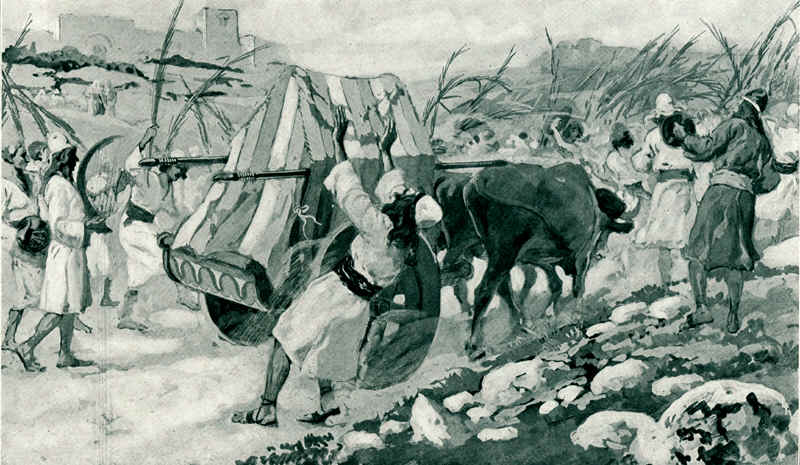
When Uzzah reached out to steady the Ark, he did not survive the encounter (2 Samuel 6:6-7) — a text that unsettles modern readers, but whose message is unambiguous: God's dwelling-place is not ours to treat casually, however good our intentions.
The psalmist, more gently, asks: "Who shall ascend the hill of the LORD? And who shall stand in his holy place? He who has clean hands and a pure heart" (Psalm 24:3-4).
The New Testament does not relax this reverence; it interiorises it. Christ himself, on seeing the Temple courts turned into a marketplace, "made a whip of cords and drove them all out of the temple," declaring, "You shall not make my Father's house a house of trade" (John 2:15-16). If the Lord's anger was kindled by commerce in the outer court, what should we imagine He feels when strife and manipulation enter the inner sanctuary itself, where the Eucharist is offered?
St Paul, writing to the Corinthians about right conduct at the Table, warns that "whoever eats the bread or drinks the cup of the Lord in an unworthy manner will be guilty concerning the body and blood of the Lord" (1 Corinthians 11:27) — a warning addressed first to those who preside there.
The witness of the Fathers
The Fathers of the undivided Church, whom our orthodox traditions hold in such honour, wrote at length about the fear proper to the altar. St John Chrysostom, preaching on the liturgy in Antioch and Constantinople, repeatedly reminded his clergy that the sanctuary is the place where "the Lamb of God is sacrificed," and that those who serve there do so trembling, as the angels themselves are said to tremble before the mystery.
St Cyril of Jerusalem, catechising the newly baptised, taught them to approach the "awesome table" with the same fear a subject would bring before a king — how much more, then, should shepherds guard their own conduct in that place, and guard the young men in their charge from being made instruments of institutional rivalry inside it.
If our bishops are indeed "spirit-filled," as we hope and pray, then this is precisely the moment for them to disown, publicly and without equivocation, whatever conduct allowed two young priests to be drawn into confrontation before the altar.
Not disciplinary silence. Not quiet transfers. A clear word, spoken from love of the Church and not from institutional self-protection, that the sanctuary is not a stage for anyone's ambition or rivalry, and that its guardians — young and old, priest and bishop alike — will be called to answer for how they treated it.
An appeal, not an indictment
I make this appeal deliberately without naming individuals, dioceses, or the particulars still unfolding. My purpose is not to try anyone in the court of public opinion, still less to add fuel to intra-church rivalries that already burn too freely in Kerala. It is, rather, to ask every reader — bishop, priest, and layperson — a simple question: if this can happen in the Holy of Holies, what does it say about the temper we bring to everything outside it? A Church that cannot keep peace in its own sanctuary has little authority to preach peace to the world.
We are, all of us, "witnesses of the Lord" (Acts 1:8), and a witness is judged by the coherence between what she proclaims and how she conducts herself in her most sacred space. I write this, therefore, not to condemn, but to plead — as one who loves the Church too much to stay silent, and respects her too much to be anything but candid.
.jpg)
.png) Cedric Prakash
Cedric Prakash
 ICPA
ICPA
 ICPA
ICPA
 ICPA
ICPA
 ICPA
ICPA
 ICPA
ICPA
 ICPA
ICPA
.jpg)
 A. J. Philip
.jpg)
.png) Jacob Peenikaparambil
Jacob Peenikaparambil
.jpg)
.png) John Dayal
John Dayal