

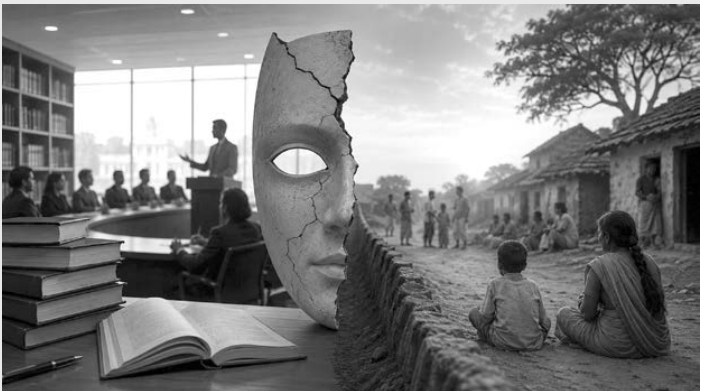
They write of democracy
from rooms where democracy
has never had to enter the kitchen,
where equality is discussed
beneath lights that never reveal
the darkness outside.
They write of equity
with carefully chosen vocabulary,
of diversity with polished sentences,
of inclusion with conference banners
stretching across walls
where the excluded are still absent.
They write of human rights
and peace,
of justice and fraternity,
of participation and dignity
words beautiful enough
to make oppression sound
as though it has already ended.
But where do these words live
when the seminar is over?
Where does democracy live
when the scholar returns home?
Where does equality live
when the Dalit neighbour
still occupies a different social world?
Where does inclusion live
when friendship itself
has visible caste boundaries?
A theorist can cross a thousand pages
without crossing a caste boundary.
A researcher can enter
a Dalit village for fieldwork
and leave before sunset.
A scholar can spend years
studying untouchability
without sharing the ordinary intimacy
of a life shaped by it.
The dissertation knows the village.
The body does not.
The footnote knows humiliation.
The theoretical/theatrical life does not.
And this is where
the mask begins to appear.
Not necessarily in the words.
The words may be radical.
The words may condemn caste.
The words may condemn untouchability.
The words may condemn racism.
The words may invoke Dalit, Ambedkar,
democracy, equality, justice, untouchability,
universal declaration of human rights,
human dignity and constitutional morality.
But words can travel
where bodies refuse to go.
A paragraph can enter
the Dalit settlement
without the author ever entering
the social reality
that produced the paragraph.
The theorist may know
the statistics of exclusion
while remaining unfamiliar
with the loneliness
of being excluded.
May know the history
of humiliation
without knowing
how humiliation rearranges
a person's relationship
with public space.
May know discrimination
as an empirical category
without knowing
how it feels
when a surname arrives
before the person does.
This is not an argument
that one must be Dalit
to oppose caste.
But none of the non-Dalits
oppose the caste system.
None of the non-Dalits
annihilate the caste system.
None of the non-Dalits
live among Dalits.
It is physical residence
a magical certificate
of solidarity.
But there is something troubling
when those who speak most fluently
about the oppressed
remain permanently distant
from the social worlds
of the oppressed.
There is something troubling
when the Dalit becomes
a subject of knowledge
but rarely a producer of knowledge.
When the Dalit experience
becomes the material
from which the non-Dalit's
academic/theoretical/theatrical
authority is built.
The scholar speaks.
The Dalit is quoted.
The scholar interprets.
The Dalit becomes evidence.
The scholar receives recognition.
The Dalit remains
inside the condition
that made the scholarship possible.
And then the language
of inclusion becomes strange.
Because inclusion
cannot mean only
including Dalit suffering
inside privileged scholarship.
It must also mean
including Dalit intellectual authority,
Dalit interpretation,
Dalit leadership,
Dalit presence,
Dalit disagreement,
Dalit refusal,
living with Dalits,
marrying Dalits
like John Rawls.
Otherwise inclusion
becomes another form
of controlled entry.
You may enter the page
but not the Center for the Study of
Developing Societies,
You may enter the citation
but not the Centre for the Study of
Culture and Society,
You may enter the archive
but not the Center for Studies in
Social Sciences,
You may enter the footnote
but not the Indian Institute of
Advanced Studies.
You may become an object
of analysis
but not an equal authority
over interpretation.
And perhaps this is
the deepest contradiction
of cultural theory:
the oppressed person
can become globally visible
and locally powerless
at the same time.
The Dalit village
becomes famous in scholarship
while the Dalit neighbour
remains socially visible.
The word anti-caste
becomes fashionable
while caste relations
remain ordinary in their
everyday life.
The language becomes radical
while social relationships
remain conservative.
The theorist speaks
against exclusion
and yet may never ask:
Who is excluded
from my friendship?
Who is excluded
from my intellectual circle?
Who is excluded
from my department?
Who is invited
to speak?
Who is invited
to teach?
Who is invited
to interpret?
Who is allowed
to disagree with me
without being called
angry, ideological,
emotional, or divisive?
These questions
cannot be answered
by another conference paper.
They require
a confrontation
with one's own location.
Because caste is not merely
a text to interpret.
It is a structure
that organizes proximity.
It decides
who eats with whom,
who marries whom,
who trusts whom,
who shares a home,
who shares a table,
who becomes a friend,
who becomes a colleague,
Who loves whom,
Who dates with whom,
Who live-in-relation with whom,
who becomes an outsider.
And therefore
a theory of caste
that never interrogates
the theorist's own social distance
can become incomplete
even when its vocabulary
sounds revolutionary.
The mask is not
that the theorist writes.
The mask is pretending
that writing itself
is equivalent to solidarity.
The mask is believing
that citation is proximity.
That representation
is relationship.
That empathy
is equality.
That studying oppression
is the same thing
as allowing oppression
to disturb one's own privilege.
There is a difference
between looking at suffering
and allowing suffering
to transform one's social world.
There is a difference
between speaking about justice
and accepting the consequences
of justice.
And there is a difference
between being sympathetic
to Dalits
and being willing
to share a world
with Dalits
without hierarchy.
So let the question
remain uncomfortable.
Not:
"How well
do you write about caste?"
But:
"What has your writing
changed about your own distance
from caste?"
If nothing changes,
if the social boundary remains,
if privilege remains unquestioned,
if the Dalit remains primarily
an object of scholarship,
then perhaps the theory
has become another mask.
Perhaps the theory has become
another Lord in the UK or US,
turning the egalitarian Christian spaces into
the theorist's shithole Hindu spaces,
like barbarian Muslims turned the UK into
A shithole Islamic kingdom,
like they turned every European and white Western
Christian country into their shithole Islamic societies.
A sophisticated mask.
A democratic mask.
A progressive mask.
A social scientist's mask.
A cultural theorist's mask.
A diversity mask.
An inclusive mask.
An equity mask.
A Third World mask.
A Bhikhu Parekh mask.
A mask made
from the vocabulary
of equality.
And behind it
the old distance waits.
The page says:
We are equal.
The social world asks:
Then why do you
still live so far away?
.jpg)
.png) Cedric Prakash
Cedric Prakash
 ICPA
ICPA
 ICPA
ICPA
 ICPA
ICPA
 ICPA
ICPA
 ICPA
ICPA
 ICPA
ICPA
.jpg)
 A. J. Philip
.jpg)
.png) Jacob Peenikaparambil
Jacob Peenikaparambil
.jpg)
.png) John Dayal
John Dayal