

.png) Joseph Maliakan
Joseph Maliakan

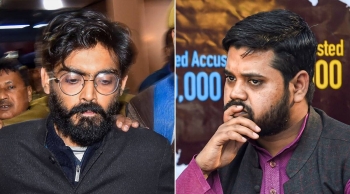
The February 4 order of Additional Sessions Judge Arul Verma of the Saket Court discharging JNU student Sharjeel Imam and student activists Safoora Zagar, Asif Iqbal Tanha and eight others in the December 2019 Jamia violence case should be etched in golden letters in the hearts of all freedom-loving people everywhere.
Verma’s discharge order is very significant because it will have a major salutary effect on how the innumerable cases filed under the draconian Unlawful Activities (Prevention) Act, 1967 (UAPA) and various sections of the Indian Penal Code (IPC) without proper evidence or investigation are dealt.
The case pertains to the incidence of violence that erupted at Jamia Millia Islamia University in December 2019 after a clash between police and the people protesting against the Citizens Amendment Act (CAA).
The FIR alleged offences of rioting and unlawful assembly under several sections of the IPC. Ironically, cases were registered only against the protesting students and no effort was made to book policemen who entered the Jamia campus and brutally beat up even those in the university library.
Discharging the accused, Verma said “dissent is nothing but an extension of the invaluable fundamental right to freedom of speech and ex
ASJ Verma further said that, as laid down by the Supreme Court in P. Vijayan vs the State of Kerala, the court is duty bound to lean towards an interpretation which protects the rights of the accused, given the power disparity between them and the state machinery.
In fact in his concluding remarks, which are most significant, Verma said to safeguard the citizens’ fundamental right to freedom of speech and assembly, in all its actions the State was obliged to draw a clear line between dissent and insurrection, especially in the context of protests like the present one where the prosecution sought to blur them.
“Furthermore, such a police action is detrimental to the liberty of citizens who choose to exercise their fundamental right to peacefully assemble and protest. Liberty of protesting citizens should not have been lightly interfered with,” ASJ Verma pointed out.
In its detailed order the court observed that the police was unable to apprehend the “actual perpetrators” and “surely managed to rope them (accused) as scapegoats in the matter.” The prosecution was also severely indicted for filing “ill-conceived chargesheets.”
Additional Sessions Judge Arul Verma said that the police have “arbitrarily chosen” to array some people from the protesting crowd as accused and others as police witnesses. This “cherry picking” is absolutely detrimental to the precept of fairness, the court said.
The court further observed that mere presence at the protest site without overt acts cannot lead to implication as accused, and said that the prosecution has ex facie been launched in a “perfunctory and cavalier fashion” against them. To allow such persons undergo rigmarole of long drawn trial does not augur well for the criminal justice system of our country, Judge Verma added.
“The desideratum is for the investigative agencies to discern the difference between dissent and insurrection. The latter has to be quelled indisputably. However, the former has to be given space, a forum, for dissent is perhaps reflective of something which pricks the citizen’s conscience,” the order said.
In the Jamia violence case, the police had originally filed a chargesheet only against Mohammad llyas on April 21, 2020. This was then followed by a supplementary chargesheet against 11 other accused persons. A third supplementary chargesheet was filed as recently as February 1, 2023. The prosecution tried to establish that the witnesses had identified the accused persons on the basis of some photographs.
In this context the court observed that the Delhi Police failed to adduce fresh evidence and rather sought to present old facts in the garb of “further investigation” by filing supplementary chargesheets.
“In the present case, it has been most unusual of the police to file not one chargesheet but three supplementary chargesheets, with really nothing new to offer. This filing of a slew of chargesheets must cease, else this juggernaut reflects something beyond mere prosecution, and would have the effect of trampling the rights of the accused persons,” the order said.
It further said that there were no eyewitnesses who could substantiate the version of the police that the accused were in any way involved in the commission of the offences. It said that no test identification parade was held until filing of the third supplementary chargesheet and that the photographs and videos only demonstrate that the accused were standing behind barricades.
"There is nothing on record to even prima facie suggest that the accused herein were part of some riotous mob… Surely prosecution cannot be launched on the basis of conjectures and surmises and chargesheets definitely cannot be filed on the basis of probabilities,” the order said.
The court also pointed out in the present case the investigative agencies should have incorporated the use of technology, or have gathered credible intelligence, and then only it should have embarked on “galvanizing the judicial system” against the accused. Else it should have abstained from filing such ill-conceived chargesheets against persons whose role was confined only to being part of a protest.
.jpg) Stanislaus Alla
Stanislaus Alla
.jpg) Stanislaus Alla
Stanislaus Alla

 Adv. Rev. Dr George Thekkekara
.jpg)
 A. J. Philip
.jpg)
.png) John Dayal
John Dayal
.jpg)
.png) Jacob Peenikaparambil
Jacob Peenikaparambil
.jpg)
 P. A. Chacko
.png)
.png) Robert Clements
Robert Clements