

.png) Cedric Prakash
Cedric Prakash
.jpg)
It has been a bad year for many: the pandemic COVID-19 has played havoc with lives and livelihoods of millions everywhere.
It has been a particularly bad year for human rights in India: in a systematic but brutal manner, the legitimate rights of people are not only denied but are crushed.
The victims as usual are the poor and the marginalised; the Adivasis and the Dalits; women and children; the excluded and other vulnerable workers. To add to it, human rights defenders, and others who take a visible and vocal stand against a regime which day by day prove to be anti-people, anti- Democracy and anti-Constitutional are at the receiving end of a system which reeks of vendetta.
On 26 November (the Constitution Day in India) it was estimated that more than 250 million people in India went on strike protesting against the anti-farmer and anti-labour policies of the Government. The people of India have little to cheer as the world observes yet another Human Rights Day on 10 December.
The rights of farmers are being crushed: today thousands of them are literally on the warpath, converging on to Delhi, making sure of a massive blockade. An all-India bandh(strike) has been called for 8 December.
Their message is clear: it is they who provide the nation with sustenance through their toil and sweat; they no longer wish to be taken for granted; as a group that can just be treated with disdain: as a vote-bank.
Their protest is apolitical yet members of the ruling class have been calling them names like ‘Khalistanis’, terrorists etc. They demand that their legitimate rights are respected: they want an immediate roll back of three bills recently passed by the Government – they are convinced that these bills will have a negative impact on their livelihood and are blatantly designed to help the crony capitalists to profit.
In a statement the farmer groups said that in their talks with the government they have asked for the withdrawal of the three laws that they say will leave them at the mercy of large corporations and override safeguards against being cheated. Support for the farmers rights is pouring in from all over the country but also from abroad.
The rights of migrants are being crushed: the nation witnessed their plight from the night of 24/25 March when the lockdown was first announced. Millions of migrants were stranded overnight without food, cash, and shelter.
What the Government did not visualize was that they would have the grit and determination to walk back home. There are the terrible pictures and footage of them walking miles back to their native places. They were subjected to violation of their fundamental rights under Articles 14, 15, 19, and 21 and often to severe police harassment on interstate borders.
Many reportedly died as a result of the lockdown, due to exhaustion en route home, starvation, suicides, police excesses, illnesses, and rail and road accidents. There is a Supreme Court order demanding that the plight of these migrants is not only looked into but their suffering is also alleviated; but who cares?
The rights of workers are being crushed: the working class has suffered tremendously during this pandemic. Besides, the Government denying them public transportation for almost two months to return home, they were also denied wages when their establishments were closed during the lockdown.
The Government seemed to desperately have wanted to keep them back at their ‘workplace’ so that they could be available as soon as the lockdown to work once again at the mercy of their employer; many of them are back for long hours of work but with reduced wages. To add salt to their wounds, on 23 September Parliament passed three labour code Bills when the opposition was boycotting the monsoon session on the issue of the farm Bills.
The three Bills, the Industrial Relations (IR) Code, the Occupational Safety, Health and Working Conditions (OSH) Code, and the Social Security Code, along with the Code on Wages, 2019, amalgamate 44 labour laws. All these Codes deal with wages, industrial relations, social security, safety, and welfare conditions. There are several features of the Codes which are problematic and go against the rights of workers; besides, the process by which they were pushed through was hardly transparent. For one, all central trade unions were opposed to the amalgamation of the hard-won labour laws and had submitted their objections on several occasions. The Government however, does not relent.
The rights of Adivasis are being crushed: one experiences this, the way the jal-jungle-jameen is being taken away from them. The areas which they have inhabited for centuries is being handed over for industrialisation, for mining, for so called ‘development’ works and other mega-projects.
More than two million of them and other forest-dwellers remain at risk of forced displaced and loss of livelihoods after their claim to stay on in their habitats under the Forest Rights Act was rejected. Many Adivasis from the Kevadia area (which is around India’s latest white elephant – a gross statue in the name of Sardar Patel) were made to leave their homes overnight. PESA is the Provisions of the Panchayats (Extension to Scheduled Areas) Act, 1996 -a law enacted by the Government of India for ensuring self-governance through traditional Gram Sabhas for people living in the Scheduled Areas of India. The sad part is that the Adivasis are also being denied their rights under PESA.
The rights of human rights defenders and NGOs are being crushed: this Government brooks no dissent. What is happening to this essential dimension of democracy has come in from no less a person than the UN High Commissioner for Human Rights Michelle Bachelet who on 20 October appealed to the Government of India to safeguard the rights of human rights defenders and NGOs, and their ability to carry out their crucial work on behalf of the many groups they represent.
Bachelet expressed regret at the tightening of space for human rights NGOs in particular, including by the application of vaguely worded laws that constrain NGOs' activities and restrict foreign funding. In a strongly worded statement Bachelet said,
"India has long had a strong civil society, which has been at the forefront of groundbreaking human rights advocacy within the country and globally, but I am concerned that vaguely defined laws are increasingly being used to stifle these voices." Adding, “I am concerned that such actions based on the grounds of vaguely defined 'public interest' leave this law open to abuse, and that it is indeed actually being used to deter or punish NGOs for human rights reporting and advocacy that the authorities perceive as critical in nature.
Constructive criticism is the lifeblood of democracy. Even if the authorities find it uncomfortable, it should never be criminalized or outlawed in this way."
What is happening to Fr Stan Swamy and the fifteen others arrested (and now languishing in prison) under the draconian Unlawful Activities Prevention Act (UAPA) for involvement in the Bhima- Koregaon violence, is a case in point. Many others are detained for no reason.
The rights of minorities are being crushed: it keeps happening at a frightening regularity. Muslims and Christians are at the receiving end of venomous hate speeches, constant denigration and even attacks.
The Babri Masjid – Ram Mandir issue had two Supreme Court verdicts with communal overtones favouring the majoritarian community. Come 6 December one is reminded of that infamous day in the annals of the country when the Sangh Parivar destroyed the Babri Masjid in 1992- of course no one was declared guilty of this heinous crime!
The abrogation of Articles 370 and 35 A in Kashmir has enhanced the communal divide. The ‘Love Jihad’ law of UP is clearly focussed on a Muslim boy marrying a Hindu girl. Besides it is expected to lead to a spate of anti-conversion laws in the country. A real bogey and which certainly violates the fundamental rights of a citizen.
The recently concluded Greater Hyderabad Municipal Corporation elections had very strong communal messages delivered which has polarised the communities there very sharply. The Government conveniently forgets that India is a secular country
The environment is being crushed and with that, the rights of all the citizens. Recently, the Ministry of Environment, Forests and Climate Change (MoEFCC) has given a green signal to more than forty projects without the mandatory environmental clearances. Most of these projects favour their rich crony capitalist friends literally giving them a license to loot, plunder and rape the environment and much more!
The felling of thousands of trees and the destruction of a natural sanctuary in Mollem, Goa – has brought thousands of Goans out on the streets. The aim of this project is to build a double track railway line for the shipping of coal for the Corporation of one of the country’s henchmen.
Our precious biodiversity and our fragile ecosystems are being destroyed.
The Government today just does not care and has clearly gone on a downward spiral: doing everything they can to destroy the environment: The Western Ghats and the Aravalli Hills; the building of a dam in Dibang; the selling of coal mines to private companies and much more
The environment is also being crushed with the growth of polluting industries without the necessary environmental safeguards because of callousness and corruption. On 7 May, a gas leak that occurred at the LG Polymers chemical plant near Visakhapatnam killed eleven persons and affecting more than a thousand others.
December 3 marked 36 years since the highly toxic chemical methyl isocyanate (MIC) leaked from a storage tank in Bhopal’s Union Carbide India Limited (UCIL) plant killed around 25,000 people and injured nearly 550,000 people in 1984 .
Three and a half decades later, the latter continues to demand justice from India’s judiciary and governance with the help of the Bhopal Gas Peedith Mahila Udyog Sanghthan (BGMUS) and the Bhopal Gas Peedith Sangharsh Sahayog Samiti (BGPSSS.)“The year 2020 has been an extremely traumatic period for Bhopal gas victims. The struggle for justice, which gas-victims had been relentlessly waging for the previous 35 years, was itself a testimony to the failure of the Indian State to mete out justice in all these years,” said a joint press statement released by the two groups. The main culprits have however got away with murder and in connivance with ruling regimes.
The rights of women and children, the rights of Dalits, of the excluded and other vulnerable groups are all being crushed. Above all, the right to freedom of speech and ex
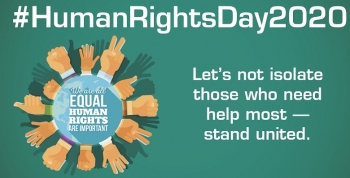
The only way to observe Human Rights Day 2020 – is to wake up from our slumber, shake off the apathy and to rise together: demanding and ensuring- HUMAN RIGHTS FOR ALL!
( Cedric Prakash is a human rights & peace activist/writer Contact: cedricprakash@gmail.com )
.jpeg)
 A. J. Philip
.jpg)
.png) Jacob Peenikaparambil
Jacob Peenikaparambil
.jpg)
.png) John Dayal
John Dayal
.jpg)
 Pachu Menon
.jpg)

.png)
.png)
.png) Robert Clements
Robert Clements
.jpg)