

.jpg) Mathew John
Mathew John
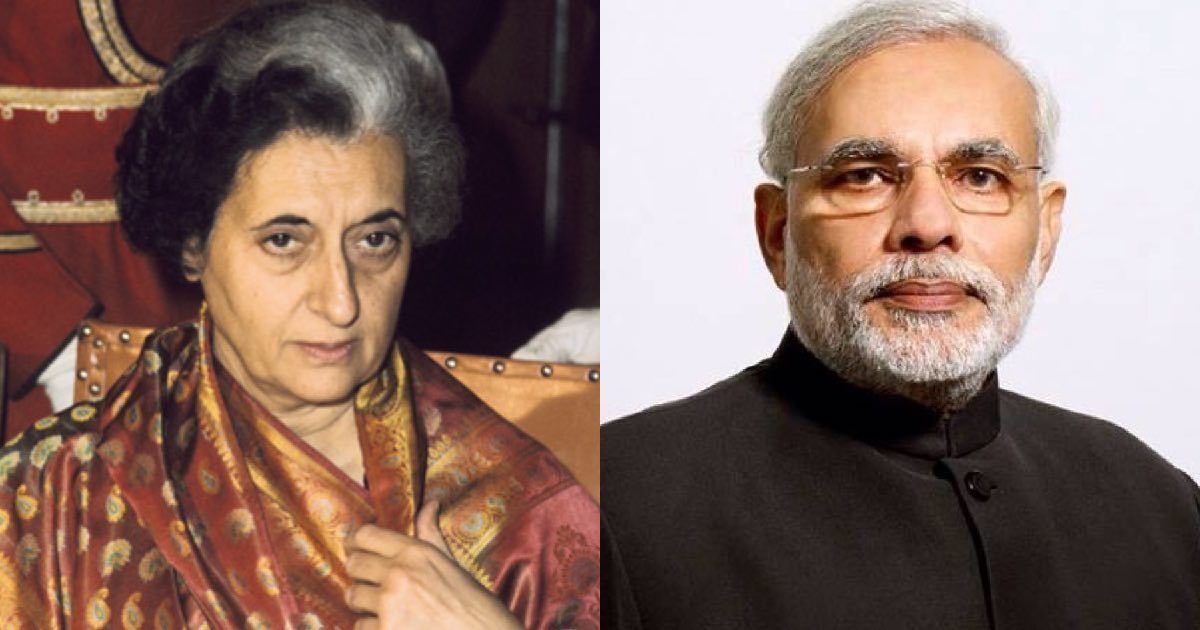
At a time when political observers are debating whether India today is a full-blown electoral autocracy or a democracy in its twilight, one inevitably harks back to the other dire period when our nation was in thrall to a dictatorship. Almost five decades ago, Indira Gandhi declared a state of internal emergency, swooped down on political opponents, trade unionists and student activists, even as civil liberties were suspended. The Emergency was straightforward police and Sanjay Gandhi-inspired gunda raj, markedly different from the creeping, insidious authoritarianism behind the veneer of democratic functioning that is the modus operandi today.
Indira Gandhi’s was a jejune tyranny that was all about holding on to power through intimidation and fear. At the same time, she was desperate to legitimize her illegal reign through critical amendments to the Constitution. The 39th Amendment, for instance, ruled that the election of the Prime Minister could not be challenged in the Supreme Court but only by a body constituted by Parliament. That was also when a lily-livered Supreme Court, with the honourable exception of Justice H. R. Khanna, decided in the habeus corpus petition that detentions without trial were legal under the Emergency.
Sanguine about her popularity after the successful war against Pakistan in 1971 when she was likened to goddess Durga, Indira Gandhi made no effort to mobilize support among the people to embellish her power or image. Cosmopolitan and secular, she was also pro-poor in her economics, for which she was viewed with suspicion by industrialists of her time. The Emergency severely eroded her popularity, as confirmed by the Congress debacle in the 1977 elections and her own humiliating defeat.
Modi has done what Indira Gandhi attempted but failed to achieve: become synonymous with the nation. Whereas the “India is Indira and Indira is India” trope remained delusional spiel among the sycophants in the then Congress party, Modi is identified with the nation as its custodian and benefactor. How else does one explain the unabating idolization of a man who caused misery to millions due to demonetization and handling of the pandemic; in whose watch there has been unremitting persecution of minorities and dissidents, atrocities against Dalits, record unemployment?
Modi has, with calculated ruthlessness, covered all the bases for securing absolute power over the polity that would be the envy of any tyrant. Besides, he invokes a level of devotion unparalleled in our history. He is the quintessential cult figure in a country of avowed idol worshippers. The cult of personality is a perverse form of bhakti where man supercedes God as the cynosure of veneration. Ambedkar warned against bhakti, which may be the path to salvation in religion, but is a dangerous attribute to imbibe in politics and a “sure road to degradation and eventual dictatorship”.
The Modi cult has been choreographed to perfection by publicists and event managers. An aura of mystery and distinction has been built around the high priest of Hindutva. He has used his charisma and oratorical skills to attract a huge following of blind worshippers who share his ersatz nationalist fervour, virulent hostility toward Nehru and what he represents, and pathological hatred of Muslims. Like with all narcissistic cult leaders, he has forged a beguiling image of his past – sold tea as a child at a railway station, was an itinerant seeker after the truth, went to jail over satyagraha for Bangladesh’s Independence, et al.
The ideological underpinning of Modi’s rule is the exclusive Hindutva vision propagated by Veer Savarkar of “one nation, one people, one culture”. Effective execution of such a radical, ideological transformation of society is possible only through the Orwellian route of an authoritarian State. Employing a multi-pronged strategy, this regime has taken imperious control of every aspect of governance. The media has become the proverbial stenographer to power; the bureaucracy has outdone itself as lickspittle; the law-enforcement agencies are the menacing hatchet men of the regime, arresting and terrorizing opponents and dissidents; even the Election Commission functions as enforcer of this government’s dictates.
The Emergency was hitherto the darkest chapter in the history of the country, but the people restored our democracy. We are in a darker place today, an electoral autocracy that has coopted the institutions of governance to restrict our freedoms. We are in the grip of a majoritarian ethos of bigotry, hate, lynching and bulldozers.
It’s chilling to think that the poison injected into our collective bloodstream is here to stay, irrespective of what happens politically in the future.
(This article first appeared in The Telegraph. Views are personal)
.jpg)
.jpg)
.png) Jacob Peenikaparambil
Jacob Peenikaparambil

.png) John Dayal
John Dayal
.jpeg)
.png) Joseph Maliakan
Joseph Maliakan

.png) Dr Arnald Mahesh SDB
Dr Arnald Mahesh SDB

.jpg) Jose Vattakuzhy
Jose Vattakuzhy
.png)

.jpg) Isaac Gomes
Isaac Gomes
.png)
.png) Robert Clements
Robert Clements