

.png) Julian S Das
Julian S Das
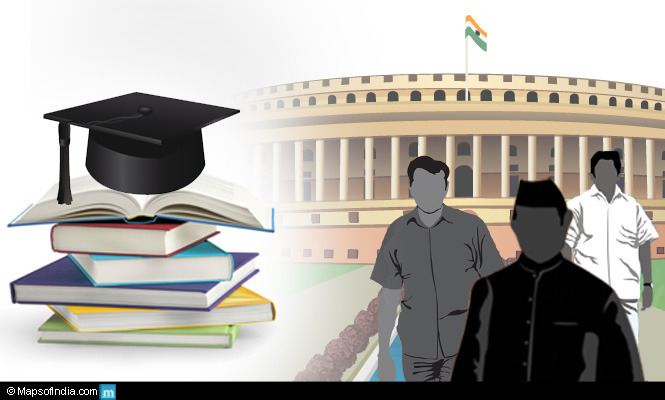
I have been nurturing a crazy idea for several years now, though it might be one of the most favourite ideas ever churned out of the hoi polloi, in view of greater common good. It concerns those who govern us, centrally and locally. If only the citizens were to push this idea into some sort of working model, then most of the problems haunting our nation would be gone forever, at least for the greater part.
Every job today demands a set of requirements. One cannot apply for the job of an engineer, unless he has studied engineering from a reputed, recognized college or university. But that is not enough to fetch a job, he or she may have to prove that he or she knows what pertains to the job, through written tests and interviews sans strings.
If a person wishes to join the elite ranking officers in the nation, either in Indian Administrative Service (IAS) or Indian Police Service (IPS), one has to go through one of the toughest examinations in the world, the most gruelling competitive examinations. It is a chance given them to prove their mettle, that they are truly capable of joining the submissive, subservient civil servants, at the beck and call of the ministers they are working under, or to swing with the current of political air in the country.
Preparing Political Leadership
Now coming to the most powerful, authoritative positions in the country, the Members of the Parliament (MP) and the Members of Legislative Assemblies (MLA), what is the requirements they have fulfilled in order to decide on the fate of over a billion citizens of the nation or several million people of the state respectively. Granted that they have fulfilled the requirement of specified age, what qualification do they have to occupy these highest seats of power?
Is it not shameful that a minister of education, who might have just completed class 10 or 12 with average mark, would be delivering the presidential address at the convocation of a central or state university? Naturally the deficit in the ministers is covered by the IAS officers, who draft all the talks and speeches, and the ministers may have to depend solely on the scripts or the tele-prompters, and the media praising such ministers for the gems of advice he or she had given to the students.
It is important that the nation evolves a system of forming her future leaders, who would vie for seats of power, not on the basis of the political party they support, but going beyond political affiliation, having a heart, head and hands to work for the people of the nation, and such people should be subjected to long years of testing, so that no person with mixed motives or selfish intentions are allowed to sit in seats of power and corrupt not only the system, but also the very nation.
Qualifications of MPs, MLAs
It was basically curiosity which led me to download the qualification of the Members of Parliament, which luckily was available on the internet, and put the data to analyse where we stand in respect of the intellectual calibre of the men and women who decide on our fate, who make laws of the land and impose them on all the citizens of the nation.
The picture seems quite alarming, even when I know that the data presented in the websites are unverified, and it would be a Herculean task to verify if the certificates these MPs had submitted are authentic. For we had come across MPs with doctoral studies, but cannot speak even a few sentences in English, but were Ministers of Education, the erstwhile Ministry of Human Resource Development.
|
Count of MPs by Qualification |
|
|
(blank) |
3 |
|
Post Graduate |
135 |
|
Others |
17 |
|
Literate |
1 |
|
Illiterate |
1 |
|
Graduate Professional |
100 |
|
Graduate |
133 |
|
Doctorate |
24 |
|
8th Pass |
12 |
|
5th Pass |
4 |
|
12th Pass |
69 |
|
10th Pass |
44 |
The graph shows the educational qualification of MPs, but let me note that this is an unverified data. We can take that the category under “Others” implies illiterate, and so also the three blank cells. Only one of the MPs (from Dindigul in Tamil Nadu) was honest enough to acknowledge that he is illiterate, and only one MP (from Robertsgunj in Uttar Pradesh) acknowledged himself as literate.
There are 148 MPs who have educational qualification of Class 12 passed or below, up to illiterate and others. This is out of a total of 543 MPs in the country. In other words, the MPs with Class 12 and below form 27.25% of the total number of MPs. Is it not shocking that these are the people who can have studied opinion on policies and laws governing the people of the nation.
Let us take a look at the per centage of the data available for the states with maximum number of MPs, whose educational qualification is class 12 passed and below : The three top-most states are, in order of per centage – Maharashtra (18.44%), Uttar Pradesh (11.64%) and Gujarat (8.81%).
Following closely is Bihar with 8.44%. It goes without saying that the three top-most states with low-level of the educational qualification of the MPs are ruled by the same party. Is it just coincidental, or is it saying something about how and where our nation is heading to, is something we can think about.
|
State Percentage of Educational Qualification Class 12 and below (0% - 20%) |
|
|
ANDHRA PRADESH |
3.83% |
|
ASSAM |
1.92% |
|
BIHAR |
8.44% |
|
CHHATTISGARH |
2.23% |
|
DAMAN & DIU |
0.36% |
|
DELHI |
1.40% |
|
GUJARAT |
8.81% |
|
HIMACHAL PRADESH |
1.51% |
|
JAMMU AND KASHMIR |
0.60% |
|
JHARKHAND |
2.83% |
|
KARNATAKA |
5.75% |
|
KERALA |
2.34% |
|
MADHYA PRADESH |
2.78% |
|
MAHARASHTRA |
18.4% |
|
ODISHA |
4.60% |
|
PUNJAB |
3.88% |
|
RAJASTHAN |
3.83% |
|
TAMIL NADU |
6.22% |
|
TELANGANA |
2.96% |
|
UTTAR PRADESH |
11.64% |
|
UTTARAKHAND |
1.28% |
|
WEST BENGAL |
4.37% |
Looking ahead
It is observed that most often the senior-most political leadership is with minimum educational qualifications, but with unswerving loyalty to the party they belong to, while the younger generation is educationally qualified, but would have to wait for their turn (after the seniors give way) to take leadership roles. If only the younger men with better educational qualifications and intellectual acumen are given a chance, they might do better than the seniors.
It may be frightening to think that most of the MPs in Parliament, who cannot even speak a few sentences in English, would have to study numerous Bills with complex technical jargon, and express their studied opinion on the floor. When they cannot read such documents, leave alone understand, how will they vote on the Bills.
If this sad state has to change, then public opinion should be created to have the kind of political leaders who can have their independent studied opinion and contribute to a strong legislature which can work for the good of all people of the nation.
.jpg)
.png) Jacob Peenikaparambil
Jacob Peenikaparambil
 A. J. Philip
.jpg)
.png) Cedric Prakash
Cedric Prakash
.jpg)
 P. A. Chacko
.jpg) Thomas Menamparampil
Thomas Menamparampil
.png)
.png) Robert Clements
Robert Clements
.jpg) A. J. Philip
A. J. Philip
 Jacob Peenikaparambil