

.png) Chhotebhai
Chhotebhai
.jpg)
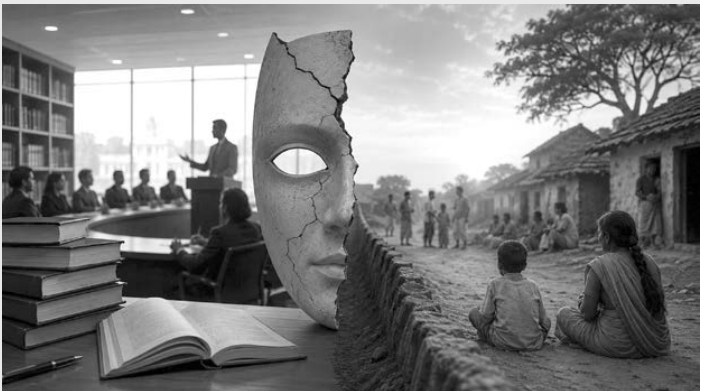
There are two types of people that believe that the Indian Constitution is a scrap of paper. They are those who deliberately choose to ignore its provisions, or those that are grossly ignorant of it.
This 26th November marked the 74th anniversary of the adoption of the Constitution in 1950. I was asked to address a Google meet on the Constitution and imminent threats to it. Thereafter, I too organised a meeting on the same topic, addressed by Magsaysay Awardee and socio/political activist Dr Sandeep Pande. It forced me to collate my thoughts that I am now sharing.
Providentially, just a few days ago I met Retd. Maj Gen Sudhir Vombatkere in Mysore. He is the one who has filed a PIL in the Supreme Court against the notorious, archaic, colonial era law on Sedition. He gave me an informative booklet on the Constitution that he himself had prepared.
The idea of a constitution was first mooted by Mahatma Gandhi on September 10, 1931. A resolution to that effect was moved by Jawahar Lal Nehru on December 13, 1946. A Constituent Assembly (CA) was formed to draft the Constitution. It had 299 members, who had 166 sittings and deliberated on 2473 amendments.
A 7-member drafting committee was set up on August 29, 1947 with Dr B.R. Ambedkar as its Chairman. The other 6 members of the committee were 5 so-called upper caste members and one Muslim. I am intentionally drawing attention to the ethnic composition of the drafting committee. This is because when the American Constitution was adopted in 1767, the indigenous peoples and African origin slaves had no constitutional rights. Hence, we need to study our Constitution, that is probably the longest in the world and the most detailed. It is thirty times longer than the American one.
We can draw two important lessons from the aforementioned points. Firstly, that legislation is often a long and tedious process that cannot be rushed through; as evidenced by the brute parliamentary majority of the present dispensation. Secondly, any legislation must reflect the hopes, aspirations and even the fears of all sections of the society.
When the Constitution was being framed, its interim Chairperson, Sachidananda Sinha, had opined that the Constitution would be the panacea for all the social evils prevalent in the country. 74 years later, can we say that this has actually transpired? The answer is a resounding “No”. That is why its opponents pay scant regard to a “scrap of paper”. There is an adage, “Where there is a will there is a way”. I may add a corollary, “Where there is no will there is always a way out”!
In this piece I shall limit myself to the Preamble of the Constitution. It begins with the solemn intonation, “We the people of India, having solemnly resolved ….”. Are we conscious of being a people, citizens of this great country? How much resolve (determination) do we possess? Or are we just dissolved and diluted in our commitment to the nation and its citizenry?
The Preamble uses four words to describe the idea of India – a Sovereign, Socialist, Secular, and Democratic Republic. It seeks to secure for all its citizens – Justice, Liberty, Equality and Fraternity. One could write reams about these 4+4=8 words. Let’s address them one at a time.
1. Sovereignty: We may have attained freedom from a colonial monarchy that is now gradually being replaced by an oligarchy. Insecure leaders use every trick in the book to cling to power or perpetuate it. Whenever Indira Gandhi felt politically insecure, she would invoke the spectre of a “foreign hand”, so that her sceptre remained intact. The present political dispensation is far worse. To detract or deflect attention from real issues it invokes the bogeys of Pakistani terrorists or threats to Sanatan Dharma. The film world was not to be left behind, churning out ultra-nationalist movies like “The Kashmir Files” and “Tejas”.
2. Socialist: There is no doubt that we have made substantial progress in moving towards a socialist society. However, social disparities and an ever-widening financial gap tell another story. I am not a macro economist to reel off statistics. But two indices strike me. During the Covid lockdown those at the bottom of the pyramid were the most affected. In contrast, several industrial houses posted increased profits. People’s car of India, the Nano, flopped; but SUVs and luxury cars have reported increasing sales. I daresay that some “capitalist” European countries have better social security and health benefits than we have.
3. Secular: This word has become an abomination in our country. Anyone who talks about secularism is frowned upon with suspicion, almost like an anti-national. Government behaviour is far from secular (impartial). Most functions begin with Hindu rituals, including the inauguration of the new Parliament building. Elsewhere Muslims are not allowed to use loudspeakers from their minarets, but Hindu jagrans (night watches) continue unabated, replete with blaring DJs. Certain religious processions are banned, while others are showered with flower petals by State helicopters. Churches built on private land are bull dozed overnight, ostensibly because they are unauthorised. But despite a clear-cut order from the Allahabad High Court, temples abound on public land – pavements, parks and even Government offices. Love Jihad, Hijab and more recently Halal, as also the so-called “Anti-Conversion Laws” are used to terrorise religious minorities. Secularism is vanishing like the morning dew.
4. Democratic: Yes, we are a democracy, but here again its wings are being clipped by the day. The RTI Act, that was used with subterfuge and by conniving bureaucrats, to bring down the UPA Government in 2014, has been given a decent burial. Agencies like the ED and CBI are used to browbeat critics and opponents. Huge tranches of money are used to purchase legislators and bring down elected governments. The opacity of Electoral Bonds has added to the darker side of election funding; favouring the party in power. A quid pro quo to donor industrialists cannot be discounted.
5. Justice: As the adage goes, “Justice delayed is justice denied”. With the increasing costs of litigation, many poor innocents languish in jails, while white collared criminals can get away with blue murder.
6. Liberty: There has been a constant erosion of liberty or freedom, be it in thought, speech or writing. There are increasing controls on ex
7. Equality: The Constitution talks of Equality of Opportunity. This is a misnomer that means nothing. The Mandal Report refers to three types of equality: a. Equality of Opportunity b. Equality of Treatment and c. Equality of Result. Let me explain:
a. Opportunity: Every student is given an equal opportunity to appear at a public examination. But a poor student who cannot afford private coaching has no food in his belly or light in his house, cannot compete with those who are not so deprived. This is not true equality.
b. Treatment: This is experienced in a court of law where the presiding officer treats both parties with equanimity. Yet, the one who can hire an expensive lawyer has a distinct advantage over those who can’t. So, this too is not true equality.
c. Result: This is a state where all attain a reasonable degree of social and financial equanimity, regardless of caste, colour, creed or gender. This may seem utopian, but that is the ultimate goal of society, Ram Rajya or the Kingdom of Heaven. Unless we set our sights high, we will never come close to our goals.
8. Fraternity: There can never be true development (vikas) if large sections of society lose faith (vishwas) in the government, which is what is happening right now. We cannot fool with the warp and woof of the fabric of society. A warped society (pun intended) can never make true progress.
As we commemorate our Constitution we must individually and collectively strive to attain its lofty and cherished goals. We need to actively promote communal harmony and brotherhood and stand up against hate and a divisive agenda. Through acts of service let us rebuild self-confidence in people, especially those on the periphery (to use a favourite word of Pope Francis). Let hope spring eternal in the human breast, for “We shall overcome one day”. JAI HIND!
• The writer has been actively involved in promoting peace and communal harmony.
.jpg)
.png) Jacob Peenikaparambil
Jacob Peenikaparambil
 A. J. Philip
.jpg)
.png) Cedric Prakash
Cedric Prakash
.jpg)
 P. A. Chacko
.jpg) Thomas Menamparampil
Thomas Menamparampil
.png)
.png) Robert Clements
Robert Clements
.jpg) A. J. Philip
A. J. Philip
 Jacob Peenikaparambil