

 Fr. Gaurav Nair
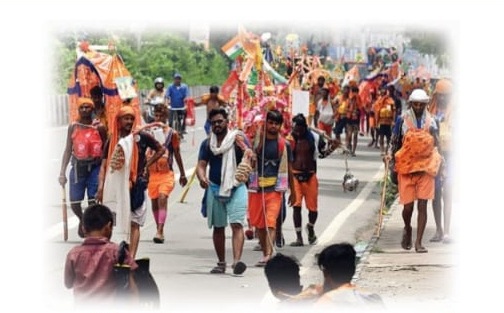
The Kanwar Yatra, an annual pilgrimage that gained popularity in the late 1980s, has gained some heavy political undertones this year as the BJP and Mr Narendra Modi came to power for the third time. It is not that its rise was not politically motivated; it was parallel to that of the Hindutva forces. But this time, the Yatra is gaining communal colours like never before. The directive to display the names of the owners and employees at eateries is a clear sign of this.
The state's involvement has grown exponentially, with state governments providing elaborate facilities, security, and logistical support. In states like Uttar Pradesh, where the BJP is in power, the government's endorsement of the Yatra is particularly pronounced. State-sponsored amenities include medical camps, food distribution centres, and dedicated lanes on highways, ensuring a seamless journey for the pilgrims.
The political support is not merely logistical; it extends to symbolic gestures. Chief Ministers and other high-ranking officials have actively participated in the Yatra, often accompanied by extensive media coverage. These actions are not ex
The Kanwar Yatra has become a flashpoint for political manoeuvring, with various parties seeking to align themselves with the burgeoning Hindu nationalist sentiment. In particular, the BJP has leveraged the Yatra to consolidate its voter base.
The Yatra initially consisted of a very different demographic: the pious, the aged and even women. It now consists chiefly of young men playing loud music and pushing the misery of their lives onto others. Reportedly, the yatris are predominantly from low-income families in Delhi, Haryana, Uttar Pradesh, and Rajasthan and work in the informal sector. For them, the Yatra is an escape from their uncertain realities. It is an opportunity to prove their mettle under the umbrella of religion.
In the years since Mr Modi came to the fore, the yatris have been increasingly thuggish and belligerent, fuelled no doubt by the narratives of the top man and his ménage. To top it all off, the BJP has been unapologetically loud and uncouth since before it took oath. Their acrid speeches and matching actions have lost any veneer of civility they might have had previously.
Since its politicisation, the Yatra has been a source of tension between Kanwariyas and local communities. The disruptions caused by the pilgrimage, including traffic snarls and vandalism, among other things, often lead to friction and escalate to violence in not a few cases. The barbarous tendencies shown by the pilgrims in 2018 cannot be forgotten. Even this year, Kanwariyas trashed an eatery in Haryana.
All these proclivities, mixed together, furnish a deadly cocktail that can erupt into violence anytime. It is an indirect rallying call. Anything happening during the Yatra can be brushed off and even used as a rationale to "retaliate". Against this background, the directive seems to be a stab at alienating and marking the targets to aid the hounds of Hindutva in their bestial hunt. The BJP's agenda seems evident in the light of all these indications. Are we awaiting another Godhra or Babri?
.jpg)
.jpg) Stanislaus Alla
Stanislaus Alla

 Adv. Rev. Dr George Thekkekara
.jpg)
 A. J. Philip
.jpg)
.png) John Dayal
John Dayal
.jpg)
.png) Jacob Peenikaparambil
Jacob Peenikaparambil
.jpg)
 P. A. Chacko
.png)
.png) Robert Clements
Robert Clements