

.png) Joseph Maliakan
Joseph Maliakan
.jpg)
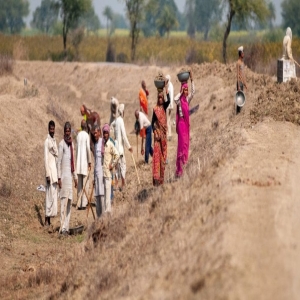
The new Bill introduced by the Union government, Viksit Bharat - Guarantee for Rozgar and Ajeevika Mission Gramin (VB - GRAMG), to replace the Mahatma Gandhi National Rural Employment Guarantee Act 2005 (MGNREGA), nullifies the Right to Work guaranteed by the Indian Constitution.
GRAMG, despite its "divinely-inspired" name, paradoxically undermines the scheme for guaranteed work for a minimum of 100 days a year for the rural unemployed poor. GRAMG completely changes the character of MGNREGA.
The existing scheme to provide minimum employment to the rural poor is based on demand for employment. In other words, the Union government is duty-bound to provide funds for the employment of the rural poor in accordance with demand, as the scheme is centrally sponsored.
Before the beginning of every financial year, the states prepare labour budgets which are approved by the Union government. Later, if more people seek work under the right-to-work programme, the labour budgets are updated. Thus, according to demand for work, the budgets are increased. This is one of the key features of MGNREGA.
However, under the GRAMG, the scheme will be converted to an allocation-based programme, and what is very disturbing is that the norms for allocating funds have not yet been made clear. It is feared that the Union government will weaponise the scheme to punish unbending state governments, especially those ruled by opposition parties.
Presently, the wage bill for the scheme is paid by the Union government, and the expenses are mainly borne by the Centre. However, under GRAMG, the entire expenditure, including the wage bill and administrative costs, will be shared by the Union and the States on a 60:40 basis. This will result in a substantial financial burden on the states, especially the poorer states like Bihar, Madhya Pradesh, Rajasthan and Uttar Pradesh.
From a bottom-up scheme, the GRAMG has become a top-down programme, according to Jayati Ghosh, a development economist. Though the new Bill envisages a minimum employment of 125 days, considering that the average days under MGNREGA per year have been only 40 to 50, in future we will get much less, she added.
"You can't make decisions like this by sitting in Delhi. This is a stupid way to run a country as complicated and diverse as India. This is a terrible blow for federalism and therefore has to be opposed," she said, referring to Section 4(5) of the VB-G RAM G Bill, which states: "The Central Government shall determine the state-wise normative allocation for each financial year, based on objective parameters as may be prescribed by the Central Government."
Under GRAMG, the Government of India will have full powers to decide on financial allocations, wage rates, and the location and timing of the scheme's implementation. Further, it gives the Union government unbridled powers to do what it wants without any obligations. All obligations are the responsibility of state governments, and without the required funding, the scheme will remain on paper.
For some inexplicable reason, GRAMG proposes a sixty-day pause during the peak agriculture seasons of sowing and harvesting. In a country like India, with varying climatic conditions, different crops, and different sowing and harvesting seasons across the country, for which 60 days in the year will the scheme be paused? One is reminded of the businessman who, on being asked why he wasted money on advertising, said, "I know half the money I spent on advertisement is a waste, but I do not know which half!"
The Bill proposes dividing work into four categories: water security, rural infrastructure, livelihood infrastructure, and disaster resilience. This division of work is inadequate to define work under the new scheme
The MGNREGA provided employment as a matter of right, and this right cannot be taken away by a mere majority vote; therefore, this Bill is reprehensible, according to Prabhat Patnaik, Professor Emeritus at Jawaharlal Nehru University.
GRAMG, despite its name, will spell disaster for the wretched of the country.
.jpg)
.png) Cedric Prakash
Cedric Prakash
 ICPA
ICPA
 ICPA
ICPA
 ICPA
ICPA
 ICPA
ICPA
 ICPA
ICPA
 ICPA
ICPA
.jpg)
 A. J. Philip
.jpg)
.png) Jacob Peenikaparambil
Jacob Peenikaparambil
.jpg)
.png) John Dayal
John Dayal