

.png) Joseph Maliakan
Joseph Maliakan
.jpg)
The Supreme Court's unilateral and hasty stay order on the 2016 University Grants Commission Regulation is a severe blow to attempts to control widespread discrimination against scheduled caste, scheduled tribe and backward class students in the higher education institutions in the country.
On January 13, 2026, the UGC notified the Equity Regulations 2026, replacing the 2012 framework governing caste discrimination and equal opportunity in higher education institutions. According to the notification, the regulations mandate that all universities and colleges establish Equal Opportunity Centres (EOCs) and campus-level committees to investigate complaints of discrimination and promote equity and inclusion.
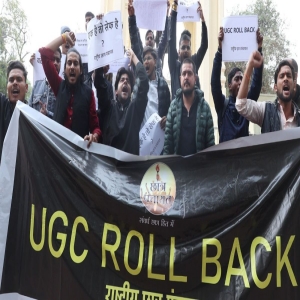
The UGC said the notification followed a rise in complaints of caste-based discrimination and cases such as those of Rohith Vemula and Payal Tadvi, which highlighted gaps in existing redress mechanisms. However, Regulation 3(c) defined caste-based discrimination as discrimination against Scheduled Castes (SC), Scheduled Tribes (ST)and Other Backwards Classes (OBC), which became a focal point of opposition from upper-caste students mainly in the BJP-ruled states of Uttar Pradesh, Bihar and Rajasthan and on a very small scale in Madhya Pradesh.
Subsequently, several petitions were filed in the Supreme Court challenging the constitutional validity of the UGC regulations drafted by a committee including former Cabinet Minister Ravi Shankar Prasad.
It is pertinent to note that there was no protest against regulations in the majority of states, including BJP-ruled Maharashtra and Gujarat, as well as the Southern states of Andhra Pradesh, Telangana, Karnataka, and Kerala.
The scale of discrimination in our higher education institutions can be gauged from some ground-level statistics. For example, in the matter of professorial appointments in our universities, 80 per cent of the seats reserved for OBCs, 83 per cent for SCs, and 64 per cent for STs lie vacant. Even today, 77 years since Independence, 80 per cent of professors' positions in universities are occupied by upper castes!
As for the intake of SC and ST students in higher education institutions, the less said, the better. In the 1980s, when this reporter was covering the Central Universities for the Indian Express, I conducted a random survey to determine the intake of SC and ST students in Delhi University.
According to the reservation rules in education, 15 per cent of the seats should be reserved for SCs and 7 per cent for STs. The total intake at Delhi University at the undergraduate level in the early eighties never exceeded 5 per cent. If the situation in Delhi was so pathetic, one can only imagine what the conditions must have been in other parts of the country.
The dropout rate among SC and ST students was also very high, with hardly 50 per cent completing the degree course. From the foregoing, it is clear who is being discriminated against and needs protection against discrimination.
Evidently, the Supreme Court stay by a bench comprising the Chief Justice of India, Surya Kant, and Justice Joymalya Bagchi did not take into account the ground reality.
The protests were not only confined to the Hindi heartland, but the protesters also raised abusive casteist slogans. Some chanted "gadhe ko kaise ghoda banaoge" (how can you make horses out of asses?), a derogatory remark based on the stereotypical representation of the lower castes by upper castes.
The declaration by the Union Education Minister, Dharmendra Pradhan, that the new regulations were made to ensure an equal and safe environment for students did not affect either the protesters or the Supreme Court bench.
The Supreme Court's hasty order under Article 142 has come at a time when it has denied bail to Khalid and Imam, despite their having been jailed for more than five years without trial. The Supreme Court has also shown no urgency in taking up petitions challenging the constitutionality of the draconian Unlawful Activities Prevention Act (UAPA) or the many Controversial Freedom of Religion (Conversion) Acts with provisions for stringent punishments enacted by several state governments.
In referring to the UGC Regulation, the Supreme Court went so far as to say that the regulations raise several important questions that, if not addressed, will have far-reaching consequences that will divide society. Issuing notice to the UGC and the Union government, the bench said, "Meanwhile, the 2026 Regulations be kept in abeyance and the 2012 Regulations will continue in force till further orders."
The bench also told the Solicitor General Tushar Mehta that the government must constitute a committee comprising eminent jurists to address the issue. "We should move forward to build casteless Society," the CJI said.
.jpg)
.png) Cedric Prakash
Cedric Prakash
 ICPA
ICPA
 ICPA
ICPA
 ICPA
ICPA
 ICPA
ICPA
 ICPA
ICPA
 ICPA
ICPA
.jpg)
 A. J. Philip
.jpg)
.png) Jacob Peenikaparambil
Jacob Peenikaparambil
.jpg)
.png) John Dayal
John Dayal