

.png) Jacob Peenikaparambil
Jacob Peenikaparambil
.jpg)
Conquering the southern states, including Kerala, is essential for the BJP–RSS combine to realise its long-term goal of transforming India into a Hindu Rashtra. Among the southern states, Kerala poses the greatest challenge for the BJP due to its unique demographic composition and high political awareness. Recognising this difficulty, the BJP has left no stone unturned in its efforts to expand its political footprint in the state.
The party's relatively improved performance in the recent local body elections—especially its victory in the Thiruvananthapuram Municipal Corporation—has further encouraged it to intensify these efforts. In this context, the recent visit and road show by Prime Minister Narendra Modi, as well as the conferring of Padma Awards on eight Malayalees ahead of the state elections, must be viewed as politically significant moves.
Political observers have noted that over the past decade, the BJP has played several calculated, divisive political cards in Kerala. Christians and Muslims together constitute around 45 per cent of the state's population (Muslims 26.56 per cent and Christians 18.38 per cent). As long as these two communities remain united, the BJP's prospects in Kerala remain limited. Consequently, one of the BJP's key strategies has been to create distrust and animosity between Muslims and Christians, particularly through social media campaigns. To some extent, the party has succeeded in this endeavour.
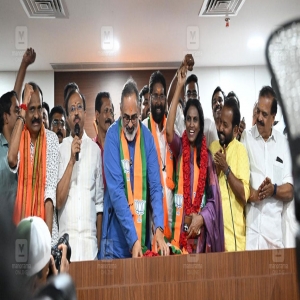
Several prominent Christian leaders—including former politicians, local body representatives, and even members of the clergy—have joined the BJP in Kerala. Notable among them are Tom Vadakan, PC George, Anil K Antony (son of veteran Congress leader AK Antony), Fr Geevarghese Thomas Kizhakkedam of the Jacobite Syrian Church, and Fr Shaiju Kurien of the Nilackal Diocese of the Orthodox Church. In the most recent panchayat, municipality, and corporation elections, the BJP fielded nearly 500 Christian candidates.
Over the past decade, several Christian organisations supportive of the BJP have emerged on social media platforms. These include the Christian Association and Alliance for Social Action (CASA), Kerala Nasrani, and Christian Helpline. Such platforms have been used to amplify narratives around "love jihad" and "narcotics jihad," themes that have found resonance among certain sections of the Christian community, particularly those anxious about communal relations. Pro-Sangh sections of the Malayali diaspora have also played an active role in promoting the BJP's narrative on digital platforms.
These efforts, especially through WhatsApp groups and other social media channels, have contributed to a slight but noticeable shift in political attitudes among a segment of Kerala's Christian population.
Several church leaders—particularly from the Syrian Christian denominations—appear to have come under the influence of this sustained propaganda campaign. Some began expressing overt dislike towards Muslims. For instance, a circular issued by the Syro-Malabar Church on January 15, 2020, following a Synod of Bishops meeting, warned against the alleged dangers of "love jihad." It claimed that Christian women were being targeted, lured into fake relationships, and recruited into terrorist organisations such as the Islamic State.
Several church leaders—including those from the Syro-Malabar Church—publicly supported the controversial film The Kerala Story, viewing it as an exposé of ISIS atrocities and forced religious conversions rather than as a polarising propaganda film.
In April 2024, the Idukki Diocese of the Syro-Malabar Church screened The Kerala Story for students of Classes 10 to 12 as part of its annual vacation Sunday Catechism programme. This decision sparked intense debate, as the film carries an "A" (Adult) certification. Critics, including some Catholic groups, condemned the move, describing the film as propaganda that could incite communal disharmony.
However, the attitude of Kerala's church leadership towards the BJP appears to have undergone a shift following developments in 2025, particularly the increasing attacks on Christians by Hindu right-wing groups and the conspicuous silence of the Prime Minister. A key incident was the arrest and detention of two Kerala nuns—Sisters Preeti Mary and Vandana Francis—along with a layperson, Sukaman Mandavi, in Chhattisgarh in July 2025 on allegations of forcible conversion and trafficking. In addition, widespread attacks on Christian institutions and disruptions of Christmas celebrations in BJP-ruled states during the Christmas week exposed the BJP's double standards.
Church leaders also strongly condemned the mob attack on a Christian pastor in Odisha in January 2026, when around 20 men allegedly belonging to Hindu right-wing groups assaulted a Protestant pastor, forced him to eat cow dung, and made him bow before a Hindu temple.
The Syro-Malabar Church–supported newspaper Deepika published scathing editorials condemning the Christmas-week attacks and the Odisha incident. These editorials highlighted the hypocrisy of Prime Minister Modi attending Christmas services at a church in Delhi on Christmas Day 2025 while remaining silent on attacks against Christians by Sangh Parivar activists.
Meanwhile, the comfortable victory of the Congress-led UDF in the recent local body elections has raised hopes of a UDF win in the next Assembly elections. However, the BJP appears to be adopting new tactics. Some political observers believe the BJP may indirectly support the CPI(M)-led LDF's return to power. If the LDF were to form a government for a third consecutive term, it could demoralise the Congress and trigger defections by many leaders. In such a scenario, the BJP could eventually emerge as the principal opposition and later as the ruling party in Kerala.
The decision to confer the Padma Vibhushan on former Chief Minister VS Achuthanandan is seen by some commentators as part of this broader strategy. Achuthanandan was a towering figure in Kerala politics and a staunch critic of the BJP. Many believe that, had he been alive, he would have declined the honour.
Recently, Vellappally Nadesan, General Secretary of the SNDP Yogam—an organisation representing the Ezhava community, which constitutes about 23 per cent of Kerala's population—appealed to the Nair Service Society (NSS) to work together for "Hindu unity." This call is interpreted by some as a subtle signal of indirect support for the LDF in the forthcoming Assembly elections, aimed at defeating the Congress-led UDF.
The conferring of the Padma Bhushan on Vellappally Nadesan may also be viewed as an attempt to woo the Ezhava vote base. His political stance has often oscillated between the LDF and the BJP-led NDA.
Against this backdrop, the Congress-led UDF cannot take its prospects for granted despite its recent success in the local body elections. The BJP's declared objective of a "Congress-mukt Bharat" suggests that it may employ any means—fair or otherwise—to weaken and defeat the Congress.
Therefore, the Congress must urgently address internal factionalism and strengthen coordination among UDF partners. If it succeeds, the UDF stands a strong chance of victory, especially amid growing anti-incumbency sentiment against the LDF. Kerala has traditionally alternated power between the UDF and the LDF, a pattern that has contributed to relatively good governance.
Continuous rule by a single party or alliance is unhealthy for democracy, as it often leads to arrogance, authoritarian tendencies, and corruption. Kerala's experience of alternating governments has ensured better governance, communal harmony, and human development compared to BJP-ruled states. In this context, one must seriously ask: what meaningful contribution can the BJP make to Kerala?
.jpg)
.png) Cedric Prakash
Cedric Prakash
 ICPA
ICPA
 ICPA
ICPA
 ICPA
ICPA
 ICPA
ICPA
 ICPA
ICPA
 ICPA
ICPA
.jpg)
 A. J. Philip
.jpg) Jacob Peenikaparambil
Jacob Peenikaparambil
.jpg)
.png) John Dayal
John Dayal