

.png) John Dayal
John Dayal
.jpg)
Santa Claus was figuratively lynched in India during Christmas 2025. As many as 150 incidents of vandalism of statues, Christmas trees and shop decorations, attacks and intimidation of carolers, worshippers, including children and women, and clergy took place at different places in the country.
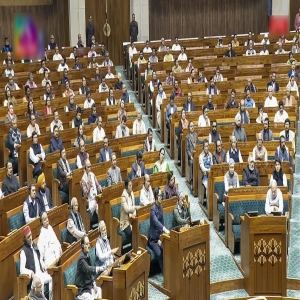
Whether these will be discussed in the two Houses of Parliament during the two-month Budget session, which began with ceremonial pageantry on January 28, the second such session in Mr Narendra Modi's third term as Prime Minister, is a moot point.
Since 2014, when he took oath as the second BJP prime minister of India, the persecution of Christians in India, particularly Dalit Christians, and related issues affecting the Christian community have been conspicuously marginalised in parliamentary discourse. Despite a documented rise in targeted violence, legal discrimination, and social hostility, these concerns receive minimal attention in the Lok Sabha and Rajya Sabha.
Mr Modi and Mr Amit Shah are not to be blamed, not directly, and neither are the Speaker of the Lok Sabha and the chairman of the Rajya Sabha, who is always the Vice President of India. The reasons behind this sidelining are not only the stony silence of Members of Parliament, particularly the Christian members, who would be thought to be most alive to the concerns and cries of the community in which they were born and baptised. Major roles are played by procedural and political dynamics that sustain it, as well as by the implications for minority rights and India's constitutional commitments.
This writer has been an eyewitness and reporter of parliamentary proceedings since the late 1970s. In the last 20 years or so, the PRS Legislative Research, a non-profit institute, has made the Indian legislative process more transparent to the public. PRS also helps MPs to be better informed. This piece draws on PRS data, parliamentary records, including the most recent official engagement on Christian persecution—an unstarred question raised in the Lok Sabha on March 19, 2025, with persecution information from the Evangelical Fellowship of India (EFI), and international bodies like the United States Commission on International Religious Freedom (USCIRF).
Manipur's 30-month tragedy is officially listed as a political and ethnic issue, pushing out of the spotlight the fact that while only a handful of Meities are Christians, almost all the Kuki-Zo, the main victims of rape, murder, and arson, are Christians of various denominations.
The parliamentary discussion, too, did not focus on the religious aspect of the crisis in the north-eastern state, where public focus was on the complicity of the then chief minister and the Prime Minister's reluctance, for months on end, to come anywhere near the state.
India's Constitution guarantees freedom of religion under Articles 25-28, and Parliament has a constitutional role in safeguarding minority rights.
Historically, parliamentary engagement with violence against Christians has been episodic and reactive, often triggered by high-profile incidents such as the 2008 Kandhamal violence in Odisha or attacks on churches in Uttar Pradesh and Madhya Pradesh.
Between the 1990s and early 2010s, discussions on Christian persecution were infrequent and mostly limited to questions (some marked as "starred" slated for possible oral replies, and the "unstarred" ones meriting a bare-bone reply), Special Mentions by MPs, or occasional debates.
In the 2008 Lok Sabha, the debate on nationwide attacks against Christians was a rare instance of a full parliamentary discussion lasting several hours with multiple speakers. That, we may recall, was the pogrom in Kandhamal and elsewhere where attacks by members of the Sangh Parivar displaced 75,000 persons from more than 400 villages where 4,000 houses and more than 400 churches were destroyed.
However, such debates have been exceptions rather than the norm.
Since 2014, reports from NGOs and international bodies have documented a rise in violence and discrimination against Christians, often linked to the rise of Hindutva groups and the enactment of anti-conversion laws. Despite this, parliamentary discussions have not increased proportionally and remain limited in scope and frequency.
As explained earlier, Parliamentary discussions on minority issues, including religious persecution, can take several forms. One is the Starred Question, which allows oral answers and supplementary questions, enabling MPs to press the government and generate debate. Unstarred Questions receive written responses without oral discussion, limiting opportunities for real-time scrutiny. Special Mentions and Zero-Hour Interventions allow MPs to raise urgent matters briefly, but these rarely lead to formal debates. A full debate can be convened, but requires prior notice, and usually happens only when the government finds it convenient.
Since 2014, most engagement with issues of Christian persecution has been through unstarred questions or occasional special mentions. Full debates and oral discussions are notably absent, restricting the visibility and depth of parliamentary scrutiny on the issue. The most recent formal parliamentary focus was on Unstarred Question No. 3001 in the Lok Sabha on March 19, 2025. This question was raised by Mr S. Venkatesan (CPI-M), an MP known for raising issues related to minority rights. He sought State-wise details of attacks on Christians and churches reported to the government, and Government actions taken in response.
The Ministry of Minority Affairs, then led by Mrs Smriti Irani, gave a written statement acknowledging incidents but emphasising that law and order is a state subject, limiting central government intervention. The response cited data from the National Crime Records Bureau (NCRB) and state reports showing reported attacks mainly in Uttar Pradesh, Chhattisgarh, Madhya Pradesh, Haryana, Uttarakhand, and Rajasthan.
The Ministry reported around 200-300 official complaints, contrasting with higher figures (600-700) reported by EFI. The government stated that action was taken in some cases, including filing FIRs and arrests under sections of the Indian Penal Code related to promoting enmity (Section 153A) and outraging religious feelings (Section 295A). However, it characterised these incidents as isolated and linked to "local disputes" or "conversion activities," denying systematic persecution claims. It also highlighted welfare schemes such as the Pradhan Mantri Jan Vikas Karyakram.
A similar unstarred question in the Rajya Sabha on February 3, 2025, by Mr Haris Beeran (Indian Union Muslim League) yielded similar responses, reinforcing the absence of substantive parliamentary scrutiny or legislative initiatives to address the root causes of persecution.
Dalit Christians face a particularly complex form of marginalisation.
Although caste discrimination is constitutionally prohibited, Dalit Christians have not been recognised as Scheduled Castes (SC) and thus do not benefit from SC reservations and protections available to Hindu, Sikh, and Buddhist Dalits. This exclusion has been a long-standing demand of Dalit Christian organisations.
Parliamentary discussions on Dalit Christians are even rarer than those on Christian persecution broadly. The issue is often subsumed under general minority welfare debates without specific attention to the intersection of caste and religion. Despite multiple petitions and court cases demanding SC status for Dalit Christians, Parliament has not enacted legislation to address this gap.
The sidelining of Dalit Christian concerns in Parliament reflects political and ideological factors. The BJP-led government, since 2014, has generally not prioritised minority rights, focusing instead on majoritarian narratives. Opposition parties have occasionally raised the issue, but lack sufficient numbers and political leverage to force a comprehensive debate or policy change.
The rise of Hindu nationalist ideology prioritises cultural and religious homogenisation, often marginalising minority voices. Parliamentary discussions may avoid topics that challenge this narrative. Opposition parties, including the Congress, Left, and regional parties, have sporadically raised minority issues but lack unity or numbers to sustain debate.
The central government frequently invokes the division of powers under the Constitution, arguing that law and order are state subjects, thereby deflecting responsibility. This calls for a discussion among the leaders of churches, the community, and politicians, both Christian and other friendly groups, on how Parliament can be more proactively engaged with issues affecting Christians and minorities in general.
.jpg)
.png) Cedric Prakash
Cedric Prakash
 ICPA
ICPA
 ICPA
ICPA
 ICPA
ICPA
 ICPA
ICPA
 ICPA
ICPA
 ICPA
ICPA
.jpg)
 A. J. Philip
.jpg)
.png) Jacob Peenikaparambil
Jacob Peenikaparambil
.jpg) John Dayal
John Dayal