

 Pachu Menon
.jpg)
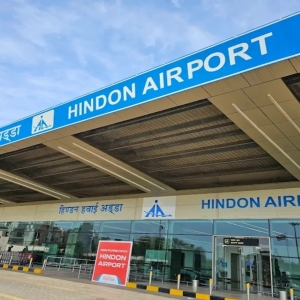
While in Delhi for a short vacation, the name of Hindon Airport in Ghaziabad came up several times during discussions about air travel.
Transforming from a little-used civil enclave within the Hindon air force station into a growing aviation hub served by airlines like IndiGo and Air India Express, this late-comer on India's aviation map connects the Delhi-NCR to cities like Bengaluru, Chennai, and Kolkata. It is said that for budget-conscious fliers living in and around East Delhi and even Noida, Hindon is a lifeline.
In her 'Hindustan Times' piece, senior writer and columnist Anjuli Bhargava highlights the merits of Hindon airport as an example to advocate for more efficient, low-cost airports in India.
Flying has become an incredibly popular mode of transport, largely due to the significant time savings it offers compared to overland or sea travel, and it is the 'aam aadmi' who has capitalised on the air travel boom.
Bringing air travel within reach of the average person, the aviation industry caters to the growing middle class primarily through the rise of Low-Cost Carriers (LCCs). A Low-Cost Carrier is an airline that does not offer traditional services normally included in the fare, thereby offering lower fares at the expense of fewer comforts.
Hence, while economising flying, the need for low-cost airports, which could drastically cut operational expenses for airlines by offering no-frills services and simple infrastructure, thus enabling cheaper fares, connecting underserved regions, and democratising air travel for more people and economies, is the need of the hour.
This approach creates a symbiotic relationship in which LCCs receive the cost structure they need, and regions gain economic stimulus from affordable, high-volume air travel.
This was precisely what the National Civil Aviation Policy (NCAP) of 2016, spearheaded by the then Union Civil Aviation Minister, Shri Ashok Gajapathi Raju, who is presently the Governor of Goa, envisaged.
Driven by the dream of making air travel affordable for common citizens, the UDAN (Ude Desh ka Aam Naagrik) scheme was conceptualised by the Ministry of Civil Aviation under the NCAP 2016, with a 10-year vision to connect Tier-2 and Tier-3 cities through a market-driven yet financially supported model.
Consequently, the country has witnessed an astronomical leap in the number of airports, which have stitched together remote hamlets with bustling metros, democratised air travel, and propelled India into the ranks of the world's largest aviation markets.
The airport boom from 74 to 157 in a decade is no doubt a testament to visionary policy-making. Coupled with the flagship UDAN initiative and its Regional Connectivity Scheme (RCS), these reforms have revived dormant airstrips across the country.
According to experts, the current state of Indian aviation, characterised by robust growth in passenger traffic, airport expansion, and technological adoption, is largely driven by overarching factors such as India's strong economic growth, a rising middle class, and consistent government policies that span across ministerial changes.
While Shri Ashok Gajapathi Raju was instrumental in laying the crucial policy groundwork, the sector's long-term trajectory is primarily guided by these broader trends and by the continuity of the NCAP and UDAN schemes under successive leaders.
But the recent news that the government is planning to offer subsidies to airlines operating flights from dormant regional airports in a bid to bring unused infrastructure into service and justify billions spent on development comes as quite an antithesis to the fanfare with which the whole exercise of democratising air travel was envisioned.
With quite a few airports opting out of the regional flight bandwagon or becoming non-operational under the Union government's UDAN scheme, the impression was that the initiative had hit a roadblock and failed to take off.
Reviving UDAN involves a modified, expanded scheme focusing on revitalising dormant regional airports, offering airline subsidies, extending operations beyond 2027 to new destinations, and enhancing infrastructure.
UDAN 2.0 focuses on revitalising old airstrips, easing regulations, boosting funding, and connecting many more remote areas to achieve goals such as reaching 400 operational airports by 2047.
Indian aviation is at a crossroads, facing a growth paradox. Airport congestion, as a major infrastructure issue, should prompt the Civil Aviation Ministry to develop smaller airports alongside upgrading larger ones. Focusing on smaller hubs helps distribute traffic and reduces strain on metros.
Low-cost airports (LCAs) provide a win-win for governments, airlines, and passengers, driving the next phase of aviation expansion. Even otherwise, concentrating air traffic and infrastructure in a few major metro airports creates systemic vulnerabilities, as seen in the recent 'IndiGo imbroglio', where an over-reliance on a single airline led to widespread chaos when its operations collapsed.
The argument is a call for diversification and the development of regional infrastructure to build a more resilient and balanced aviation system, reducing the risks associated with monopolies or over-concentration of services.
.jpg)
 A. J. Philip

.png) Cedric Prakash
Cedric Prakash
.jpg)
 P. A. Chacko
.jpg)
.jpg)
.jpg) Thomas Menamparampil
Thomas Menamparampil
.png)
.png)
.png) Robert Clements
Robert Clements
.jpg)
.png)
.png) Chhotebhai
Chhotebhai