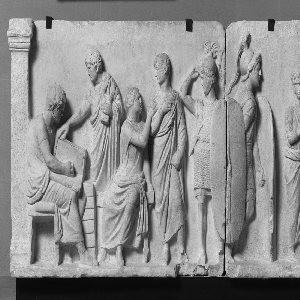


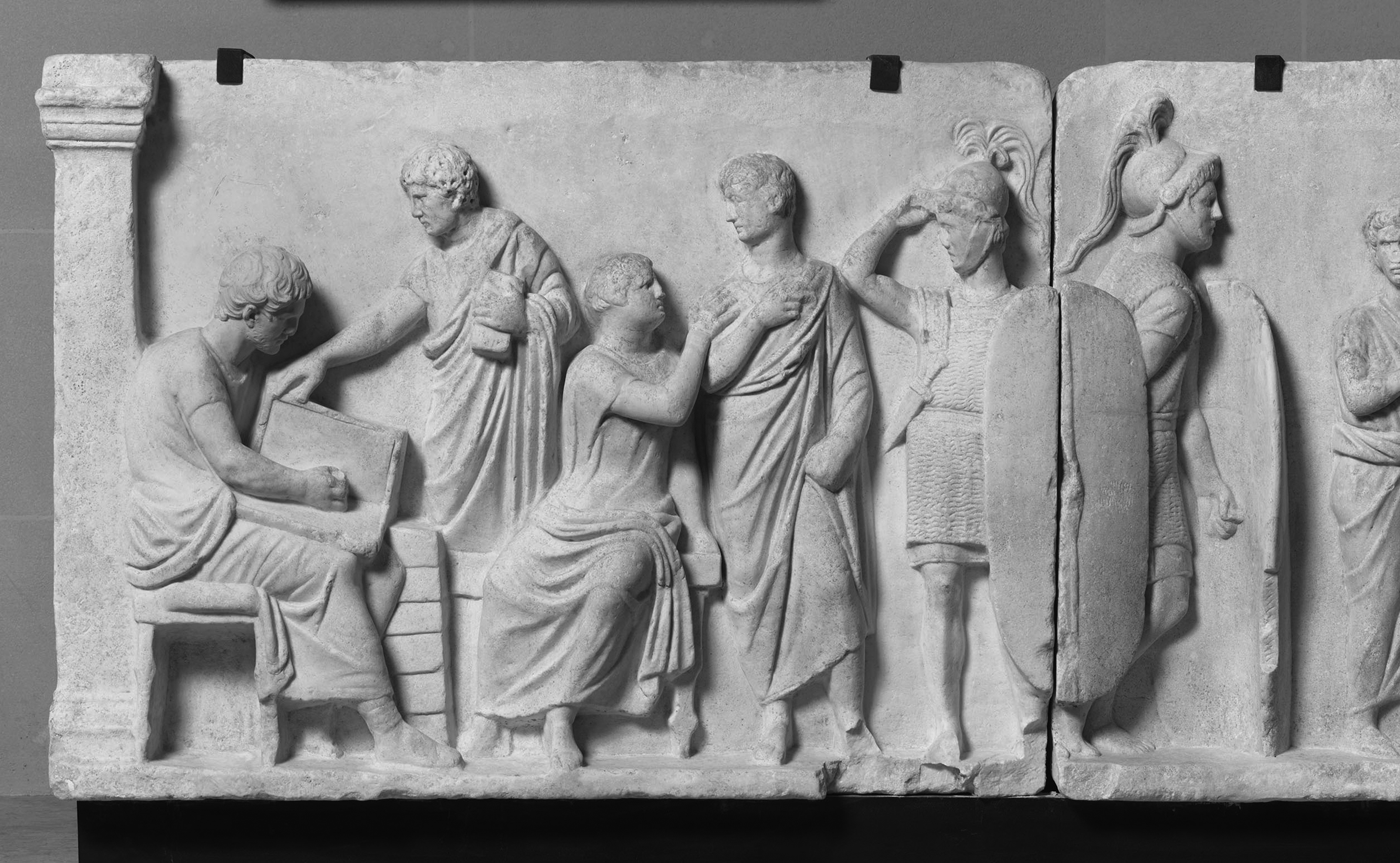
In the second year of his reign, Caesar Augustus decided the world needed to be counted. Every person, every household, registered and taxed—a grand bureaucratic dream of control dressed up as order. The decree travelled from Rome to the farthest provinces, including a dusty corner called Judea, where a carpenter and his pregnant wife were forced onto dangerous roads because some distant emperor wanted numbers in neat columns. That census, meant to tighten Rome's grip, instead set the stage for a birth that would eventually undo every empire's certainty about who mattered and who didn't.
Two thousand years later, we are still being counted. Only now the ledgers are digital, the categories more elaborate, the stakes tangled up in questions of citizenship, ration cards, and voting rights. We have our own emperors who love data more than people, who believe security comes from knowing exactly who belongs and who can be pushed out. After the chaos of recent elections, the Supreme Court's revelations about electoral bonds, the violence in Manipur that never quite made prime-time news for long enough, and unemployment numbers that haunt every middle-class dinner table, we find ourselves in a season of registration that feels uncomfortably familiar. Everyone wants to count us, categorise us, decide if we are genuine or infiltrators, patriots or threats.
Into this atmosphere of suspicion and sorting, Christmas arrives with its old, stubborn story. A story about a couple nobody wanted to make room for, a birth that happened in the space reserved for animals, and a child who would grow up saying that whatever we do to the least powerful among us, we do to God. It is not a story designed for greeting cards.
The Gospel of Luke mentions the census almost casually, as if to say: this is how empires work, always measuring and managing. Rome's census was supposed to demonstrate power, yet it accidentally fulfilled an ancient prophecy that the Messiah would be born in Bethlehem. The emperor thought he was moving chess pieces; he was actually arranging the scene for his own irrelevance. That tension between what power thinks it is doing and what actually happens runs through the entire Christmas story like a thread of light through darkness.
King Herod understood this better than most. When foreign mystics showed up asking about a newborn king, he didn't dismiss it as superstition. He felt the threat immediately. A baby, born to nobody important, in a nothing town—and somehow this endangered his throne more than any rebellion. So he did what scared rulers always do: he ordered violence against the innocent, killing children in Bethlehem to eliminate one possible rival. The Christmas story doesn't hide from this horror. It places the massacre right next to the angels' song, refusing to let us forget that wherever God shows up among the vulnerable, violence is never far behind.
We have our own Herods now, less obvious perhaps, but no less real. They appear whenever a rumour about beef or love or prayer turns into a mob. They surface in bulldozers that demolish homes and livelihoods with barely a pretence of due process. They hide in social media trends that decide someone is anti-national before any court speaks. They sit in offices where lists are made of who deserves to stay and who must prove their belonging through documents their grandparents never needed. The methods have changed, but the reflex is ancient: eliminate the threat by eliminating the people.
Yet the first people to hear about Jesus's birth were not threats to anyone. They were shepherds, working the night shift in fields outside Bethlehem, men whose job made them ritually unclean and socially invisible. Angels appeared to them first—not to the priests in Jerusalem, not to scholars debating prophecy, not even to the reasonably righteous people trying their best. The announcement went to workers whom everyone else looked down on. It was a declaration about whose lives matter to God when empire and religion have made their own calculations.
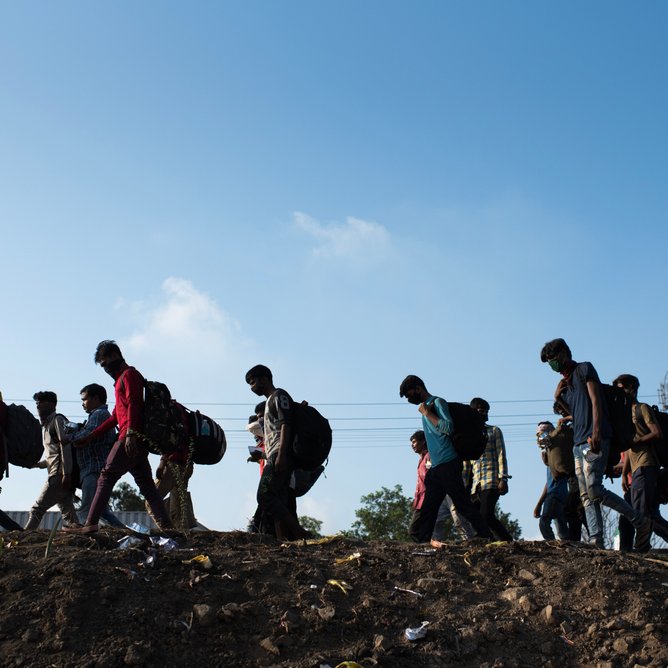
Who are the shepherds now? Perhaps the migrant workers who built our cities and were abandoned during lockdown, left to walk hundreds of miles home because they suddenly didn't count. Perhaps the young woman in a relief camp who still hasn't been allowed to return to her village because the violence that destroyed it is deemed too complicated to solve. Perhaps the graduate driving an auto-rickshaw because five years of applications produced nothing but automated rejections. Perhaps the farmer whose land is being acquired for a project he'll never benefit from. The ignored, the inconvenient, the people who make our comfort possible while remaining uncomfortably visible only when something goes wrong.
Then there were the wise men, coming later from the East with their strange gifts and dangerous questions. Foreigners with resources, following knowledge that didn't fit into local religious categories. Herod tried to use them, asking them to report back once they found this king. But they went home by another route, conscience overriding royal commands. We need people like that today—those with privilege, education, and platforms —who choose disobedience to unjust power over comfortable compliance. Those who bring their gifts not to palaces but to places of need. Who refuse to carry messages back to modern Herods hungry for control.
The political nature of Christmas makes many people uncomfortable. We prefer it wrapped in sentiment, safely distant from our actual conflicts about who belongs in this country, which lives are grievable, whose suffering deserves attention. But the story resists domestication. Mary's song, the Magnificat, is about thrones being toppled and the hungry being filled while the rich go away empty. That is not theology that fits easily on a Christmas card, yet it is what she sang.
Our modern registrations and identity documents serve similar purposes to Rome's census—they are about control, about making sure the state knows who and where you are, about creating systems in which some people can move freely while others must constantly prove they have the right to exist in their own neighbourhoods. The National Register of Citizens debates, the Citizenship Amendment Act controversies, the quiet deletion of voters from rolls, the way Aadhaar links everything from school admissions to death certificates—all of it asks the question Rome asked: who counts?
Christmas answers differently. It says that before any government counts you, you are already counted in heaven. Before any bureaucrat decides if your papers are in order, you are already a child created in God's image. Before any mob decides you are the wrong religion for this street, you are already loved with a love that crossed the distance between eternity and a feeding trough to find you.
This is not about being naïve about governance, borders, or the genuine complexities of running a diverse nation. It is about remembering that systems meant to serve people have a way of becoming systems that people must serve, often at the cost of their dignity and sometimes their lives. When registration becomes a weapon, when counting people becomes a way of discounting them, something has gone terribly wrong. The Christmas story, born under exactly such a system, reminds us that God's first move is always toward the ones the system has pushed to the margins.
So as we celebrate this year, perhaps the question is not whether we can fit Jesus into our politics, but whether we are willing to let his birth question our politics. Are we making room for the refugee family, or are we Bethlehem with no vacancy? Are we listening for angels among the workers we depend on but rarely see? Are we, like the wise men, willing to kneel before something that doesn't fit our expectations? Or are we more like Herod, seeing threats everywhere, willing to sacrifice innocence for the illusion of security?
The empires that counted Caesar and Herod among their certainties are dust now. Rome's census records are fragments that scholars debate. But that baby born in Bethlehem, to parents who didn't matter according to any ledger that mattered, changed the world more than all the emperors combined. Not through coercion or data collection or making sure everyone had proper documentation, but through vulnerability, solidarity with suffering, and an insistence that every single person—especially the ones powerful people would rather not count—bears infinite worth.
The story is not over. We are still taking censuses, still building walls, still deciding who belongs. And Christmas still comes every year, quietly asking if we have left any room, if we are willing to see God in unexpected faces, if we can hear angels singing to people we have learned to ignore.
The light still shines in darkness. And all our careful counting, all our categories and registrations, and our attempts at control cannot overcome it.
.jpg)
 A. J. Philip
.png) Cedric Prakash
Cedric Prakash
.jpg)
 P. A. Chacko
.jpg)
.jpg)
.jpg) Thomas Menamparampil
Thomas Menamparampil
.png)
.png)
.png) Robert Clements
Robert Clements
.jpg)
.png)
.png) Chhotebhai
Chhotebhai