

 A. J. Philip
.jpg)
Mahatma Gandhi was never a comfortable figure for the Narendra Modi–led government. His name is invoked, his spectacles are displayed, his statues are garlanded across continents, but his ideas sit uneasily with the ideology that governs the present dispensation. That ideology is Hindutva, far removed from Gandhism.
Hindutva is a political-cultural ideology that seeks to define India primarily as a Hindu nation. It views national identity through a religious lens, emphasising cultural homogeneity, majoritarian values and historical grievance, often blurring the line between faith, culture and state power.
The term itself was coined by Vinayak Damodar Savarkar, whose ideas continue to influence the ruling establishment. He articulated Hindutva in his 1923 book of the same name, defining the nation in terms of common blood, culture and reverence for the land as holy. His formulation excluded many Indians and replaced Gandhi's inclusive nationalism with an assertive, muscular identity politics.
Long before Muhammad Ali Jinnah formally advanced the two-nation theory, it was Savarkar who first articulated the idea that Hindus and Muslims constituted two separate nations that could not meaningfully coexist within a single political framework.
Savarkar's formulation, rooted in cultural and religious identity, rejected composite nationalism. Jinnah later adopted and politically weaponised this very logic to justify the demand for Pakistan, with catastrophic consequences for the subcontinent.
His shadow over Indian history darkens further when one turns to the assassination of Mahatma Gandhi. He was accused of conspiring in the assassination carried out by Nathuram Godse. Though he was acquitted due to lack of clinching evidence, later inquiries, including the Kapur Commission, pointed to his ideological and organisational proximity to the conspirators.
That ideology found social resonance in places one would least expect. Poet and lyricist ONV Kurup recounts in his autobiography an incident that left him deeply shaken. On the day Gandhi was assassinated, a wealthy Hindu family in Thiruvananthapuram distributed sweets to celebrate the killing of the Father of the Nation.
Kurup, a humanist steeped in Kerala's syncretic culture, could not believe what he saw. Decades later, many like him are shocked that the very city corporation of Thiruvananthapuram would come under BJP administration—a reminder that the currents Gandhi warned against never entirely disappeared.
Why are Hindutva forces opposed to Gandhi? The answer lies not in conjecture but in Godse's own words.
Nathuram Godse argued that Gandhi's advocacy of non-violence weakened Hindus, turning them into pacifists incapable of self-assertion. He accused Gandhi of draining Hindus of their "manliness" and strength, portraying ahimsa as surrender rather than moral courage.
Bal Gangadhar Tilak, also from Maharashtra, fundamentally differed with Mahatma Gandhi on non-violence, believing that freedom could not be won through passive resistance alone. Tilak accepted the use of force against colonial rule and famously argued that Swaraj was his birthright. He was jailed by the British for alleged conspiracy and sedition.
The immediate provocation, however, was political. Godse cited Gandhi's fast to compel the Indian government to release funds owed to Pakistan under the Partition agreement. To Gandhi, honouring commitments was a moral imperative; to his killers, it was betrayal. That fast sealed his fate. Godse used a German pistol to kill Gandhi.
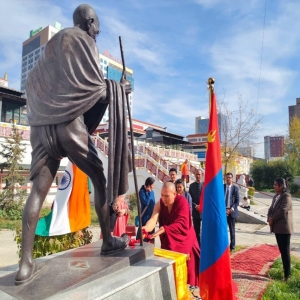
Narendra Modi, however, faced a different problem with Gandhi. Gandhi was not merely an Indian leader; he was an international moral icon. For millions across the world, India was the land of Gandhi—if not Nehru. I remember landing in distant Ulaanbaatar in Mongolia in 1994 and encountering a statue of Mahatma Gandhi. It was a startling reminder of how far his influence travelled, without armies or wealth. That influence is institutionalised elsewhere too.
At the Martin Luther King Jr. Centre in Atlanta, a major tourist destination, Gandhi is prominently featured alongside the American civil rights leader. King openly acknowledged that Gandhi's philosophy of non-violence deeply inspired his struggle against racial injustice in the United States. It even compelled him to not only visit India but also travel to the far corners of the country in the company of his wife, Coretta Scott King, who movingly describes the journey and its transformative impact in her autobiography, which I read with great joy.
And sometimes, Gandhi appears where one least expects him. On the way to the Statue of Liberty in New York, a massive electronic billboard once displayed Gandhi's image with his famous warning: "An eye for an eye will make the whole world blind." Even in America's most symbolic landscape, Gandhi speaks a universal moral language.
Modi is among the most widely travelled leaders in the world, perhaps unmatched in the frequency and scale of his foreign visits. He could have ignored Gandhi at his peril.
During these travels, it has become almost obligatory for the Prime Minister to visit Gandhi statues, pay floral tributes and invoke his name. Diplomatically, it is unavoidable; globally, Gandhi remains India's most recognisable brand.
Yet, symbolism at home tells a different story. Recently, Archbishop Kuriakose Bharanikulangara of the Faridabad Archdiocese observed that in some elite areas of Delhi, roads are swept three times a day. A former Vatican diplomat who has served across Europe, Africa and the United Nations, he noted that few capitals boast as many parks and gardens as Delhi. And yet, vast stretches of the city stink.
Sri Lanka, not a wealthy country, shows little litter even in its towns. Its water bodies are clean, with no plastic bottles floating in them. Nepal, a Hindu-majority nation, has no cows roaming the streets, eating plastic waste in Kathmandu or elsewhere. Cleanliness is a habit that must be instilled from childhood. We keep our houses clean, but throw waste on the roads. Recently, I saw someone in a BMW car throwing plastic wrappers onto the street.
India launched an unprecedented cleanliness drive under Swachh Bharat, yet open garbage remains ubiquitous. Neither religious majorities nor national campaigns guarantee civic discipline. Gandhi's emphasis on personal responsibility seems forgotten, replaced by slogans without sustained enforcement.
I often wonder if any other country needed a nationwide "cleanliness mission" driven from the top. I welcomed the Swachh Bharat Mission in good faith. Delhi has a three-engine governance model. Yet, garbage lies openly near Deepalaya School in Kalkaji Extension, on the Janakpuri–Vikaspuri road, and at hundreds of other sites. Gandhi wrote endlessly on cleanliness, the dignity of labour, and simple living. His collected works run into 100 volumes, each the size of a Bible. Yet today, Gandhi is reduced to a logo.
Cleverly, Gandhi has been transformed into a symbol of toilets. Public conveniences display his iconic spectacles, reducing a towering moral philosopher to a sanitation mascot. His stature is not erased, but subtly diminished through selective appropriation.
Incidentally, the toilet was voted the greatest invention of the second millennium—from 1001 AD to 2000 AD—in a survey conducted by the American magazine Time. It ranked above electricity, the computer, the telephone, the X-ray and other transformative innovations.
This brings us to governance by renaming. If the Modi government excels at anything, it is rechristening old schemes as revolutionary initiatives. On December 18, Parliament passed the SHANTI Bill—Sustainable Harnessing and Advancement of Nuclear Energy for Transforming India, 2025—replacing the Atomic Energy Act of 1962 and the Civil Liability for Nuclear Damage Act of 2010.
Earlier came a far more symbolic move: renaming the Mahatma Gandhi National Rural Employment Guarantee Act (MGNREGA) as the Viksit Bharat Guarantee for Rozgar and Ajeevika Mission (Grameen) Bill, 2025—VB-G RAM-G.
In one stroke, Mahatma Gandhi disappeared from India's most ambitious welfare law, replaced by RAM, with a reverential "G" attached. In today's charged political climate, questioning such symbolic substitutions risks being labelled sacrilegious or anti-national.
This is not an isolated exercise. Nirmal Bharat Abhiyan became Swachh Bharat Abhiyan; a rural LPG scheme was reborn as Ujjwala. Rebranding has become governance shorthand—suggesting transformation without necessarily delivering it.
But the new employment law is not merely old wine in a new bottle. It threatens to poison the programme slowly. On paper, it raises guaranteed employment from 100 to 125 days. In practice, it shifts 40 per cent of costs to states—10 per cent for Himalayan states—ending the Centre's full funding. Control is centralised, ostensibly to curb corruption.
MGNREGA, enacted in 2005 under Manmohan Singh with Left support, was revolutionary. I recall meetings of the Kolkata Group led by Amartya Sen, with Jean Drèze, Kapil Sibal and the late Sitaram Yechury, where the idea of employment as a legal right was shaped. It paid political dividends for the UPA government led by Manmohan Singh in 2009, but more importantly, it provided livelihoods and created durable assets such as roads, buildings, and wells.
It is sobering that after 75 years, India still needs job guarantees for 125 days. With nearly 800 million dependent on subsidised rations, the need is self-evident. Yet the government has steadily undermined the programme. Employment numbers have fallen to 6.24 crore this year from a peak of 11.17 crore during the pandemic.
Economists warn that shifting costs to states will hurt poorer regions and dilute the scheme's rights-based character. Decision-making is centralised, and financial responsibility is decentralised. This is a dangerous inversion.
Congress MP Shashi Tharoor mocked the renaming by quoting a 1971 song: "Ram ka naam badnaam na karo." His point was sharp—invoking Ram to dismantle a pro-poor programme risks desacralising both faith and welfare, turning symbolism into cynicism.
The new Bill transforms a legally enforceable right into a budget-limited welfare scheme. Instead of funding being demand-driven, expenditure is capped and restricted to select areas. Though the government claims improvements—more workdays, faster payments and digital transparency—critics like Jean Drèze argue these changes weaken the programme's foundational guarantee rather than strengthen it.
A law that guarantees work, however modestly, embodies the Gandhian idea of dignity through labour. By centralising control, shifting costs and hollowing out rights, the government risks collapsing this progressive legislation under its own handling. Gandhi's name may be erased, but the damage will be borne by India's poorest.
When Godse's bullets struck him, Mahatma Gandhi's final words were reported to be "Hey Ram"—not a cry of fear or anger, but a deeply personal invocation of God, spoken with serenity at the moment of death. It was the ultimate ex
Today, as Gandhi's name is invoked even while his ideas are hollowed out, one can imagine him in his heavenly abode, uttering the same words again—not in pain, but in sorrow. Hey Ram would then be less a prayer and more a lament: a quiet, compassionate plea at the sight of a nation that honours his image, borrows his symbols, but steadily walks away from the values for which he lived and died.
.jpg) A. J. Philip
A. J. Philip
.png) Cedric Prakash
Cedric Prakash
.jpg)
 P. A. Chacko
.jpg)
.jpg)
.jpg) Thomas Menamparampil
Thomas Menamparampil
.png)
.png)
.png) Robert Clements
Robert Clements
.jpg)
.png)
.png) Chhotebhai
Chhotebhai