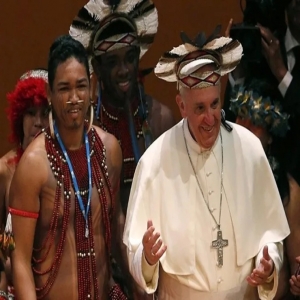


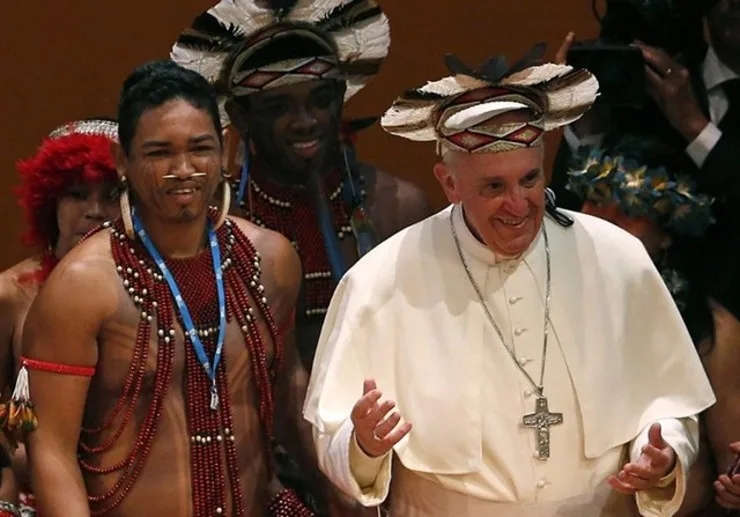
With hearts heavy yet grateful, the Universal Catholic Church bids farewell to Pope Francis—a shepherd of simplicity, a voice for the voiceless, and a true servant of God. His whole life echoed the Gospel of mercy, justice, and love. On April 21, 2025, Pope Francis entered eternal rest, leaving behind a profound legacy of compassion, humility, and courageous leadership that transformed the Church's life and touched the world's hearts.
Jorge Mario Bergoglio, who would later become Pope Francis, was born in Buenos Aires on December 17, 1936, to Mario Bergoglio and Regina María Sívori. Young Jorge's engagements in the parish activities played a vital role in his faith formation. He assisted in the eucharistic celebrations as an altar server. The whole family had a great devotion to Mother Mary and St Joseph. Not only did his family influence the spiritual life of young Jorge, but the devotional practices of the Italian community in Buenos Aires also inspired him.
He joined the novitiate of the Society of Jesus on March 11, 1958. After completing his humanities studies in Chile, he returned to Argentina in 1963 and earned a degree in philosophy from the Colegio de San José in San Miguel. From 1967 to 1970, he pursued theological studies and obtained a degree from the Colegio de San José. He was ordained as a priest on December 13, 1969. After his ordination to the priesthood, he was sent to Madrid to undergo a formation period with the 'tertianship' from 1971 to 1972. On July 13, 1973, the Jesuit General appointed Bergoglio a Provincial Superior.
Cardinal Antonio Quarracino, the Archbishop of Buenos Aires, wanted him as a close collaborator, leading to Pope John Paul II appointing him titular Bishop of Auca and Auxiliary of Buenos Aires on May 20, 1992. On June 3, 1997, he was made Coadjutor Archbishop, and upon Cardinal Quarracino's death on February 28, 1998. Three years later, on February 21 2001, Archbishop Bergoglio was made a cardinal in a consistory by John Paul II.
On March 13, 2013, he was elected as Pope. The election of Pope Francis, the first pope from Latin America, the first Jesuit pope, and the first to take the name of St Francis of Assisi, surprised most people. From the beginning of his papacy, Pope Francis exhibited a fresh sense of humility, humanity, and warmth. By bowing before the crowd in St. Peter's Square and calling himself a sinner, he introduced a new style that reverberated deeply with ordinary people.
The Pope's leadership of the Church influences not only Catholics but also individuals from other faith traditions. His approach and deliberations on various occasions foster an atmosphere that helps others recognise God's presence here on Earth.
The first Latin American Pope has worked to align the role of the Roman pontiff more closely with that of a servant-leader. He aimed to open up the Church and its institutions to the refreshing spirit of the Gospel, reminiscent of the gentle breeze that moved across the Lake of Galilee. His evangelising spirit is well expressed in his encyclical, Evangelli Gaudium, no. 5: "An evangelising community knows that the Lord has taken the initiative, he has loved us first, and therefore we can move forward, boldly take the initiative, go out to others, and seek those who have fallen away, stand at the crossroads and welcome the outcasts."
Indeed, his vision for the Church and the world stands as a transformative force, shaping hearts, renewing faith, and guiding humanity toward compassion and unity. Pope Francis envisaged a universal fraternity that focuses on a place for everyone. The basic human community that the Pope aimed at is a dignified life for all, including nature, for which we are the caretakers. He asserted universal fraternity in his own words, "everything is related, and we human beings are united as brothers and sisters on a wonderful pilgrimage, woven together by the love God has for each of his creatures and which also unites us in fond affection with the sun, sister moon, brother river and mother earth." Laudato Si', no. 92.
According to him, fraternity calls for true freedom and equality. For Pope Francis, solidarity is not just occasional acts of generosity but a commitment to the common good, prioritising the well-being of all over mere wealth accumulation. He urged addressing the root causes of poverty, inequality, unemployment, lack of land and housing, and the denial of rights, as well as viewing solidarity as a transformative force in shaping history, as seen through the efforts of popular movements.
Pope Francis' concept of "social friendship" becomes fascinating and significant as it extends beyond individuals seeking a shared experience of God. The Pope stated, "A love capable of transcending borders is the basis of what in every city and country can be called as "social friendship." Genuine social friendship within a society makes true universal openness possible." Fratelli Tutti, no. 99. He moved us beyond individualism, affirming that true freedom unites personal rights with the common good. He insisted that social friendship involves recognising the inherent dignity of everyone and working for the common good. He also stressed upon the need for open, respectful, and sincere dialogue as a foundation for social harmony. Engaging in dialogue comprises the acts of approaching, speaking, listening, observing, and striving to understand one another to discover common ground.
Before becoming Pope, Cardinal Jorge Mario Bergoglio introduced the concept of the "periphery" to the College of Cardinals, a term that has since become central to Pope Francis' message. He called the Church to go out to the periphery and make it our mission field. He reminded us that Jesus himself came from the margins, was born in a stable, forced to flee as a refugee, and raised in an insignificant town. Throughout his ministry, Jesus sought out those marginalised by society, such as prostitutes, widows, tax collectors, and criminals. In this light, the "periphery" refers to all excluded, forgotten, abandoned, or pushed aside. Pope Francis describes these as the "thrown away" of society. This includes refugees, the poor, the elderly, people with disabilities, prisoners, and those who feel rejected by the Church. Pope Francis' mission to those in the peripheries urges us to view the world from the margins, not just from positions of power.
Pope Francis shared his predecessors' concern over human dignity. However, he broadened the focus to promote an ecologically inclusive concept of dignity, which is important and timely for doctrinal development. The Pope invited the Church "to believe in a Father who loves all men and women with an infinite love means realising that he thereby confers upon them an infinite dignity" Evangelii Gaudium, no. 178.
In today's world, it has become increasingly clear that the pursuit of social justice is closely linked to achieving eco-justice; similarly, advocating for eco-justice naturally leads to social justice. In other words, protecting the Earth and its ecosystems goes hand in hand with defending the rights of the poor, and supporting the marginalised requires safeguarding the environment.
Pope Francis has extensively addressed the theme of an ecological mission aimed at creating a more sustainable and just world, emphasising the shared responsibility of all people to care for our common home. He highlighted the deep connection between environmental stewardship and social justice, which advocates for a holistic approach that addresses both the protection of the environment and the needs of vulnerable populations. Pope Francis called for a collective response integrating ecological awareness with efforts to promote human dignity, urging individuals and societies to work together for a more inclusive and sustainable future.
Indeed, it is an irreparable loss to the Church and the world. We undoubtedly miss this great personality of our time. And therefore, in bidding farewell to Pope Francis, we honour a life poured out in humble service, prophetic courage, and boundless love. His legacy will continue to inspire the Church and the world to walk the path of mercy, justice, and fraternity.
.jpg)
.png) Cedric Prakash
Cedric Prakash
 ICPA
ICPA
 ICPA
ICPA
 ICPA
ICPA
 ICPA
ICPA
 ICPA
ICPA
 ICPA
ICPA
.jpg)
 A. J. Philip
.jpg)
.png) Jacob Peenikaparambil
Jacob Peenikaparambil
.jpg)
.png) John Dayal
John Dayal