

.png) Jacob Peenikaparambil
Jacob Peenikaparambil
After the 2024 Lok Sabha election, where the BJP did not secure an absolute majority, there was widespread expectation that the Modi 03 government, which now relies on allies, would control cow vigilantes and put an end to the bulldozing of properties belonging to individuals accused of crimes. Contrary to these expectations, incidents of bulldozing homes and violence against Muslims on suspicion of eating cow meat have become more frequent. It appears that right-wing groups are in a belligerent mood, seeking revenge on minorities for the BJP's setback in the recent elections.
On August 28, Ashraf Ali Syed Hussain, a resident of Jalgaon, was travelling on the Dhule CSMT Express when a dispute over a seat quickly escalated. A group of men accused Hussain of carrying beef in two containers. In viral videos, the men are seen questioning Hussain about the meat he was carrying before kicking and slapping him. According to The Wire, they punched him in the face, chest, and stomach, hurled abuses, snatched his phone, and recorded the assault on multiple devices before posting it on social media. The police later confirmed that the meat was buffalo. Although three culprits were arrested, they easily obtained bail since the police initially charged them under bailable sections. Due to pressure from various political groups, non-bailable sections were later added, and the bail order was cancelled.
Another incident occurred on August 27 in Charkhi Dadri, Haryana, where a migrant worker named Sabir Malik was beaten to death by members of a cow vigilante group. Malik, originally from West Bengal, was lured to a shop under the pretence of selling empty plastic bottles. There, he was accused of eating beef and mercilessly thrashed, leading to his death—an attack made solely on the suspicion of consuming beef.
Reacting to the incident, Haryana's BJP Chief Minister Nayab Singh Saini said, "Mob lynching is not right. But there is great respect for cows, and at times, people of the village react when such information comes." The BJP chief minister failed to outrightly condemn the murder of a human being, particularly a poor man who earned his livelihood by rag-picking. His statement suggests that his sympathies lie with the cow vigilantes, a right-wing group.
NDT News reported on Monday, September 3, that a Class 12 student named Aryan Mishra in Haryana's Faridabad was allegedly chased in a car and killed by cow vigilantes who mistook him for a cattle smuggler. According to the police, five members of a cow vigilante group were arrested for the August 23 attack. Non-Muslims are also now facing the consequences of the BJP's encouragement of cow vigilantes.
India Today reported that "in the last 10 years, Haryana has seen a rise in lynchings and mob violence by cow vigilantes." In 2023, two Muslim men from Rajasthan's Bharatpur district were allegedly abducted and burned to death in a car in Haryana.
Reacting to these incidents of violence against members of the Muslim community, Rahul Gandhi criticised the BJP government. "Those who have climbed the ladder of power by using hatred as a political weapon are continuously establishing a reign of fear across the country," the Leader of the Opposition in Lok Sabha wrote on X.
The National Crime Records Bureau has stopped collating data on mob lynching, as the Modi government found that it would expose the truth behind the allegations of increasing incidents of mob lynching by cow vigilantes. Some estimates suggest that half a dozen lynchings by cow vigilantes have occurred since Modi assumed power for the third term. Two factors contribute to the recurrence of this crime: the BJP's patronisation of its foot soldiers as a strategy to polarise the majority community's votes and the opposition parties' failure to censure such crimes.
Following the Lok Sabha elections, there has been no let-up in the bulldozing of houses belonging to those accused of crimes, especially Muslims and other marginalised groups. On June 15, eleven homes belonging to Muslims were demolished in Madhya Pradesh's Mandla district, with police claiming to have found beef in their refrigerators. Four days later, the Yogi government of Uttar Pradesh carried out a massive eviction drive in the Akbarnagar area of Lucknow, demolishing 1,169 houses and 101 commercial establishments, all in the name of promoting riverfront tourism.
On August 22, in Chattarpur, Madhya Pradesh, the newly built house of Congress leader Haji Shehzad Ali was destroyed, with accusations that he had instigated a Muslim crowd against the local police. The Udaipur Municipal Corporation on July 17 demolished the rented home of a 15-year-old Muslim boy accused of stabbing his Hindu classmate. As in other BJP-ruled states, the administration claimed that the structure was illegally built on land belonging to the forest department. The boy's family were tenants, not owners of the house, and were not accused in the case. The department reportedly sent an evacuation notice to the family in the morning, and the house was razed by the afternoon. Typically, a notice must be issued at least 15 days before the date of demolition.
The incidence of bulldozing houses and shops, primarily belonging to Muslims, Dalits, and slum dwellers, has surged in recent years. According to figures compiled by the Housing and Land Rights Network, a staggering 1,53,820 demolitions occurred in 2022 and 2023 alone, rendering 7,38,438 people homeless. An Amnesty International report noted 128' punitive demolitions' in Assam, Gujarat, Madhya Pradesh, Uttar Pradesh, and Delhi between April and June 2022.
The Congress party, which remained silent on the issue of bulldozer justice until the 2024 Lok Sabha election, has now openly condemned the blatant violation of the rule of law. Both Congress President Mallikarjun Karge and Priyanka Gandhi strongly condemned the illegal demolition of houses by BJP governments. "If someone is accused of a crime, only the court can decide their guilt and punishment. But punishing the accused's family as soon as the accusation is made, taking away the roof over their heads, not following the law, disobeying the court, demolishing the house of the accused as soon as the accusation is made—this is not justice. This is the height of barbarism and injustice," Priyanka wrote in a post on X.
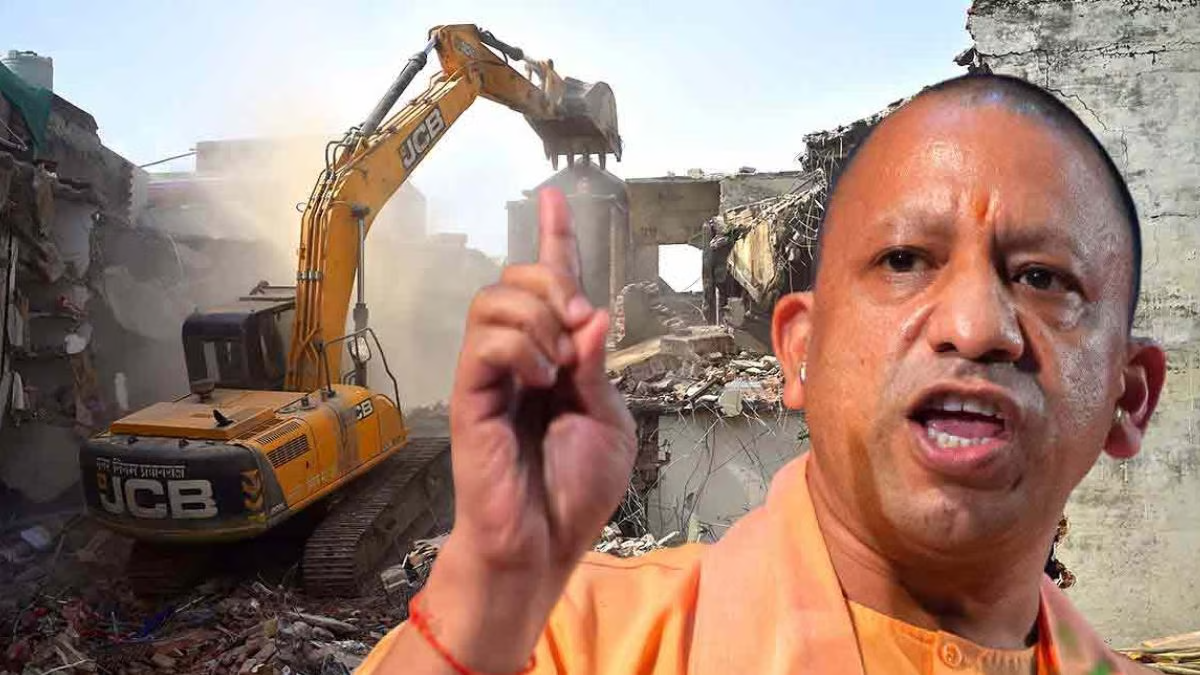
Yogi Adityanath, known as "Bulldozer Baba," pioneered bulldozer justice. During his first term, Adityanath registered cases against around 15,000 people under the Uttar Pradesh Gangsters and Anti-Social Activities (Prevention) Act and also demolished the houses of several accused, branding them as "illegally constructed." Gradually, it became a standard practice in Adityanath's UP to bulldoze houses, shops, and other establishments of those accused in criminal cases, often targeting Muslims.
Other BJP chief ministers followed Yogi Adityanath's example. Shivraj Singh Chauhan, the former chief minister of Madhya Pradesh, known as "Mama," was the first to imitate Adityanath. Shedding his moderate image, he supported the use of bulldozers in April 2022 following communal clashes in Khargone. His government demolished 16 houses and 29 structures, earning him the nickname "bulldozer mama."
Mohan Yadav, the current CM of Madhya Pradesh, ordered the demolition of 10 meat shops in Bhopal in December last year as part of his "intensive campaign" to check the "illegal purchase and sale of meat." On the same day, the government razed the houses of three men accused of attacking a BJP worker.
The former chief minister of Haryana, Manohar Lal Khattar, also experimented with "bulldozer justice." Following the communal riots during a VHP yatra in Nuh in July last year, his government demolished several homes and other structures believed to belong to the accused. Hemant Biswa Sarma, the chief minister of Assam, who is known for his vituperative hate speeches against Muslims, also implemented bulldozer justice in his state.
Many concerned citizens and civil society organisations expected the Supreme Court to address the issue of bulldozer justice, as it constitutes a blatant violation of the rule of law. In many cases, authorities have demolished the houses of those accused in criminal cases without following due process. Often, backdated eviction notices were issued before demolishing properties.
Fortunately, the Supreme Court began hearing a plea against the demolition drive in Delhi's Jahangirpuri area soon after the 2022 riots on September 2. The petitioners pointed out that many state governments increasingly resort to using bulldozers to demolish the properties of people accused of crimes. During the hearing, Justice BR Gavai remarked, "How can anybody's house be demolished only because he is an accused? Even if he is a convict, it can't be done without following the procedure as prescribed by law." The court also said it would lay down "pan-India" guidelines on the issue. The Supreme Court bench has invited suggestions from concerned parties for the proposed guidelines.
It is hoped that the Supreme Court will put an end to the practice of "bulldozer justice" through its pan-Indian guidelines on the issue. As The Hindu editorial on September 4 pointed out, "the judiciary cannot be oblivious to the political symbolism that the bulldozer has acquired as an instrument of collective punishment inflicted on those the authorities label as rioters. There are instances of the houses of named suspects being demolished, without regard to the fact that the rest of the family may have nothing to do with the offense."
.jpg)
.png) Cedric Prakash
Cedric Prakash

 ICPA
ICPA
 ICPA
ICPA
 ICPA
ICPA
 ICPA
ICPA
 ICPA
ICPA
 ICPA
ICPA
.jpg)
 A. J. Philip
.jpg) Jacob Peenikaparambil
Jacob Peenikaparambil
.jpg)
.png) John Dayal
John Dayal