

.png) Jacob Peenikaparambil
Jacob Peenikaparambil
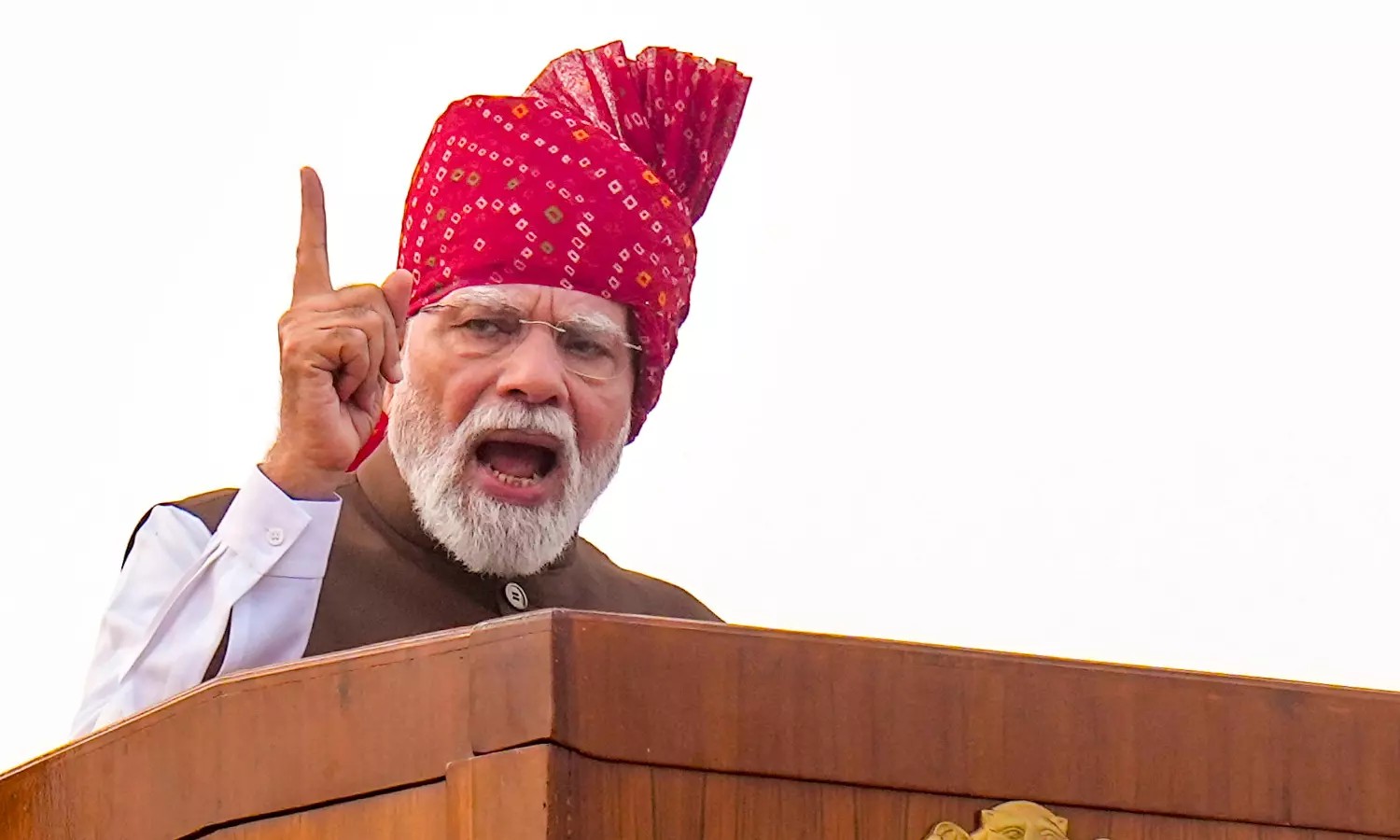
Prime Minister Narendra Modi is known for coining new political terminologies, particularly for his opponents and critics. These include Andolanjeevi for protesters; Urban Naxals for activists, intellectuals, academics, writers and civil-society critics; the Tukde-Tukde Gang for liberal elites, journalists, intellectuals and political opponents; Parjeevi (parasite) for opposition parties; Nakli Gandhi for members of the Nehru-Gandhi family; Parivarvad for the Congress and other dynastic political parties; appeasement politics for the Congress and opposition parties; anti-national for activists, opposition figures and others critical of government policies; and vote-bank politics for the Congress and other political parties.
The most recent addition is Dimaagi Naxals (Intellectual Naxalites), a term Modi used in his Independence Day address on August 15, 2026. These labels, in different ways, are used to portray opponents and critics as threats to the nation.
The Prime Minister did not explain the distinction between "Urban Naxals" and "Dimaagi Naxals." Modi said that while Left-Wing Extremism (LWE) had been dealt with in India's forests, "Dimaagi Naxals" remained entrenched in society. He called for such people to be identified and isolated and for India's youth to be aligned with the mainstream.
"For years, individuals with a Maoist mindset had entrenched themselves within the corridors of power in the country. This Maoist mindset influenced policies, even through their roles as advisors on government committees. We have succeeded in eliminating armed Naxals in the forests and freeing the nation from that crisis," he said.
"However, while the armed Naxals are gone, 'Dimaagi Naxals' are waiting for an opportunity, looking for ways to pave the way for violence and discord. They are employing various tactics to drag society down the wrong path. We must identify these 'Dimaagi Naxals.' We need to isolate them and align the nation's youth with the mainstream effort to transform the country into a developed nation," he added.
According to political observers, the term appears to have emerged in the context of the recent Gen Z protests led by the Cockroach Janata Party (CJP), which reportedly pressured the Modi government to ask Union Education Minister Dharmendra Pradhan to step down. The protests, which reportedly included children of some staunch BJP supporters, appear to have rattled not only the BJP but also its ideological parent, the Rashtriya Swayamsevak Sangh (RSS). This seems to have prompted different voices within the Sangh Parivar, possibly as part of a damage-control exercise.
During an interactive outreach session with more than 2,000 Generation Z students at an India International Movement to Unite Nations (IIMUN) event in Mumbai, RSS Sarsanghchalak Mohan Bhagwat strongly supported the youth, stating that young people participating in protests should not be labelled "anti-national." In response to student agitation, he emphasised that their grievances were genuine and that questioning authority through peaceful dissent was a legitimate part of the democratic process.
At the same time, some RSS leaders were highly critical of the young people's protest at Jantar Mantar. Atul Limaye, RSS Joint General Secretary, while addressing activists of the Akhil Bharatiya Vidyarthi Parishad (ABVP), alleged that Left-leaning organisations had hijacked the demonstration. He argued that right-wing organisations should analyse the movement and claimed that "the Left's concept of 'alternative politics' was successfully tested through the agitation."
Taking inspiration from Gen Z, members of Gen Alpha—the generation broadly defined as those born between 2010 and 2024—particularly high-school students, have also staged protests in different parts of India, demanding better facilities and services in their schools. In several cases, the authorities have been compelled to respond to their demands.
For example, on August 14, hundreds of schoolgirls in Ujjain, Madhya Pradesh, came out in protest against plans to merge and relocate several government schools in which they study to Daudkhedi, a location approximately six to ten kilometres from their respective schools and outside the city limits.
Another example of the effectiveness of student protest is the apology issued by the Chairman of the Bar Council of India (BCI). The BCI revoked its directive that had blocked the 2026 graduating batch of NALSAR University of Law, Hyderabad, from enrolling as advocates.
Students at NALSAR had organised a campaign opposing the invitation of Chief Justice of India Surya Kant as the chief guest at their forthcoming convocation. In response, BCI Chairman Manan Kumar Mishra issued an emergency circular directing all State Bar Councils to halt the registration and enrolment of the entire 2026 graduating class pending an inquiry into the student protest.
Within hours of the initial notice, the BCI withdrew the blanket ban. The decision came amid widespread condemnation from members of the legal fraternity and law students, as well as remarks from Chief Justice Surya Kant that student dissent and dialogue are normal parts of campus life.
Amid the prospect of further agitation by NALSAR alumni and students of other National Law Universities, BCI Chairman Manan Kumar Mishra issued a formal public apology on August 15, expressing regret for any anguish caused to the student community and affirming the right to peaceful ex
What appears to have worried the BJP and the Prime Minister is the diminishing fear among young people and their growing boldness in questioning the government and demanding accountability. Students and young professionals, irrespective of caste, class, religion or ethnicity, are increasingly expressing their opposition to policies they consider wrong. The Prime Minister may be concerned about alienating Gen Z and, therefore, may be seeking to identify a new enemy beyond the already familiar category of "Urban Naxals"—people allegedly influencing young citizens to question the government.
It seems that the term "Dimaagi Naxals" could also be interpreted as an indirect warning to young people, particularly the leaders and supporters of the Cockroach Janata Party (CJP). In this context, "Dimaagi Naxals" could potentially encompass all those who stand for secular democracy, pluralism and the constitutional values of justice, liberty, equality and fraternity, as well as freedom of ex
Unfortunately, during his 70-minute Independence Day speech, the Prime Minister did not express regret over the deaths by suicide of students in the aftermath of the NEET question-paper leak, nor did he address the alleged brutality of the police and paramilitary forces against young people who marched towards Parliament on July 20, 2026.
Majoritarian and exclusionary nationalism often constructs its identity by identifying and targeting an enemy. In Hitler's Nazi Germany, Jews were portrayed as the enemy. Majoritarian nationalism tends to divide society into an "in-group" and an "out-group." It relies on the perception of an enemy to create collective solidarity, justify the exercise of state power and suppress internal dissent by maintaining a perpetual sense of crisis.
During the past twelve years, the BJP has mobilised a large section of Hindus as its core support base by portraying Muslims and Christians as enemies of the Hindu nation and by appealing strongly to Hindu religious sentiments. Such politics violates the constitutional principle of secularism. The BJP under Prime Minister Modi has sought to implement, to some extent, the ideological framework associated with MS Golwalkar, the second Sarsanghchalak of the RSS, who described Muslims, Christians and Communists as internal enemies of the nation.
Along with this strategy, Prime Minister Modi has presented his supporters with the vision of India becoming a developed nation, Viksit Bharat, by 2047. His Independence Day speech in 2026 also placed considerable emphasis on this vision.
In this process, however, the Modi government has failed to pay adequate attention to pressing issues confronting ordinary citizens, including unemployment, the deterioration of the education system and inadequate healthcare facilities. As a result, some sections of even its traditional support base have begun to sympathise with those who question government policies, as was evident during the Jantar Mantar protest.
In this context, Prime Minister Modi feels compelled to identify a new enemy to consolidate his followers' support. This new enemy could paradoxically be critical-minded Hindus—who cultivate the scientific temper enjoined by the Constitution, question inappropriate government policies, demand accountability and refuse to substitute blind obedience for democratic citizenship. The invention of the new term, "Dimaagi Naxals," therefore raises a fundamental question: Is dissent itself being transformed into a form of political extremism?
The disappearance of fear among young people may be one of the most significant developments in India's contemporary political landscape. Young citizens who are prepared to question authority peacefully are not necessarily enemies of the nation. On the contrary, their willingness to question, dissent and demand accountability can be a sign of a healthy democracy.
The million-dollar question, therefore, is whether the politics of identifying new enemies will succeed in maintaining the Prime Minister's political grip over the people of India—particularly the younger generation and, more specifically, the Hindus who increasingly see democratic citizenship as requiring not blind obedience but critical thinking, constitutional values and accountability.
.jpg)
.png) Cedric Prakash
Cedric Prakash
 ICPA
ICPA
 ICPA
ICPA
 ICPA
ICPA
 ICPA
ICPA
 ICPA
ICPA
 ICPA
ICPA
.jpg)
 A. J. Philip
.jpg) Jacob Peenikaparambil
Jacob Peenikaparambil
.jpg)
.png) John Dayal
John Dayal