

.jpg) Ramesh Menon
Ramesh Menon
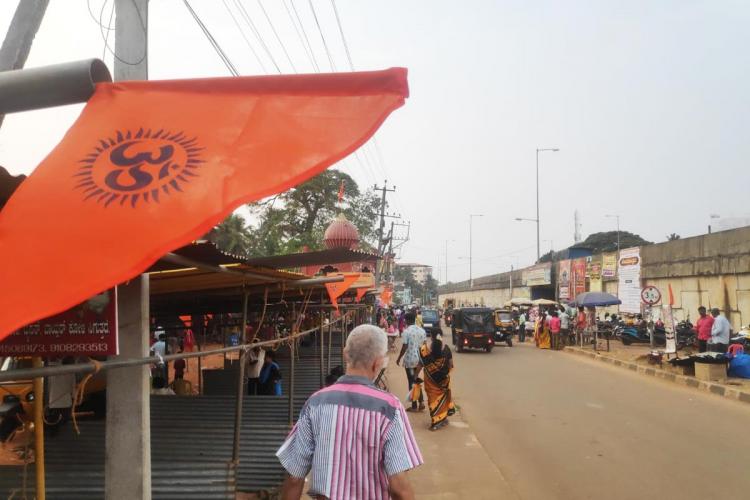
It is election time in India all through the year. Every state government, aided by the Central government, is constantly busy planning for the next elections. The Karnataka elections are a year away, but the BJP-run government has already kicked into election mode with the hijab controversy raging to prevent school girls from wearing hijab, followed by Hindu-centric festivals in temples banning Muslim traders around it.
Predictably, it has got a lot of support from the majority community. The Muslims in the state are feeling targeted and isolated. The movement is now spreading with more temples being forced by right-wing groups to bar the Muslims from conducting any business around it.
Why do we need to whip up communal hatred to polarise voters? What does it tell about us as people? What does it tell us about our political culture getting more toxic as the days pass? Is this the kind of India, our freedom fighters and architects of the Constitution envisioned? What does it mean for prosperous Hindus living outside India in Muslim countries? Will there be a backlash? Is the Central government even thinking of the image India would have in the international arena?
For ages, Muslims were involved in Hindu festivals and rituals. Even in places like Varanasi, many Muslims are engaged in producing typical items required for Hindu festivals and poojas. How will banning small-time traders who dealt with meagre things in their stalls around Hindu temples or festivals strengthen Hinduism?
Let us not forget Hinduism is a philosophy where the cornerstone is being extremely tolerant allowing all faiths and religions. How can any rag-tag group of so-called Hindutva activists dictate how and what needs to be done in the name of saving Hindus? Why are the saints and sages silent as ancient and inherent strengths of Hinduism are being destroyed?
This move in Karnataka is the beginning of something that we will regret in the decades to come. It is something that we need to be worried about. It is not going to be a pretty picture. The collateral damage of something like this is a price that future generations will pay. If it can happen in Karnataka, it can happen in other states.
Senior Karnataka BJP MLC and leader, A H Vishwanath, condemned the ban, questioning what would happen if Indian citizens working in Muslim majority countries were boycotted there and urged the state government to take action on this issue. The government, he said, was watching all this unfold without taking a stand and they must act now. His was one of the saner voices in the state.
By the way, is the ban on Muslim vendors legal? Doesn’t it clearly violate Article 15(2) of the Indian Constitution, which prohibits discrimination based on religion? Why are the courts not intervening? Interestingly, in the past, both the Karnataka High Court and the Supreme Court had stayed this particular rule and permitted Muslim traders to function in and around temple premises. This rule is only meant for the long-term leasing of shops in and around temples. It does not apply for short-term leases to run petty businesses at festivals or along routes where Hindu processions meander through.
For years, the Kote Marikamba Jatra in Shivamogga in Karnataka had Muslim traders plying their trade around the festival. Nobody had an issue. But now, encouraged by the recent success of the BJP in polls that were very polarised as the Uttar Pradesh elections so eloquently showed, right-wing groups forced the temple authorities to ban Muslim traders. Soon after, Muslim traders were banned in Udupi for the Host Malgudi and Kollur Mookambika temple festivals. It was a signal for other temples to follow suit in Dakshina Kannada district of the state.
This is going to spread and will consequently whip up hatred where there was none. The collateral damage will be permanent.
Posters were seen in various parts of Karnataka demanding a ban on Muslim traders outside temples. Karnataka Law Minister J C Madhuswamy justified the posters by citing a little-known law. He said that the Karnataka Hindu Religious Institutions and Charitable Endowments Act of 2002 stated that no property including land, buildings or site situated near Hindu religious institutions shall be leased to non-Hindus. What he did not say was this law violated the Constitution.
However, even in this law, there is no clause that says that Muslim traders will not be allowed to set up stalls. It does not authorise temple authorities to impose such a rule. Rule 31 of this law does mention that “no property including land, building or sites situated near the institution shall be leased out to non-Hindus.” So, this rule does not deal with Muslim traders setting up little stalls but deals with the terms of leases of immoveable property owned by a Hindu religious institution notified under the Act.
BJP MLA Anil Benake emphatically said there was no question of imposing restrictions during temple festivals. “It is wrong to say that people should purchase only in some stores and not in other stores. Under the Constitution, everybody has equal rights,” he said.
Former Congress Minister Priyank Kharge questioned if the Karnataka government would now target IT major Wipro headed by Aziz Premji where lakhs of people worked and were involved in building the nation. There are Muslims who chose to stay back in India and not go to Pakistan, he said, underlining that India’s trade with Saudi Arabia, Iraq, Malaysia, Qatar, Kuwait, Turkey, Bangladesh and Jordan ran into several billion dollars. “Let the BJP take a stand that they will neither import from or export to Islamic nations,” he stated.
Clearly, temples are not acting on their own in taking these decisions. Small groups of pro-Hindu organisations act as pressure groups, forcing them to not allow Muslims to carry on the business that they have done for years. More and more directives are being shot to various temple organisations to stop allowing Muslims to ply any trade around the temples or festivals. For example, the Hindu Sena said, “No Muslim should be given a place to put up stalls during the Maari Puja festival. If the Muslims are allowed to put up their stalls, you (temple authorities) alone will be responsible for the problem and the danger.”
Now, there is no way this madness will not spread and further communalise and polarise society. There are no signs from the government, both in the state and the Centre toward stopping it. The disturbing trend that started in the coastal districts of Karnataka has now spread to Hassan, Shivamogga, Chikkamagalur, and Tumakuru districts.
The People’s Union for Civil Liberties in Karnataka has in a letter to Chief Minister Basavaraj Bommai and Governor Thawar Chand Gehlot said that there was a deliberate misinterpretation of Rule 31 as it only deals with long-term leases of immovable property owned by a temple (up to 30 years for land, and five years for shops and buildings). “It does not deal with the short-term licenses which would be used to allot stalls or spaces to vendors during a festival,” the letter said.
But it did not seem that both of them were listening.
(Ramesh Menon is an author, senior journalist, documentary filmmaker, and educator)
.jpg)
.png) Cedric Prakash
Cedric Prakash
 ICPA
ICPA
 ICPA
ICPA
 ICPA
ICPA
 ICPA
ICPA
 ICPA
ICPA
 ICPA
ICPA
.jpg)
 A. J. Philip
.jpg)
.png) Jacob Peenikaparambil
Jacob Peenikaparambil
.jpg)
.png) John Dayal
John Dayal