

.png) Dr Suresh Mathew
Dr Suresh Mathew
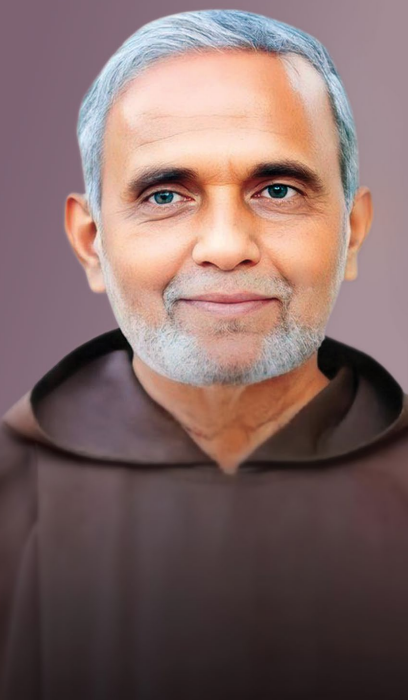
The passing of Rev Fr Xavier Vadakkekara, a trailblazing Capuchin priest, journalist, and media leader, has left a void in the Catholic media landscape in India. As the former editor of Indian Currents weekly (1997-2006) and Assisi magazine (Malayalam), Fr Xavier was a driving force behind the Catholic Church's efforts to engage with the world through media. His visionary leadership, intellectual curiosity, and passion for social justice inspired a generation of Catholic journalists, writers, and thinkers.
Born on January 25, 1953, at Neeloor near Thodupuzha in Kerala, Fr. Xavier's family migrated to Vadakkancherry in Palakkad. Fr Xavier pursued his capuchin priestly training in various parts of Kerala, Tamil Nadu and Karnataka. He was ordained a priest on April 19, 1980, and began his ministry with zeal and dedication at Changanassery in Kerala. After a year of ordination, he was transferred to Bharananganam in Kottayam district of Kerala as the editor of Assisi magazine, a publication that focused on promoting Christian values and Catholic teachings in Malayalam. He also established Jivan Books, a publishing unit for promoting Christian books.
In pursuit of doctoral research, Fr Xavier travelled to the Philippines in 1987, where he earned his doctoral degree in 1993. He later returned to India and worked as a professor of communication at Vijnananilayam at Janampet in Andhra Pradesh. His expertise in communication and journalism inspired a new generation of students.
In 1993, Fr Xavier moved to North India at the invitation of Fr Martin Poothokkaren, the then Mission Superior of the North Indian Capuchin Mission. He established Media House, a publishing house, to promote education and communal harmony. As its director, he played a pivotal role in shaping the Catholic Church's publishing strategy in India. He was a master strategist, able to navigate the complexities of the media landscape with ease.
He was also instrumental in setting up Shramik Vidya Peeth, later known as Jan Shikshan Sansthan, an institution for adult and skilled education. This was the first Shramik Vidya Peeth in India granted to the Christian Community by the Government of India.
Fr Xavier's vision for education and social empowerment led him to establish MITT (Media Institute of Training and Technology) at Surya Nagar in Ghaziabad, Uttar Pradesh, primarily for computer education, in the 1990s. He also played a key role in establishing the Assisi Institute of Communication and Technology in Noida, Uttar Pradesh, which offered master's programmes in communication and journalism, affiliated with Hisar University, Haryana.
His commitment to social welfare was evident in his initiatives, such as CHILD (Children's Help in Life Development), a project aimed at educating street and slum children in Ghaziabad, UP, in collaboration with Caritas India.
In 1998, Fr Xavier, with the support of the Capuchin Mission of Krist Jyoti, led by Fr Dominic Thirunilath, took over Indian Currents from the Catholic Bishops' Conference of India (CBCI). The CBCI was planning to close down the weekly due to financial struggles, but Fr Xavier and his team breathed new life into the publication. He served as its editor from 1997 to 2006. Under his editorial guidance, Indian Currents and Assisi became beacons of progressive Catholic thought, tackling tough issues, and providing a platform for marginalised voices. His commitment to excellence, accuracy, and fairness earned him the respect and admiration of his peers and readers alike.
His fearlessness in tackling tough issues was inspiring, particularly in the coverage of attacks on Christians and Muslims in Gujarat. He never shied away from confronting the government or exposing fundamentalist elements through the write-ups in Indian Currents. What's more, he didn't hesitate to address issues within the Church too. I recall a particularly striking cover page of Indian Currents disparaging the denial of a funeral for a Catholic in a Kerala diocese; it was juxtaposed with a story commending a bishop from North East India for his peace-building efforts among warring groups in the region.
His commitment to truth and justice was unwavering. He was not willing to compromise for the sake of pleasing people. Since he was clear about his mission, he could not be deterred by pressure tactics. He had a vision—a vision about how the church media should be. As editor of two magazines, he showed the path to accomplish that vision.
What made Fr Xavier's achievements all the more remarkable was that he accomplished them despite being partially blind. His determination and resilience in the face of physical challenges inspired those around him, and his efficiency in getting things done was a testament to his unwavering commitment to his work.
He was a mentor and guide to many young journalists and priests who worked with him. Among them were Fr Jacob Kani, Fr Alexander Kizhakkekadavil, and myself, who benefited from his wisdom, expertise, and guidance. Under his guidance, Jyoti Press, a printing unit, was established in Noida, UP in 2002.
He was a man ahead of his time whose courage and commitment to communal harmony inspired countless people. One poignant example of his unwavering dedication to justice and peace was his response to the Gujarat riots in 2002. Deeply troubled by the senseless violence that claimed a couple of thousand lives, Fr Xavier took it upon himself to document the atrocities, ultimately publishing a comprehensive book, "Gujarat 2002," edited by John Dayal.
Fr Xavier's friendships and collaborations transcended religious boundaries, reflecting his inclusive and progressive outlook. His circle of friends and associates included individuals from diverse faith backgrounds. This eclectic group was a testament to his ability to build bridges and foster dialogue.
Cardinal Martini once remarked, "The Church is 200 years behind the time." However, Fr. Xavier was, in many ways, at least 50 years ahead of his time. In a remarkable display of selflessness, his body was donated to the All India Institute of Medical Sciences (AIIMS) in Delhi for medical research. This final act of generosity reflects his lifelong commitment to serving humanity.
In his final days, Fr Xavier was in Kerala, where he spent time with his brother, Fr Benedict Vadakkekara, at a Capuchin ashram in Kattappana, Kerala. He returned to Delhi in February but fell ill by the end of the month. After a three-week battle in Holy Family Hospital, Delhi, Fr Xavier breathed his last on March 16, 2025.
Thousands of mourners, including journalists, media professionals, and people from diverse backgrounds, gathered at the Krist Raja Church in Masoori, Ghaziabad, to bid farewell to him. Archbishop Kuriakose Bharanikulangara of the Faridabad diocese paid homage by praying the Office for the Dead.
The funeral Holy Mass was presided over by Rev Dr Bhaskar Jesuraj, the Bishop of Meerut, Uttar Pradesh. In his homily, Bishop Yeshuraj hailed Fr Xavier as someone who tirelessly promoted truth and fairness in the media mission. The bishop highlighted his contributions to the field of journalism, including his stint as the editor of Indian Currents.
His body was handed over to the AIIMS by the Capuchins after the Holy Mass and funeral service were over. His brother, Fr Benedict, his sister, Sr. Elizabeth, and a few relatives were among those who attended the funeral.
As we bid farewell to this remarkable priest and journalist, we remember his infectious enthusiasm and passion for journalism. Rest in peace, dear Fr Xavier Vadakkekara. Your legacy will live on in our hearts and minds, and your contributions to the Catholic media in India will never be forgotten.
.jpg)
.png) Cedric Prakash
Cedric Prakash
 ICPA
ICPA
 ICPA
ICPA
 ICPA
ICPA
 ICPA
ICPA
 ICPA
ICPA
 ICPA
ICPA
.jpg)
 A. J. Philip
.jpg)
.png) Jacob Peenikaparambil
Jacob Peenikaparambil
.jpg)
.png) John Dayal
John Dayal