

.png) Julian S Das
Julian S Das
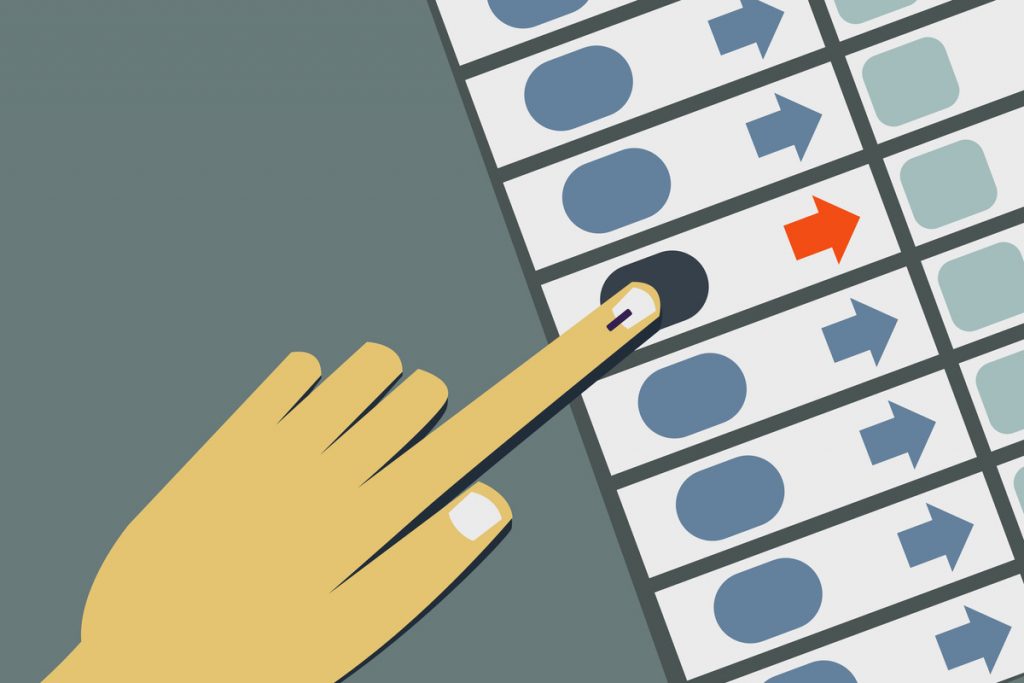
Though the nation has to wait for two more years to see a possible change in the present incumbent in New Delhi and witness a new wave of change and hope, there is a small opportunity, not insignificant in any way, in the forthcoming polls in five states, which might have a bigger say in the general elections in 2024.
The Assembly elections in Uttar Pradesh, Punjab, Manipur, Goa and Uttarakhand, starting in February, would give us the orientation to which side the politics is going to forge in the next years. The political situation in the country is quite volatile and is beyond the capacity of anyone to predict what would happen when.
It is not easy to say whom the aam aadmi would want to sit in the chair of Chief Ministers in the poll-bound states, and there are parties which are contending in all these states, and would wish to be on the national political scenario too, to govern the people from New Delhi. We had seen how some of the most promising candidates had to pack up and leave the seats of power, after their tenure was over, and were not given another chance. Fortunately, the Indian voters have grown to read between lines, not to be carried away by the sweet talks of the campaigners, or the money distributed at night, and the fringe benefits they promise the people in exchange for votes.
At the national level, the colour of the landscape has been gradually changing; it is no more the predominant saffron, but the land is becoming multi-coloured, with all shades and hues, which bring greater beauty and vitality. It is possible that the nation is interested in changing the colour of the nation from saffron and bring a more sober and serene shade to its political scape. Thus, we are about to witness this gradual metamorphosis, even as the five states enter into the crucial polls in the coming weeks.
Awaiting a Change
Believe it or not, the political landscape of the subcontinent is fast changing, changing even faster than the spread of Omicron, or the increase of the Ozone layer. The results of elections in the past have shown that the political scenario is beyond any one’s guess, and even the most versatile poll analysts may feel nervous to state how the results might turn out at the end of the long electoral game.
The Election Commission of India has announced the dates of elections, starting from February 10, and the model code of conduct has been imposed in these states. All eyes are fixed on Uttar Pradesh, with four parties vying for the Chief Minister’s seat, with the Bhartiya Janata Party (BJP) pulling Prime Minister Narendra Modi and Home Minister Amit Shah to lead the campaigns, disregarding the Covid protocol. But one wonders if what had happened in West Bengal was just a precursor to what is in store for Uttar Pradesh.
It is commonplace these days to predict what is going to happen in the near future, and we often come across people who say what they wish, whether they are convinced of what they say, and most often they do not see the light of day. The YouTube will be full of poll predictions, from numerologists to Tarot card readers, from all those who think that by predicting the win of the seemingly most dominant party, they would get their word true.
But it might be hard to belie elections in India this time, because what had been brewing silently across the length and breadth of the nation will find ex
The Chief Minister of West Bengal, Mamata Banerjee, is fond of the image of sports when it comes to political games. In fact, the resounding refrain during the West Bengal polls last time was aptly, ‘Khela hobe’ (we will have the game), and now she is testing new grounds, after pitching a tent in Bengali-predominant Tripura, in poll-bound Goa.
It might be too early to predict what is in store for Banerjee in Goa, but one thing is sure, the fine fabrics of BJP in the state is slowly tearing, even as the Christian MLAs are leaving the party to join the Congress, the AAP, or the Trinamool Congress. Before we consider other states, it appears that the state with a sizable Christian population might not be favourable to the communally tainted BJP this time. To form a government in alliance with any other party would be below the dignity of the party, and therefore we can be sure that saffron might not last too long in the coastal state.
It should be a hard task for the poll-strategist Prashant Kishore, who is aiding Banerjee to claim a lion’s share out of Goa’s Assembly, to find the common grounds between the Eastern and Western states, in order to woo people to join the game to oust BJP from the soil that had been sanctified by the sweat and blood of St Francis Xavier.
Looking at the present scenario in Goa, it would be hard for any single party to come up to the desired number of 21 seats to occupy the seat of governance. Congress leaders are averse to having a pre-poll alliance with Banerjee’s TMC, while some senior Congress leaders do not see anything wrong in such an alliance in order to oust BJP. Ultimately it is bound to be a coalition government that seems to be awaiting Goa. Though opinion polls seem to point a narrow win for the BJP, the fight is not going to be easy for any of the contenders.
Epicentre of Political Action
The battle is not going to be easy in the central state of Uttar Pradesh, which is under the care and control of the BJP, and the party hopes to retain the state assembly under its care. But will the opposition be able to come to the level of strategic planning and execution to woo the more than 15 crore voters of the state.
In the previous election, the BJP had secured about 75 per cent of the seats, with 303 of the total 403 seats in the Assembly; the next contender Samajwadi Party managed to get only 47 seats; however, the reigning king of Samajwadi Party, Akhilesh Yadav, hopes to move from 47 seats to 400 seats, which, by any one’s imagination, is a pigment of imagination.
But if the top contenders are convinced of the need to change the colour and very culture of violence and hatred in the country, then they need to keep in mind the age-old adage: united we stand, divided we fall. Times have changed ever since the monk-turned-politician Yogi Adityanath avowed to change the state into a spiritual capital of the nation, and had invested the tax-payers’ money in building mandirs and found a whole-hearted support of the high-command in Delhi. But politics which mixes religion to it, to make a despicable concoction, cannot always win the support of the public, who is sure to wake up out of the stupor and claim their rightful place in politics.
What had been happening in the state in the name of religion would have given the citizens enough food for thought as to what sort of government they want: the one which divides them in the name of their religious affiliations, what they eat, where they go to worship, or the one where Hindus and Muslims may share one Iftar, where Muslims might bury the ‘outcaste’ Hindus, where humanity takes precedence over religious fervour. If the nation wishes to safeguard its secular credentials and its democratic straits, then they have to choose a party which cannot antagonize one religion against another, which cannot pump in the tax-payers’ money to appease the fanatic right-wing ideologies.
But if that is to take place, then it is impossible to think of a single party, apart from BJP, which can hope to secure the majority seats. Coalition may be the way to go, but if the individual parties do not want to come together to keep the communally tainted party at arm’s length, then it would be hard for a possible change in Uttar Pradesh. Though Akhilesh Yadav had won 224 seats in 2012, it would be an uphill task if he were to repeat the same victory this time.
Mud-slinging in security lapse
There has been too much hype in the news and in political circles on the security lapse of the Prime Minister on January 5. Sure, it was a lapse, but to call it a major security lapse might be a bit exaggerated. It would not be an exaggeration to say that the whole incident might have been tweaked in order to throw mud on the Congress-ruled Punjab, especially in the light of the end to farmers’ agitation, which made the Prime Minister to come down from his glass-house and withdraw the farm laws. This appeared to be tit-for-tat on the people of Punjab, who spearheaded the move.
Politically, the Prime Minister’s convoy being held up on a bridge due to protest by farmers in Ferozepur and his return to Delhi without addressing the rally could show the Congress government in a bad light. The Supreme Court has been wise to take the issue in its hand to appoint an inquiry commission to probe into the security lapses of the Prime Minister. But will this episode cast a spell in favour of the BJP, is something we have to wait and watch.
In the next months, we are going to witness a lot more events and incidents which might give a hint to where the nation is heading, and how its political landscape is slowly changing for better, to bring in fresh air of democracy, secularism and humanism, which alone can determine the true ideals of Indian nationalism.
.jpg)
.png) Cedric Prakash
Cedric Prakash
 ICPA
ICPA
 ICPA
ICPA
 ICPA
ICPA
 ICPA
ICPA
 ICPA
ICPA
 ICPA
ICPA
.jpg)
 A. J. Philip
.jpg)
.png) Jacob Peenikaparambil
Jacob Peenikaparambil
.jpg)
.png) John Dayal
John Dayal