

.png) Jacob Peenikaparambil
Jacob Peenikaparambil
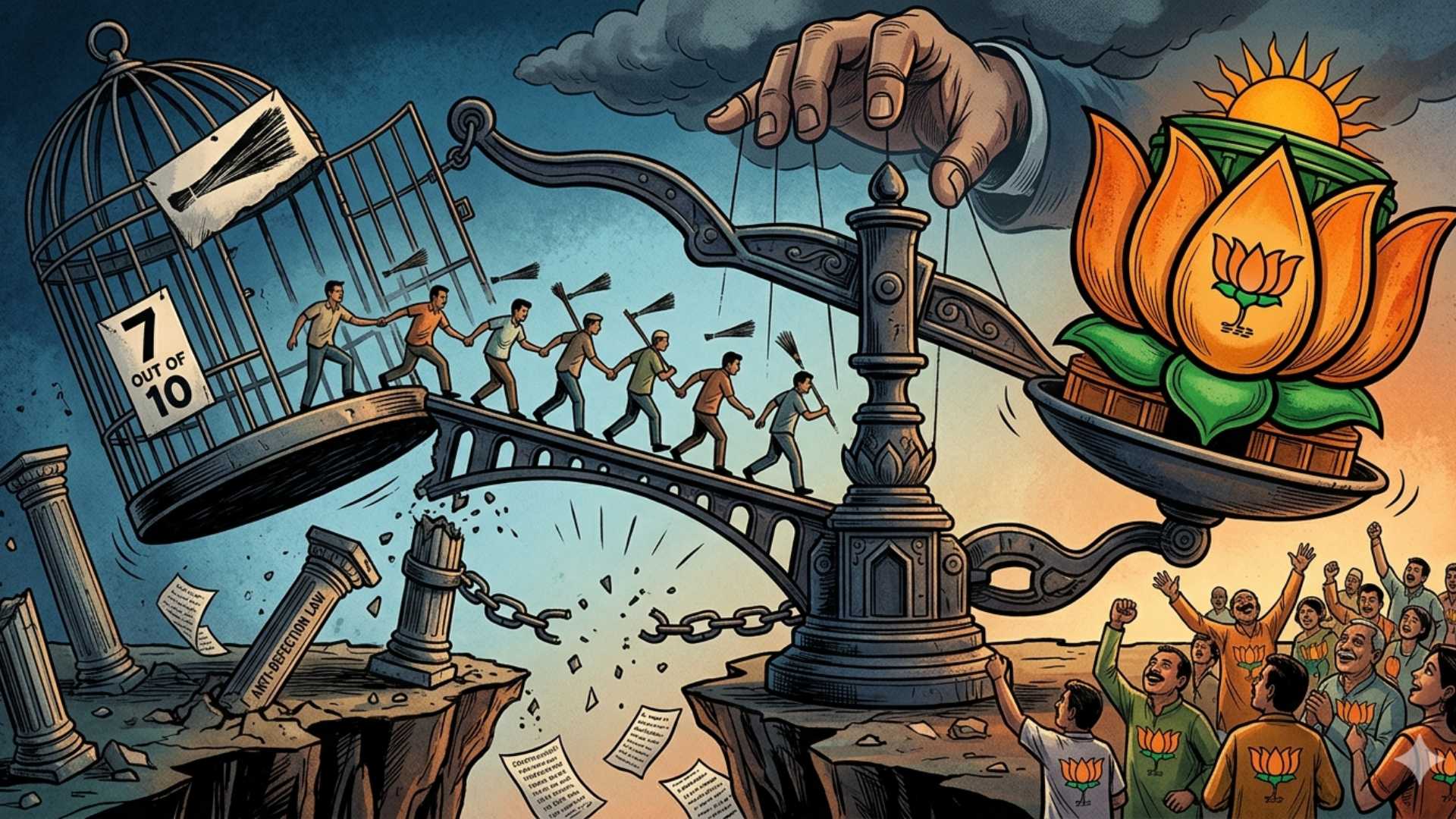
A shocking development for the Aam Aadmi Party (AAP) and welcome news for the BJP unfolded on April 24, when seven Rajya Sabha MPs from the AAP reportedly deserted their party under the leadership of Raghav Chadha and joined the BJP. This mass defection—comprising 7 out of AAP's 10 Rajya Sabha MPs—meets the two-thirds threshold required to claim a legal "merger" under India's anti-defection law, potentially allowing them to retain their seats in the Upper House.
While the BJP welcomed the newcomers as a sign of a vibrant democracy, the AAP and the broader opposition condemned the move as a blot on democratic values. An AAP spokesperson described it as "Operation Lotus" by the BJP. In an interview with Rajdeep Sardesai on India Today TV, Yogendra Yadav termed the defection "shameful" and "deeply saddening," calling it an abandonment of principles. He argued that such actions reflect a broader, systemic effort to weaken the opposition, where political allegiance is traded for personal gain rather than driven by ideological conviction.
As expected, Rajya Sabha Chairman CP Radhakrishnan officially accepted the merger of the seven AAP MPs with the BJP on April 27, 2026, raising the BJP's strength in the Rajya Sabha to 113.
Media speculation about Raghav Chadha potentially leaving the AAP had been ongoing since the arrest of party founder Arvind Kejriwal. This episode has once again highlighted what critics describe as the BJP's strategy of splitting opposition parties and absorbing factions of MLAs or MPs into its fold, either as members or as allies. Since 2014, this has been seen as a key political strategy aimed at consolidating power.
According to critics, the BJP employs a combination of "carrot and stick" tactics to attract opposition leaders. A pattern is often alleged: investigative agencies such as the Enforcement Directorate (ED), Central Bureau of Investigation (CBI), National Investigation Agency (NIA), and the Income Tax Department conduct raids on opposition leaders, particularly ahead of elections. Once these leaders align with the BJP, cases against them are reportedly slowed, stalled, or withdrawn. Some are subsequently rewarded with government positions.
An investigation by The Indian Express (April 4, 2024) found that 23 out of 25 prominent opposition politicians facing corruption probes saw their cases closed or stalled after joining the BJP since 2014. Data from the Association for Democratic Reforms indicates that over 100 MPs or MLAs joined the BJP between 2016 and 2021.
There are numerous examples cited by critics of opposition fragmentation: the split in the Nationalist Congress Party in 2023, the Shiv Sena division in 2022, 22 Congress MLAs loyal to Jyotiraditya Scindia joining the BJP in Madhya Pradesh in 2020, 10 out of 15 Congress MLAs defecting in Goa in 2019, and 10 out of 13 Sikkim Democratic Front MLAs joining the BJP, effectively transforming the opposition landscape overnight. Similarly, after the 2017 elections in Manipur, several Congress MLAs switched sides, enabling the BJP to form its first government in the state.
A second major concern raised by critics relates to the integrity of the electoral process itself. Allegations suggest that the BJP has adopted various methods to influence election outcomes in its favour. Opposition parties have accused the Election Commission of India (ECI) of acting in a partisan manner—failing to act on complaints against BJP leaders while taking swift action against opposition figures.
For instance, Prime Minister Narendra Modi addressed the nation on April 18, 2026, via public broadcasters such as Doordarshan and All India Radio, following the defeat of the Constitution (131st Amendment) Bill in the Lok Sabha. Opposition parties, led by the Congress, accused the Prime Minister of using a "national address" for partisan purposes during ongoing state elections in West Bengal and Tamil Nadu. They described it as a "distress address" rather than a national one. In his speech, the Prime Minister accused opposition parties—including the Congress, TMC, and DMK—of "committing a sin" and engaging in "bhroon hatya" (foeticide) of the women's reservation proposal.
Despite over 700 citizens, including former bureaucrats and academics, filing complaints with the Election Commission alleging a violation of the Model Code of Conduct, no investigation was initiated. In contrast, when the BJP filed a complaint against Congress President Mallikarjun Kharge for allegedly calling the Prime Minister a "terrorist," the Election Commission promptly issued a show-cause notice to the Congress Party. Critics pointed to this as evidence of partisan conduct.
More than 100 opposition MPs moved motions during the budget session of parliament to impeach the Chief Election Commissioner (CEC), alleging bias and a lack of independence. Although the motion was rejected by the Speaker of the Lok Sabha and the Chairman of the Rajya Sabha, media reports suggest that a second attempt may be forthcoming.
Another contentious issue is the alleged "theft" of votes through the Special Intensive Revision (SIR) of electoral rolls. Critics claim that millions of legitimate voters—particularly those perceived to support the opposition—have been removed. In West Bengal, the ECI introduced a new exclusionary category, "logical discrepancy," which had not been used in previous revisions in states like Bihar, Gujarat, or Uttar Pradesh.
"Logical discrepancy" refers to voter entries flagged as internally inconsistent based on data checks—for example, mismatches in parents' names, unrealistic age differences, or an unusually large number of individuals linked to a single parent. Such entries are marked as doubtful and may be removed after review.
Approximately 2.7 million voters fall under this category, leaving their voting status uncertain. Many of these individuals had submitted enumeration forms linking them to the 2002 electoral roll, widely considered a "clean" list. However, a new AI-driven process flagged their records. Data compiled by political parties suggests that around 65% of these affected voters are Muslims.
In this context, Yogendra Yadav's observation in The Indian Express (April 28, 2026) is noteworthy. He described the SIR in West Bengal as a "Special Impediment Removal exercise," alleging that it was designed to alter the demographic realities unfavourable to the BJP, implemented by the ECI, and endorsed by the Supreme Court—without fully accounting for its disenfranchising consequences.
Further concerns about the ECI's impartiality have arisen following the reduction of the retention period for election-related videos and photographs from 1 year to just 45 days. The Indian National Congress has criticised this move as a rollback of transparency essential for democratic accountability.
Additional indicators of democratic decline in India, as highlighted by Freedom House, include:
1. Declining press freedom, harassment of journalists critical of the government, increased self-censorship, and pressure on academic and personal ex
2. Weakening associational and organisational rights, with restrictions on protests, increased scrutiny of NGOs, and constraints on opposition activities.
3. Erosion of the rule of law through selective use of legal institutions, politicisation of investigations, and unequal protection of minorities.
4. Diminishing personal autonomy and individual rights, particularly for minorities and marginalised communities, who face growing uncertainty regarding equality and safety.
Critics argue that the ideological goal of the BJP is to transform India into a Hindu Rashtra, as envisioned by VD Savarkar and MS Golwalkar. They contend that this interpretation of Hindutva is incompatible with the principles of modern, liberal, secular democracy. Since the BJP does not possess the two-thirds majority required to amend the Constitution, it is alleged that alternative methods are being employed to gradually weaken democratic institutions.
In this context, concerns have also been raised about the role of the Supreme Court, which is constitutionally entrusted with safeguarding democracy and protecting citizens' rights. Critics argue that it has, at times, fallen short in effectively upholding constitutional values and ensuring accountability.
.jpg)
.png) Cedric Prakash
Cedric Prakash
 ICPA
ICPA
 ICPA
ICPA
 ICPA
ICPA
 ICPA
ICPA
 ICPA
ICPA
 ICPA
ICPA
.jpg)
 A. J. Philip
.jpg) Jacob Peenikaparambil
Jacob Peenikaparambil
.jpg)
.png) John Dayal
John Dayal