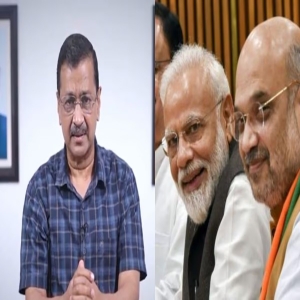


 A. J. Philip
.jpg)
Dear Shri Arvind Kejriwal Ji,
I do not usually write letters—open or private—to those out of power. Why waste time on people who can do nothing to alleviate the sufferings of the common citizen? I am making an exception in your case because you often claim, to use a Shakespearean phrase, that you are more sinned against than sinning.
The reason I write this now is that you once tried to show the Congress Party in a poor light by claiming its leaders have few qualms about leaving and joining the BJP. You asserted that, in contrast, all your party leaders are dyed-in-the-wool Aam Aadmi who would never leave the organisation for pelf or power.
You forget that Mamata Banerjee, for whom you campaigned in West Bengal, was herself a Congress leader. She took over the Congress for her own reasons. If the BJP wins in Assam, remember it is because of a leader accused of corruption who found it more comfortable working under the BJP's banner. Similarly, Sharad Pawar split the Congress in Maharashtra to form his NCP. What is "Nationalist" or "Congress" about his party? The BJP rules Madhya Pradesh because of a switch of loyalty by a Maharaja.
You played your own role in finishing the Congress in Delhi and Punjab. You tried to do so in Himachal Pradesh but failed because you could not average even 5,000 votes. In Haryana, where you claimed to be a big force, you ended up as a nobody in the last Assembly election.
Now take Gujarat, where local body election results were announced on Wednesday and Thursday. The BJP swept the polls, winning all 15 municipal corporations. In Morbi and Porbandar, it was a 100 per cent sweep. You claimed you were filling the opposition space. The truth is, you divided the Congress (read: opposition votes), which benefited the BJP.
I have always had suspicions about your credentials. Let me mention an incident. I used to teach journalism at NISCORT on the Delhi-UP border. One day, some of my students—including nuns—asked permission to leave early to join the Anna Hazare campaign against corruption. Most were thrilled. One wore a headband that said "India Against Corruption."
I knew the 2G and coal allocation scams were fraudulent. In fact, I wrote an open letter to Vinod Rai mocking his "presumptive loss." I told him that if I had become a lawyer instead of a journalist, I could have earned crores every year—a presumptive loss of hundreds of crores. He would have laughed.
Now I know clearly that the campaign succeeded because the RSS was solidly behind it. They used Jayaprakash Narayan once; this time, they used Anna Hazare, who descended on Delhi draped in Gandhian symbolism, promising to cleanse India of corruption. It was presented as a moral uprising, almost saintly. The Sangh Parivar lent muscle and logistics. Bureaucrats like Vinod Rai supplied intellectual ammunition to paint the Manmohan Singh government as irredeemably corrupt.
You claim the central government failed to prove corruption charges against you and your colleagues. Let me ask: has the Centre, with all its investigating agencies, been able to punish even a single Congress leader for scams that never existed? The Commonwealth Games scam met the same fate.
A powerful section of the media played along enthusiastically. The movement gathered familiar faces: Kiran Bedi projecting administrative rectitude; Baba Ramdev blending spirituality with enterprise; and you—an IRS officer turned activist—who emerged as the most politically astute of them all. They did not leave Delhi until the government yielded and agreed to establish the Lokpal. It was projected as a moral victory. In hindsight, it was also a political launchpad.
Yes, there is a Lokpal now, but it seems more interested in buying the latest BMW than in examining the Rafale deal, the diversion of funds to the PM Cares Fund, or corporate donations to party coffers for future benefits. Adani was a mid-level industrialist when Narendra Modi came to power. Today, he has overtaken Ambani as the richest man. Did he invent an iPad or launch a book-delivery service like Amazon's Jeff Bezos or autonomous cars like Elon Musk? No. The BJP does not forget those who help it. One former Chief Justice was made a governor; another was made a Rajya Sabha member.
Ramdev built a sprawling business empire worth thousands of crores. You, sensing the political vacuum, carved out your own space by forming the Aam Aadmi Party. I must admire you for capturing Delhi's imagination. You cultivated the image of the ordinary citizen—armed with a broom, driving a WagonR, speaking the language of the street rather than the drawing room. Reports surfaced that during your tenure as an IRS officer, you allegedly tried to avoid paying government dues, which you later returned when confronted. For your supporters, this was a minor blemish. For critics like me, it was an early sign of contradiction between rhetoric and reality.
Megalomania saw you spend hundreds of crores on advertisements. There was not a single DTC bus without your picture. You pioneered what might be called "anti-politics politics," positioning yourself as an outsider while mastering insider manoeuvring. Your early demand for full statehood for Delhi was framed as a democratic necessity, given that key subjects like law and order and land management remained with the Union government. Yet when Jammu and Kashmir was downgraded to two Union Territories, you were the first to support it wholeheartedly.
Symbolism became a tool. A grand replica of the Ayodhya temple was erected in Delhi for a one-day event attended by your MLAs, then dismantled soon after, leaving questions about cost, purpose, and public access. Has any government spent so much money just to let its MLAs pray, when Hindus believe that Ram lives in their hearts? The "common man" was conspicuously absent, except perhaps as a taxpayer footing the bill.
Free pilgrimages for senior citizens to Ayodhya were organised. Is that a government's job? To maintain balance, similar promises were made for Velankanni Church and Ajmer Sharif. Your MLAs were asked to recite the Hanuman Chalisa. But every Hindu has an "ishta devta"; imposing one is improper. Hinduism even allows atheism. These gestures blurred the line between governance and symbolism, between secular politics and religious signalling.
Moments of crisis revealed another side. During the Northeast Delhi riots, expectations were clear: a chief minister must be visible, decisive, present on the ground. You chose, instead, to sit on a fast at Rajghat. Leadership is not only moral positioning but also timely action. Like Nehru, you could have rushed there to defend victims from Parivar members brought from elsewhere, trained to use cooking gas cylinders as bombs to destroy homes.
The pattern repeated during the Citizenship Amendment Act protests. While large sections of society expressed concern, you chose to support the central government. At Shaheen Bagh, where women staged a prolonged, peaceful protest, your response was telling. You lamented that the police were not under your control, suggesting you would have cleared the protest swiftly if they were. Ironically, even Home Minister Amit Shah refrained from using force, wary of public backlash. The contrast was striking.
To your credit, your government delivered some tangible benefits: subsidised electricity and water, free bus travel for women, and improved government school infrastructure. Yet beneath the surface, familiar problems persisted—bureaucratic inefficiency, administrative lethargy, and corruption, particularly in private school fee approvals. You engaged private auditing firms to review fee structures. Schools willing to pay illegal gratification benefited, while honest NGOs suffered. I was heading a school at the time and saw firsthand how you clubbed the corrupt with the honest.
Then came the optics that proved costly. The merging of two government bungalows into a lavish residence became a symbol. In the 2025 election, the BJP's branding of the house as "Sheeshmahal" cut through your carefully constructed image of simplicity. Politics often turns on perception, and here perception proved decisive. What was the need for such a house? Did you believe you would remain CM forever? As a result, you were roundly defeated in your own constituency.
Internal dissent added to your troubles. Early associates like Yogendra Yadav and Prashant Bhushan parted ways, citing differences over ideology and internal democracy. More recently, the exit of Raghav Chadha and six other Rajya Sabha members has dealt a severe blow. Unlike earlier departures, this was not a trickle but a rupture. The legal questions—whether this constitutes defection under the anti-defection law—will be examined by the Deputy Chairman of the Rajya Sabha and possibly the courts. But politically, the impact is immediate. The BJP's strength in the Upper House has increased, and your hold over your party appears weakened.
There is also the uncomfortable issue of how these Rajya Sabha seats were allocated in the first place. It has long been whispered that financial capacity played a role. If so, loyalty becomes transactional, not ideological. And when a more powerful player offers greater rewards, the shift is hardly surprising. Add to this the pressure central agencies can exert, and the exits begin to look less like isolated acts and more like a pattern.
All this comes at a delicate time. The Punjab Assembly elections are less than a year away, and AAP's internal instability could prove damaging. What was once projected as a movement of clean politics now appears entangled in the same contradictions it once condemned. You cannot underestimate Chadha, who has considerable influence over your MLAs. You know only too well that if the BJP wants, it can engineer a split in AAP's Punjab unit. The only restraining force is that the BJP itself is not powerful there—it has only two seats. As a Malayalam saying goes, even the eagle does not fly over money.
The present trajectory, in many ways, was set long ago. The anti-corruption movement that promised a new political culture ended up reinforcing old power structures, albeit with new faces, some of whom deserve to be in jail. The Lokpal, once the rallying cry of a nation, has faded into near irrelevance. It is more interested in BMW cars than ending corruption.
In the end, you and Anna Hazare did leave an indelible mark—you changed the trajectory of Indian politics. Just not in the way once promised. To call it a fall from grace would be misleading; it was, in truth, the logical destination of a path where ideals were gradually bartered for convenience. The broom that once symbolised moral urgency and public anger was, over time, reduced to yet another emblem in the crowded theatre of politics.
What began as a movement to cleanse the system ended up adapting to it, even absorbing some of its worst habits. That is the more sobering lesson: not that the system resists change, but that it has a remarkable ability to reshape those who set out to challenge it. If you realise that you were being used by the BJP like a Trojan Horse, that realisation will at least set you free. Please accept my best wishes.
Yours etc.
.jpg)
.png) Cedric Prakash
Cedric Prakash
 ICPA
ICPA
 ICPA
ICPA
 ICPA
ICPA
 ICPA
ICPA
 ICPA
ICPA
 ICPA
ICPA
.jpg) A. J. Philip
A. J. Philip
.jpg)
.png) Jacob Peenikaparambil
Jacob Peenikaparambil
.jpg)
.png) John Dayal
John Dayal