

.png) M L Satyan
M L Satyan
.jpg)
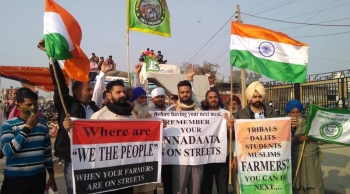
The farmers’ protest in Delhi has created a new history. The whole world is closely watching this protest. There are many lessons that we can learn from this protest. I wish to highlight some important lessons:
Love for nature: Every word that is expressed by the farmers speaks volumes of their love for nature. They have a special bond with mother earth. With great respect to the earth, they try to protect all useful plants and trees. Since they have love for nature, they can never be alienated from it.
Pride for the profession: Every farmer knows that he/she does not have a white-collar job. They know that their hands, bodies and dresses get muddy when they are involved in the agricultural work. They have no aversion to such activities. They never shy away from their work. Rather, they are ever-ready for such work. Their work does not discriminate them in any way. They know that production of food is a ‘life-giving act’. Hence, they feel proud to be farmers.
Political Awareness: The common mind-set among the public is that farmers are mostly illiterate, uneducated and ignorant of many things. But the farmers assembled in Delhi have challenged this mind-set. Their social, economic and political awareness is amazing. In fact, the awareness level of the farmers is higher than that of the people who are into other professions.
Thinking alike: From day one, many private TV channels have been visiting the protest sites to cover what is going on there. Farmers have come from different states and they are scattered in different locations (border areas). It is astonishing to see that all these farmers, who are interviewed by private TV channels, speak “one language”. One does not contradict the other. The classic examples are the six rounds of talks that they had with the Central Government Ministers and officials, including the Home Minister. “Pacifying tactics” and “Divide and rule strategy” of the ruling party utterly failed.
Unity: Different types of demonstrations of the farmers, in different states in the recent past and from 25 November, are clear signs of their unity. “United we win; Divided we fall” is their conviction. India, or any other country in the world, has never witnessed this type of “mass protest of the farmers” in the past. In this way, the farmers’ protest has created a new world-record and a model for unity.
Courage: A majority of the farmers participating in the protest happens to be from Punjab. Sikhs are known for courage. Naturally we will find them in Army, Navy and Air Force in big numbers. Children of Sikh community are taught to be bold from the tender age. If we observe the protestors carefully, we will know that more than 70 percent of them are senior citizens. They were prepared to face the water cannons, tear gas shells and police lathis. The wounded face of a 94-year-old man will always haunt every sensible citizen of this country and will prick the conscience of the police force.
Risk-taking: The farmers never dreamt that they will face obstacles like huge number of barricades, big containers and dug-up roads. In fact, the police thought that such obstacles will scare the farmers. To everyone’s astonishment, the farmers took lot of risks to remove all the barricades, push away the containers and fill up the dug-up roads with mud. When tear gas shells were hurled on them, the farmers managed to put out many of the shells. Some took them and threw them back at the police. A few farmers even climbed on the water cannon vehicles and switched off the connection.
Will-power: The farmers are living examples of the age-old proverb – “where there is will, there is way”. It is this ‘will-power’ that gave them energy and stamina to overcome the physical obstacles, clear their path and move forward. Their every word and deed are ex
Bond/Fellowship: The inspiring scenes are the “langars” (community kitchens) set up at different locations of the protest area. The non-stop supply of food items like vegetables, groceries and milk etc., the untiring services of those who are cooking the food and the volunteers who are serving the food to ‘everyone’ who comes to eat are really amazing and touching. The heart-touching scene was that the policemen, who opposed the protestors, were also fed by these langars. The local residents and people of Sikh community from Delhi are rendering their voluntary services at the langar. Medical teams have opened their counters to treat those who fall ill. The Delhi government has ensured the water supply and sanitation arrangements. In short, the whole protest area has been converted into a “convention of fellowship”.
Planning and execution: For two months, the farmers of Punjab carried on the protests within their state. Nothing much happened as their voices were unheard by the central government. Likewise, the farmers of other states too carried out small-scale protests. Their voices too did not reach Delhi. Hence, all the Farmers’ Associations decided to march towards Delhi. This was piloted by the farmers of Punjab. Farmers coming to Delhi with 96,000 Tractors and other vehicles is not a joke. Surprisingly, they all have come for a longer stay of 3 to 6 months. Every Tractor is converted into a “mobile house” with basic facilities for traveling, sleeping at nights, resting during the day, lighting and cell phone-charging arrangements. Imagine the amount of meticulous planning and preparatory arrangements that have been done for this ‘protest march’.
Clear goal: The farmers who have assembled in Delhi have a clear goal – the repeal of the three farm bills. After the six rounds of discussion, the ruling government presented them a 19-page proposal which was turned down by the farmers unanimously. They have decided to intensify their protest all over India, especially in Delhi, till their goal is reached.
If Swami Vivekananda were alive today, he will tell them, “Arise, Awake and stop not till the goal is reached”.
.jpg)
.png) Cedric Prakash
Cedric Prakash
 ICPA
ICPA
 ICPA
ICPA
 ICPA
ICPA
 ICPA
ICPA
 ICPA
ICPA
 ICPA
ICPA
.jpg)
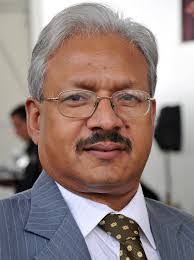 A. J. Philip
.jpg)
.png) Jacob Peenikaparambil
Jacob Peenikaparambil
.jpg)
.png) John Dayal
John Dayal