

.jpg)
I was all of 25 years old and assigned to report on the first Christmas scheduled to be celebrated near the administrative capital at Naharlagun. On Monday, December 25, 1978, the quiet hamlet of Lekhi village, near Naharlagun, became the unlikely stage for a historic moment—the first official Christmas celebration in Arunachal Pradesh. What began as a modest gathering of faith unfolded under constant risk, yet it remains remembered as a seed of resilience that grew into a tradition across the frontier state.
As usual, also in the weeks before Christmas, the Harmutty mission near the Banderdewa border gate became a lifeline for tribesmen from Arunachal. Many of them walked for days through forests and hills, carrying bundles of resin, cane, and herbs to barter at Harmutty market for salt, dried fish, and stationery. Exhausted, they found shelter at the mission, where Fr. Kulandaisamy of Tezpur diocese welcomed them with food, rest, and pastoral care.
Bible Camp for Arunachal Youth
It was here that a weeklong Bible Camp was held from December 17-24, 1978, for the youth of Arunachal. Theology students CC Jose Chemparathy and the writer from Sacred Heart Theological College, Shillong, were joined by Thomas Pullopallil from St. Albert's Theological College, Ranchi, to guide young people from Arunachal in Scripture study and fellowship.
The camp became a crucible of courage, held under the shadow of the newly enacted Arunachal Pradesh Freedom of Religion Act, 1978, which sought to bar missionaries from the Union Territory under Governor KA Rajah and Chief Minister Gegong Apang. At that time, Arunachal remained the only territory in northeast India untouched by Christian missionary activity, with the Central Government promoting direct Hinduisation efforts through Ramakrishna Mission monks and Sharada Mission nuns, replicating Christian missionary models in education and health care among tribal communities.
Crossing into Lekhi
On Sunday, December 24, as the camp concluded, I joined the tribesmen to cross the border into Arunachal to report on the first official public Christmas celebration. It was a perilous decision, as the inner line permit was mandatory for all non residents to enter the state. Being caught without it could mean arrest or deportation. If applied for the permit, there was a greater chance of it being denied. Hence, under the cover of darkness, I joined the tribesmen who slipped through forest paths, waded across icy streams, and moved silently to avoid patrols. Every step carried the tension of discovery, yet the pull of the scoop urged me forward.
By dawn, I was already in Lekhi village, the host for the celebrations, to be warmly received by Gramboora, the tall and dignified headman draped in a red woollen shawl. With gracious hospitality, he welcomed me into his humble home and offered space for the Christmas celebration.
Preparations in the Village
Preparations began under the leadership of TC Tok, a dynamic student leader. Tender bamboo was cut from the surrounding hillside, carried down, and fashioned into arches, decorations, and seating. By evening, the level field opposite the main road had been transformed into a rustic Bethlehem, fragile yet defiant, ready for the liturgy.
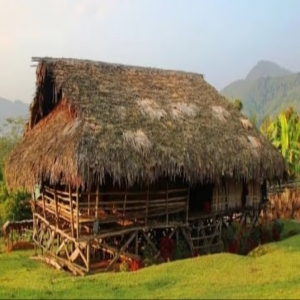
That night I shared dinner at the hearth of a Nyishi home with the headman's family. Their long house, built on bamboo stilts, had no rooms—only a single hall with walls of woven bamboo mats with an open fireplace at its centre. Beneath the bamboo mat floor, pigs and chickens stirred restlessly, their sounds rising faintly through the slats.
After dinner, eaten in the glow of embers, I was given a rough, thick blanket. One by one, the family retired around the fire. I too joined them, lying fully dressed, with shoes and an overcoat, a monkey cap covering my face and head, bracing against the cold wind that howled through the mat walls. Every creak of bamboo and gust of air carried the unease of being an outsider without a permit, vulnerable to discovery.
Before daybreak, I rose quietly to visit the freshly made open air latrine, hoping not to be noticed. Yet even here risk followed me: a pig snorted and came close behind, refusing to be driven off. I snapped a bamboo stick from the latrine enclosure to chase it away, my heart racing at the thought of being startled into noise that might betray me. Afterwards, I shaved in the biting cold and refreshed myself in the nearby stream, the icy water cutting into my skin like a test of endurance. In that moment, the simple act of preparing for the day felt like resilience itself.
Christmas Morning
By ten o'clock on Monday, December 25, five jeep loads of visitors arrived with due permits: Bishop Joseph Mittathany of Tezpur, Vicar General Fr. Cherian, priests, and Sisters. They were greeted with a Nyishi tribal welcome—floral bouquets and fresh bamboo decorations—and seated on a low stage prepared as the altar.
Before the Mass began, the community enacted its most solemn ritual: the mithun sacrifice. A bison bull was slaughtered in front of the gathering, its meat destined to be cooked and shared among all present. Fresh raw meat portions for immediate consumption were ceremonially offered to the Bishop and dignitaries, including us.
Only after this sacrificial ritual did the Eucharistic celebration begin. The penitential rite and scripture readings were conducted in Hindi, allowing people from different tribes to pray together. Hymns rose into the crisp winter air, blending with the smoke of cooking fires. Every word of the Bishop's homily carried the weight of defiance against suspicion, a proclamation of the good news of the arrival of Emmanuel—God with us—even in hostile terrain.
Disruption and Retreat
Suddenly, a commotion erupted on the main road beside the field. Members of the Arunachal Students' Union had arrived, determined to break up the gathering. Their shouts carried the threat of deportation "lock, stock, and barrel." For me, the danger was real: discovery without permits could mean arrest, humiliation, or worse.
The tension was palpable. Organisers, fearing violence, urged the congregation to disperse. The bamboo decorated altar stood abandoned, its greenery fluttering in the winter wind, a silent witness to faith interrupted. Visitors packed hurriedly into jeeps, retreating across the border.
I, too, joined them, returning to the Harmutty mission, my heart heavy yet resolute. Though the long-awaited Christmas Eucharistic celebration had been cut short, the very act of gathering, of daring to celebrate Christmas in Arunachal, was itself a testimony of resilience.
From Field to Front Page
At Harmutty, after a simple lunch shared with the Bishop, priests, Sisters, and dignitaries, they all departed for their destinations. But the story did not end there.
With the urgency of a witness, I sat down at my Brother portable typewriter, filing a news report for The Herald weekly in Calcutta. The words captured not only the joy and ritual of the Lekhi Christmas, but also the tension and abrupt end brought by protest. The report was posted from the North Lakhimpur town post office, the nearest postal link, and days later appeared as front page news in The Herald, ensuring that the story of Arunachal's first official Christmas was not silenced but proclaimed to a wider audience.
Legacy of Lekhi
Though interrupted, the Lekhi Christmas of 1978 remains a milestone. It was the first official Christmas celebration in Arunachal Pradesh, blending tribal ritual and Christian liturgy. It stood as a public affirmation of faith under restrictive laws, a courageous act of visibility at a time when Christianity was viewed with suspicion in the Northeast.
From that bamboo decorated field prepared by Tok and blessed by Gramboora's welcome, Christmas celebrations in Arunachal grew into vibrant ex
.jpg)
.png) Cedric Prakash
Cedric Prakash
 ICPA
ICPA
 ICPA
ICPA
 ICPA
ICPA
 ICPA
ICPA
 ICPA
ICPA
 ICPA
ICPA
.jpg)
 A. J. Philip
.jpg)
.png) Jacob Peenikaparambil
Jacob Peenikaparambil
.jpg)
.png) John Dayal
John Dayal