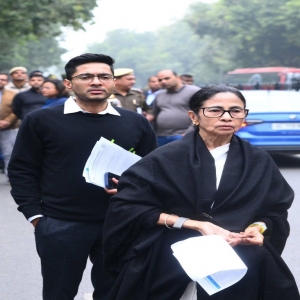


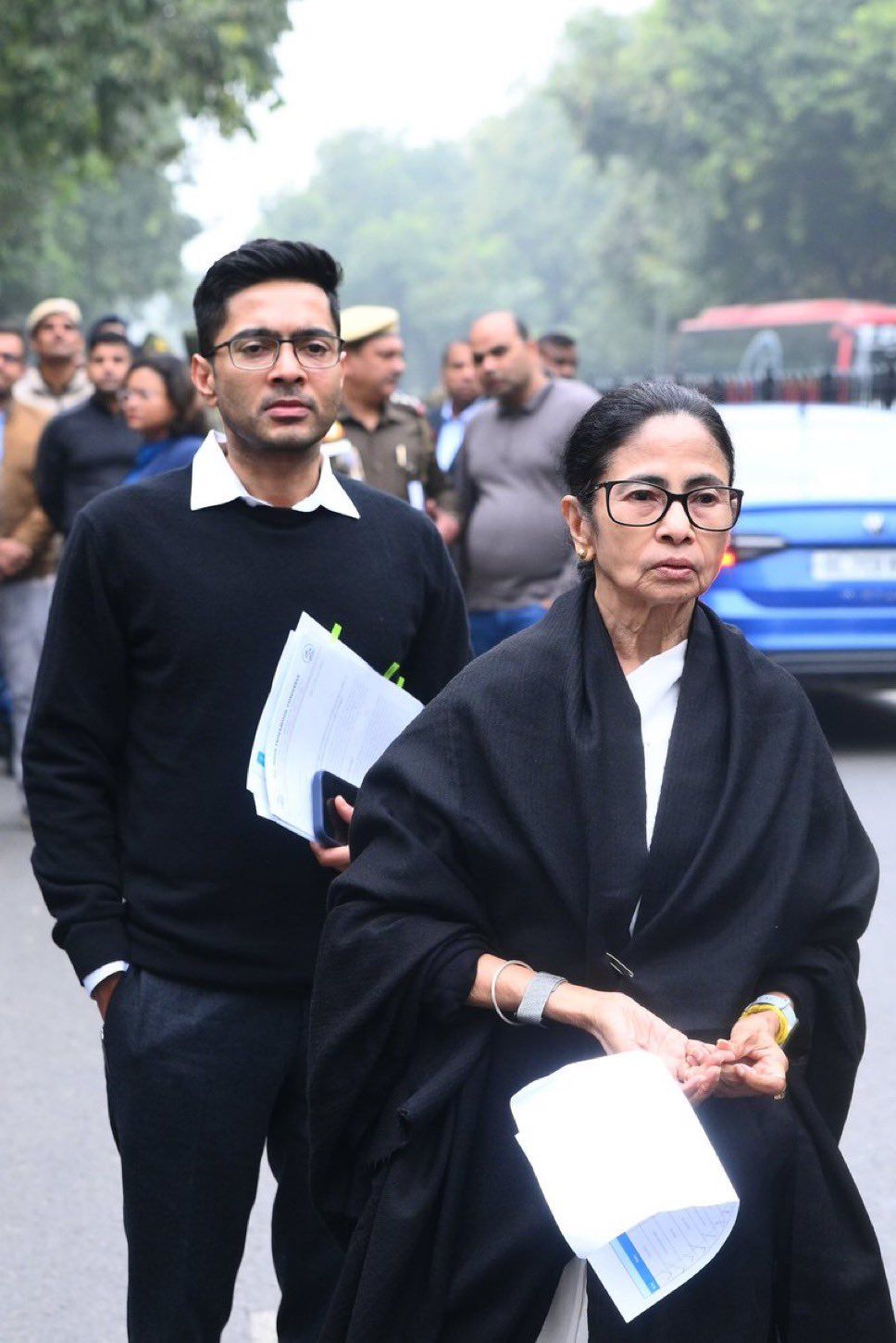
When Mamata Banerjee appeared before the Supreme Court of India to personally plead West Bengal's case over the Special Intensive Revision (SIR) of electoral rolls, it marked an unprecedented moment in post-Independence India.
Chief Ministers have appeared before constitutional courts earlier—always either as litigants represented by counsel or after being summoned by the Court. Never before had a sitting Chief Minister stepped forward as the political executive personally advancing the state's case in this manner. Crucially, the true import of this act lay not merely in its novelty, but in what it signalled about the dispute that brought her to Court.
Her appearance came against the backdrop of an SIR exercise initiated abruptly by the Election Commission of India (ECI)—first in Bihar and then extended to 12 other states. More significantly, the manner in which the SIR unfolded made it a textbook case of putting the cart before the horse, raising serious political and institutional concerns.
In earlier large-scale voter-list revisions, modalities were settled in advance: manpower was organised, door-to-door enumeration carried out, voters were given adequate time to correct anomalies, and the process typically unfolded over several months—often more than a year in large states.
This time, however, as seen in Bihar, West Bengal, and elsewhere, these essentials were absent at launch. Instead, the exercise began first and was refined on the fly. When serious problems were flagged, the ECI largely brushed them aside, even as large numbers of long-standing voters—many of them women—were excluded on dubious grounds.
It also emerged that deletions were not always the result of fresh on-the-ground verification. Political parties alleged that in many cases, enumerators acted on pre-prepared deletion lists circulated by the ECI from Delhi, undermining claims of decentralised verification.
From the outset in Bihar, opposition parties raised substantive objections to the SIR, treating it as a test case of the exercise's design. They argued that a large-scale voter revision, normally spread over many months and often more than a year in large states, had been forced into an unrealistically compressed timeframe, producing widespread errors and exclusions.
For political parties, these features raised early doubts about whether, as they alleged, the exercise was genuinely intended to achieve its stated objective of eliminating illegal migrants from the voter lists.
The fallout in Bihar was chaotic. Around ten per cent of existing voters were reportedly deleted, and opposition parties accused the ECI of engineering an exercise that skewed the electoral field in favour of the Bharatiya Janata Party (BJP), which later formed a government with the JD(U) despite pre-poll assessments suggesting poor prospects. While electoral outcomes depend on multiple variables, the allegation that the SIR altered the playing field remains unresolved.
Without correcting anomalies exposed in Bihar, the ECI extended the SIR to 12 other states—without issuing a comprehensive new manual, publicly detailing procedures, or standardising protocols across states.
In West Bengal, the SIR was marked by frequent changes. Some were benign, such as deadline extensions. Others were deeply problematic, particularly repeated revisions to the criteria used to label voters as "suspicious."
Initially, the logic was simple. Since the last SIR had taken place two decades earlier (2002–2004), those rolls were treated as sacrosanct. Voters only had to show that they or their relatives appeared on the old rolls through a process known as "mapping," without producing citizenship documents.
The ECI then digitised the old and new rolls for software-based verification. By the Commission's own admission, this process suffered from "sporadic errors" during conversion into CSV format. As a result, large numbers of voters were wrongly marked "unmapped" and faced provisional deletion unless they appeared with documents at quasi-judicial hearings.
The first round of checks flagged only about three per cent of voters as suspicious—apparently far below what the Commission anticipated. Midway through the exercise, a second algorithm was introduced, flagging "logical discrepancies" even among voters who had already been successfully mapped, forcing them to re-establish eligibility.
These discrepancies included transliteration differences between Bengali-script rolls from 2002 and English-language rolls of 2025, limits on the number of voters linked to a single ancestor, rigid parent–child age ranges, implausible grandparent age thresholds, and gender-name mismatches. Minor variations—"Bannerjee" versus "Bannerji," or "Fathima" versus "Fatima"—were sufficient to trigger suspicion. Married women who had changed surnames were affected in large numbers. As a result, voters flagged as suspicious in West Bengal alone rose from about 32 lakh to nearly 1.5 crore.
When close to ten per cent of a state's electorate is flagged or deleted—often for trivial clerical reasons—any conscientious election authority would have paused and reassessed the exercise after the Bihar experience.
Two implications demanded scrutiny: whether the 2024 Lok Sabha elections were conducted on defective rolls, and whether similar deletion rates nationwide would imply a serious statistical distortion with consequences for governance and planning.
The ECI ignored these concerns and pressed ahead, reinforcing the impression that the exercise functioned less as an effort to eliminate illegal immigrants than as a mechanism producing large-scale voter exclusion.
Along the way, serious procedural lapses and alleged malpractices surfaced. Yet accountability remained elusive—further insulated by a 2023 law that granted Election Commissioners protection from prosecution for acts undertaken in the course of their duties.
In West Bengal, the human cost became a central political issue. Mamata Banerjee publicly claimed that at least 110 deaths were linked to the SIR, including suicides by Booth Level Agents overwhelmed by the exercise and by citizens who found themselves erased from the rolls. While these links remain allegations rather than judicial findings, several suicide notes explicitly blamed the process and the ECI.
When these issues reached the Supreme Court, the response was widely perceived as inadequate. Fundamental questions—how ten per cent of voters could have fraudulently entered the rolls undetected for decades, how a revision of this scale could proceed without a fool-proof framework, and how an exercise linked by victims to deaths could continue—were never squarely addressed.
Instead, the perception grew that the Court was giving the ECI an untenable long rope. This was evident in the Aadhaar controversy: despite the ECI's claim that "aliens had acquired Aadhaar cards," with only about 130 such cases identified, three oral directions permitting Aadhaar were ignored before written orders followed, by which time the damage was largely done.
Similarly, successive court orders enabled the SIR to continue rather than resolve voter hardship. Even after Mamata Banerjee's appearance, the Court focused on administrative fixes—such as directing West Bengal to deploy more Booth Level Officers—while leaving core issues untouched: lack of standardisation, reckless haste, pressure on poorly trained field staff, and the alleged deaths linked to the process.
Moreover, except for one new member, the present ECI is the same body that conducted the 2024 Lok Sabha elections—elections accepted as valid despite the BJP failing to secure a majority. If those voter rolls were adequate, then the urgency behind the SIR and the Court's acquiescence would inevitably cast aspersions on both institutions.
Against this background, two developments made the subtext of Mamata Banerjee's appearance unmistakable. At a public event attended by the Chief Justice, she appealed to him to "save democracy," explicitly referencing the SIR. She then appeared before the Court and concluded by repeating that appeal, despite her lawyers having already placed the substantive arguments on record.
The message was clear. The battle was no longer primarily about the Election Commission. It was about how the Supreme Court was responding to an unprecedented threat to free and fair elections.
The final arbiter of democracy is not the Election Commission, but the Supreme Court. By appearing in person, Mamata Banerjee was effectively asking: "You have heard the lawyers and failed to act decisively; now that I stand here on behalf of a potentially disenfranchised electorate, will you intervene?"
The SIR was never about removing 130 illegal immigrants. It is a hurried, inconsistent, selectively implemented mass-exclusion exercise, shielded by institutional immunity. The most disturbing reality is not only what the ECI has done, but the growing perception that when the foundations of Indian democracy are under direct strain, the Supreme Court is reluctant to confront the hardest questions.
That is why a Chief Minister did what none had done before her. She ended not with legal technicalities, but with a plea to the Supreme Court of India, the last institution capable of arresting the slide.
"Save democracy" was not a slogan. It was a question about institutional responsibility and judicial response as the Election Commission pressed ahead with the SIR. The moment called for scrutiny rather than deference.
Whether the Supreme Court will rise to that responsibility remains the most urgent question facing the republic.
.jpeg)
 A. J. Philip
.jpg)
.png) Jacob Peenikaparambil
Jacob Peenikaparambil
.jpg)
.png) John Dayal
John Dayal
.jpg)
 Pachu Menon
.jpg)

.png)
.png)
.png) Robert Clements
Robert Clements
.jpg)