

.png) John Dayal
John Dayal
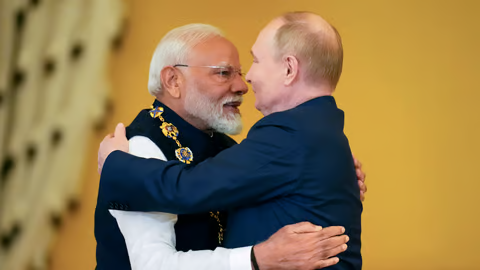
Prime Minister Narendra Modi wore the gold links carrying the medallion of the Order of St Andrews on his chest. It was a proud moment for Mr Modi and for India, for the Order is symbolic of the steady improvement in the relationship between the two countries through the vicissitudes of the end of the Cold War, the implosion of the Soviet Union, and the ongoing blockade America and Europe have imposed protesting the conflict across the Ukraine border.
Mr Modi, who has meditated in caves in the Himalayas and deep in the seas of Dwarka, was possibly never told about St Andrew the Apostle, a fisherman who was called by Jesus Christ in Galilee to be among His first Disciples. Andrew was meted out the same punishment as his Master on an X-shaped cross. He is revered in Russia and is a Patron Saint of the Orthodox Church, which, after being nearly underground during communist rule, is now very close to the ruling dispensation.
But if he thought he was the first international recipient, he was wrong. Before him, Xi Jinping of China had been vested with that honour. If Mr Modi was honoured with an official guard of honour, Mr Xi earlier in the year was given a reception in Moscow that the Tsars of old would have given to a potentate with whom they sought to cement a defence and economic alliance.
Such, indeed, was the case in the Putin-Xi bonding. Moscow is seeking both economic reassurance from the well-off China and a stronger military relationship than it was at the height of the Cold War. Moscow needs this reassurance to keep its brave face in the West, staying out in Ukraine to keep the NATO military formation as far from tis border as possible in these days of high-tech warfare.
But the moment Mr Modi embraced Mr Putin, there was a sharp cry of horror from the Ukraine president, Volodymyr Zelenskyy, in Kyiv. "You are embracing a murderer," shouted Mr Zelenskyy in print and on social media.
Then there was another gasp from another quarter when Mr Modi said – after the embrace –"Whether it is war, conflicts, or terror attacks, everyone who believes in humanity is pained when there is loss of lives. But when innocent children are killed, when we see innocent children dying, it is heart-wrenching, and that pain is immense."
His domestic critics in Parliament and in public forums have said Mr Narendra Modi happily accepts honours named after Christian Saints, embraces the Pope in Rome, and invites Cardinals for high tea at his residence but remains blind to the persecution by Sangh activists and local officials, of Christian Pastors and worshippers in the country, especially in North India. He remains cold to the 15-month-old ethnic and communal calamity in Manipur.
While India continues to be one of the biggest purchasers of sophisticated weapons and other war machine technology, in recent years, it has hardly remained an honest broker in peacekeeping internationally, as it was perhaps until 2014, the year the Modi era began.
For one thing, the killing of 7,000 children in Gaza, of the total of 37,000 or more Palestinians and some 300 Israeli soldiers killed, did not elicit a similar pained cry from Mr Modi or the Indian Ministry of External Affairs.
India also could not deny the Palestinian reproach that it was supplying ammunition and arms to Israeli combatants engaged in genocide in Gaza. India does send small arms and ammunition to Israel and buys large amounts of sophisticated armed, long-distance unmanned airborne weaponry, very expensive surveillance hardware and technology, some of which it uses against the domestic intelligentsia, reporters and civil activists., and others.
This year, there has been a major controversy in the number of Indians who have been pressed into joining war efforts in Israel and Russia. In Russia, the Indians said they had come on contract for other work but were forced into a mercenary category by being used as combatants. A few have been killed on the Ukraine front.
Russian Deputy Chief of Mission in New Delhi, Roman Babushkin, said, "Let us be very clear. We have never wanted Indians to be part of the Russian Army. You would never see any announcement by Russian authorities on this." He said that most of the Indians were recruited under a commercial framework as they wanted to "make money."
On the other hand, Israel had indeed advertised in India through several agencies. It was said the response in job-starved India was tremendous.
One was also killed in Israel's war in Gaza. A few hundred have gone there on high-paid contracts to replace Israelis who have been told to join the Israeli Defence Forces, its pseudonym for the armed forces.
Once respected in major world capitals on both sides of the political and development divide, India has shrunk its height in the comity of the southern, developing world in its urgency to be called a Viswa Guru, a world leader in economic growth and other indices.
Mr Modi's zeal in strutting on the international stage, including such dubious forums as the World Economic Forum, and his urge to embrace every male world leader he can have played no small role in his eroded stature in the eyes of capitals of developed and developing nations and international economic and political institutions.
This is in sharp contrast to China's rising reputation as a technological and economic hub in Asia and the world despite American efforts to bully it and surround it with structures helmed by the United States.
More correctly, in the last ten years, India has drifted deep into the embrace of the US and its geopolitically strategic allies. Mr Modi has taken India into the US-initiated Quadrilateral Security Dialogue (Quad), grouping it with Japan, Australia and India against China in the South China Sea and the Indian and Pacific Oceans.
India continues to have military and political ties with Russia, continuing from its relationship with the now-gone Soviet Union, which helped it modernise its Army, Air Force and Navy when the US had out an embargo against India during the 1971 war with Pakistan for the liberation of Bangladesh.
Military ties remain not in tactical treaties on protection during wars but in the supply of spare parts and ammunition for the Army's heavy tanks, guns, and ammunition, other than spare parts for warplanes.
Equally important was the Soviet-Russian help in introducing India to nuclear-powered submarines for underwater warfare. They were on lease, but this helped the defence navy take a strategic leap. Russia now imports some arms and ammunition from India.
Russia is also dependent on India, one of its biggest oil markets and a trading partner for many other goods it can no longer obtain from the West.
A fallout of the love for the US-Israel lobby, of which countries like Saudi Arabia and Jordan are occasionally seen as part, is India's near-total eclipse as a friendly persuader in the West Asian and North African countries.
The Modi years have brought about the worst decline in our neighbourly relations in South Asia. Mr Modi needs to maintain a hostile stance towards China and Pakistan to continuously nurture his political vote bank with a large chunk of the majority population. An Islamophobic stance in which
Pakistan plays a major role, and now the tiny Maldives, has segued very neatly into the hyper-Hindu Rashtra discourse, which is the undertow in his political slogans.
Under Mr Modi, defence allocation has gone up substantially. In increasing the defence budget, the prime minister has also been instrumental in roping many of his top business friends from Gujarat, including Mr Adani and Mr Ambani, into the defence manufacturing sector. They have emerged as big players in the defence industry without any prior experience in this advanced technological field. Many of these industrialists were a permanent fixture in Mr Modi's many trips to the US and Western capitals.
Union Finance Minister Mrs Nirmala Sitharaman disclosed a staggering Rs 6.21 lakh crore allocation for the Defence Ministry in the Interim Budget presentation in February this year before the nation went into the general elections for a new parliament.
The US is a critical defence partner for India. Though some of its advanced fighter jets have gone to Pakistan, India recently acquired 31 MQ-9B Sea Guardian drones from America to enhance its surveillance and reconnaissance capabilities. India also procured Apache attack helicopters, Chinook heavy-lift helicopters, and P-8I Poseidon maritime surveillance aircraft.
Israel continues to be a close and warm friend. Its recent contribution is the Barak-8 missile defence system, jointly developed by Israel Aerospace Industries and India's Defence Research and Development Organisation (DRDO).
The purchase of the 36 Rafale fighter jets has significantly enhanced India's air capabilities at higher costs than earlier negotiated. This is a major issue flagged by the Leader of the Opposition, Mr Rahul Gandhi, and others during the election campaigns. France is listed as selling Scorpène-class submarines.
The UK, a traditional partner, is discussing co-developing next-generation fighter aircraft in addition to Hawk advanced jet trainers.
Germany, too, will have a major role in advancing India's military equipment production. The India-Germany High Defence Committee (HDC) meeting in Berlin in February 2024 discussed a range of bilateral security and defence issues, focusing on developing defence cooperation as a key pillar of the Strategic Partnership between India and Germany.
Crazily enough, though official defence imports from China are minimal due to strategic rivalry and border tensions, Chinese electronics continue to be an essential part of all military and civil automobile equipment, irrespective of tonnage.
.png) Cedric Prakash
Cedric Prakash
.JPG)
 A. J. Philip
.png) Jacob Peenikaparambil
Jacob Peenikaparambil
.jpg) John Dayal
John Dayal
.jpg)
 Pachu Menon
.png)
.png)
.png) Robert Clements
Robert Clements