

.jpg) F. M. Britto
F. M. Britto
.jpg)
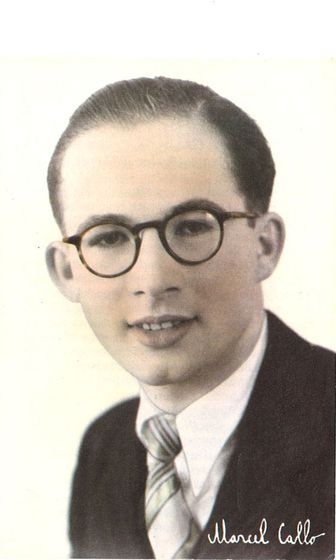
Marcel Callo was born in a farmer’s family on Dec 6, 1921 as the second of nine children. Leaving the meagre acres of land in Brittany, his father got employed in a chemical factory in Rennes city, France. Marcel Callo helped in household chores and took care of his younger siblings.
From childhood, he was a leader, a perfectionist, enjoyed games and fun. While in the school, he became a Scout and an altar server. To help out his family, the 12 year old Callo worked as an apprentice in a printing store; but he did not like the vulgar jokes of his senior fellow workers. And they ridiculed him as a “Jesus freak”. The 14 year old boy then joined the Young Christian Workers, who were called “Jocists” (JOC). Since it was action-oriented, he liked it. His natural leadership qualities began to shine. Like a normal youth, Callo enjoyed organising sports, trips, movies and dance parties at the JOC centre.
Here he met Marguerite Derniaux. Falling in love with her, the 20 year old Callo got engaged to her. But they enacted a strict spiritual life between them by saying the same prayers every day. But they never got married.
During the World War II, the Germans invaded France. His city was bombarded. Callo helped clean the rubble in his city. With his friends he visited regularly the railway station to assist the refugees fleeing from Eastern Europe due to the Nazi invasion. They helped many escape the Nazis by giving them their Red Cross armbands.
Identified as a Jocist, which the Nazis perceived as a secret order, they arrested him. When the 21 years old Callo left home on March 19, 1944, he told his family, “I am leaving, not as a worker, but as a missionary in the service of my companions.” He was taken to Germany and enrolled to serve the war.
Callo was made to work in a factory that produced firearms, which were used against his countrymen. He suffered depression for a few months. Revived by his prayers, Callo began to care for his deported companions. Here he organised the Christian workers. Once again he became their leader. And he continued to raise his companions’ spirits and urged them to pray with trust.
His religious activism came to be known to the Nazis. Condemning, “You are too much of a Catholic,” the court banished him to the concentration camp in Austria on Oct 7, 1944. Here Callo was forced daily rigorous labour of 12 hours, seven days a week, with little food or water and was also abused and beaten. After contracting tuberculosis, fever and dysentery, the 23 years old Callo died on March 19, 1945. Pope John Paul II beatified him on Oct 4, 1987. Marcel Callo has become the patron of young workers, prisoners and those affected by depression.
“The Christian should be first into the field against what is wrong – including man’s inhumanity to man.” – Francis A. Schaeffer.
.jpg) Stanislaus Alla
Stanislaus Alla
.jpg)
.png) Cedric Prakash
Cedric Prakash
.jpg) Elsa Lycias Joel
Elsa Lycias Joel
.jpg)
 A. J. Philip

.png) Jacob Peenikaparambil
Jacob Peenikaparambil
.jpg)
.png) John Dayal
John Dayal
.jpg)
.jpg)
.png) Joseph Maliakan
Joseph Maliakan
.png)
.png) Robert Clements
Robert Clements
.jpg) Cedric Prakash
Cedric Prakash