

.png) Jacob Peenikaparambil
Jacob Peenikaparambil
.jpg)
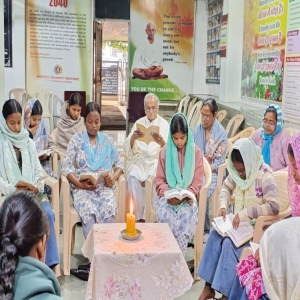
"I have attended many training programmes at different centres, but the USM training is totally different from all the others. At USM, I experienced the practice of unity in diversity because people belonging to different religions and cultures live and work together as one family for a common mission. There is absolutely no discrimination on the basis of religion or caste. Everyone experiences dignity and love at USM," said Sr. Madhura Tirkey of the Ursuline Congregation, at the conclusion of the one-week leadership training at USM held from November 22 to 28, 2025.
Sr. Madhura has accompanied groups of 25 to 30 students for leadership training at USM eight times over eight years. She not only travels with the students from Gumla to Indore but also attends every session with them and guides them with their project assignments.
Bringing a group of 25 to 30 girls from Gumla to Indore is an arduous task. First, they travel by bus from Gumla to Ranchi, then by train from Ranchi to Bilaspur, and after waiting for six hours at Bilaspur, they catch another train to Indore.
In 2023, the group could not travel from Bilaspur to Indore because the train from Ranchi was delayed for more than six hours. They were forced to continue the journey by bus. Unfortunately, the same bitter experience occurred on their return journey. Due to the extraordinary delay of the Indore-Bilaspur train, they missed the Bilaspur-Ranchi train and had to travel by bus again. In addition to financial losses, Sr. Madhura had to endure significant mental strain.
When asked how she manages to take such a risk in bringing girls from such a long distance, she said, "By undergoing crises, we can bring out the strength within us. Facing tough situations increases our faith in God." She further added, "From USM, I learned the difference between spirituality and religiosity, and between being a devotee of Christ and a disciple of Christ by practising the core values taught by Jesus. A disciple of Christ has the capacity to face adverse situations".
Regarding the changes she has observed in students after undergoing USM leadership training, she shared: "They become more disciplined, more focused on their studies, and clearer about what they want to become in life because of learning about vision formulation. They mingle easily with others and learn to respect all religions."
One important reason for bringing girls to USM for leadership training, according to her, is to develop genuine leaders from among the Adivasis. "I want to empower our girls so that they become lights in the tribal communities. Tribals are being deprived of their resources—land, forest and water. I want these girls to provide leadership in the struggles of the Adivasis to safeguard their rights." She added, "I have observed that as a result of the training, their self-confidence increases and they are able to express their views boldly in front of others."
Regarding the training methodology, she appreciated the screening of movies that portray socio-political and economic issues. "By watching the movies, students become aware of the injustices in society and are motivated to counter them through non-violent means. They also learn about their rights and duties." According to her, showing the Gandhi movie is very important because students nowadays rarely have the opportunity to learn about Mahatma Gandhi.
When asked about the views of students who have not yet attended USM training but observe those who have, she said they, too, have noticed many positive changes in the participants—improved concentration in studies, reduced food waste, and respect for everyone without discrimination. In fact, the majority of the girls who joined the November 2025 training said during their self-introduction that they were motivated to participate after witnessing positive changes in their seniors who had undergone USM training.
Sr. Madhura also spoke about the follow-up after the leadership training. On returning to school, all participants share their experiences with other students during the school assembly. She motivates the girls to write a brief reflection summarising their experiences and lessons from the train journey back home.
At the end of the leadership training, each group prepares an action plan to be implemented over the next year. This plan is presented at the USM graduation ceremony. According to the action plan prepared by the group trained from November 21 to 28, they will form a Peace Club in the school. The club will conduct monthly meetings to review the implementation of the action plan. Members will also collect money saved through small sacrifices and use the amount to support needy individuals.
In her interview, Sr. Madhura shared that parents, too, have observed many positive changes in their children after USM training. They express their observations at parents' meetings, which inspires other parents to send their children for training as well. Some parents give their children's names as early as July, at the beginning of the academic year.
Most of the parents are small or marginal farmers, yet they willingly spend ?10,000 per child on leadership training because of the positive impact they witness.
The school's principal, Sr. Hirmina Lakra, is equally committed to sending a group of students to USM for leadership training each year, and Sr. Madhura takes full responsibility for accompanying them. This year, Sr. Kiran also joined her.
When educators truly understand education as a holistic process, they do not limit it to classroom learning alone. Exposure is an essential source of learning, and developing leadership skills and values is a significant function of education. The world today urgently needs leaders with a broad, inclusive vision, integrity, justice, compassion, and a commitment to the environment. Such leaders are mainly formed through education. Sr. Madhura, Sr. Hirmina, and Sr. Kiran are teachers who understand the true meaning of education and are willing to endure any hardship and risk to provide holistic, humane education to their students.
.jpg)
.png) Cedric Prakash
Cedric Prakash
.jpg) Elsa Lycias Joel
Elsa Lycias Joel
.jpg)
 A. J. Philip
 Jacob Peenikaparambil
.jpg)
.png) John Dayal
John Dayal
.jpg)
.jpg)
.png) Joseph Maliakan
Joseph Maliakan
.png)
.png) Robert Clements
Robert Clements
.jpg) Cedric Prakash
Cedric Prakash
 ICPA
ICPA