

.png) Dr Suresh Mathew
Dr Suresh Mathew
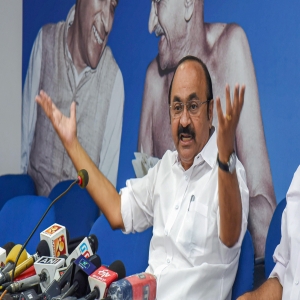
In an era when faith is often kept carefully outside the public square, VD Satheesan, Leader of the Opposition in the Kerala Legislative Assembly, speaks of the Bible with an ease that is neither performative nor political. For him, Scripture is not a slogan or a citation used for effect, but a lifelong companion that has quietly shaped his conscience, his language and his understanding of leadership.
Satheesan's engagement with the Bible began early, rooted in a disciplined habit of reading. What started as a routine of following newspapers and books gradually deepened into a sustained reading of Scripture during his formative years. Over time, the Bible became more than a religious text; it emerged as a moral framework through which he learned to interpret life, society and power. He has often remarked that the Bible's enduring relevance lies in its ability to speak across centuries to the human condition—about justice and mercy, authority and humility, suffering and hope.
This relationship with the Word occasionally finds ex
For Satheesan, the Bible's power lies not only in personal inspiration but in its formative influence on culture and civilisation. He has spoken of Scripture as a text that shaped ideas of human dignity, moral responsibility, and community life—values that continue to inform democratic practice. In this sense, his faith does not withdraw him from public engagement; it draws him deeper into it, demanding accountability to principles larger than political expediency.
Within Christian circles, particularly among Catholic and ecumenical audiences, Satheesan is often noted for his familiarity with Scripture. Church leaders and youth forums have acknowledged his ability to interpret biblical passages with clarity and relevance, connecting ancient texts to contemporary social realities. His reflections resonate because they are grounded not in theological abstraction but in lived experience—of governance, opposition, loss, and perseverance.
Yet, Satheesan is careful not to reduce faith to rhetoric. He frequently emphasises that the Bible calls believers to action: to stand with the marginalised, to speak truth to power, and to place the common good above personal gain. In his view, Scripture challenges both the believer and the leader, unsettling complacency and reminding them that authority is always a form of stewardship.
For a Catholic readership, Satheesan's journey offers a compelling witness to how faith can inhabit public life without domination or dilution. His engagement with the Bible reflects a tradition familiar to the Church itself—where Scripture is read not only for private devotion but as a lens through which society is examined and renewed. In a political climate often marked by polarisation and cynicism, his quiet confidence in the power of the Word stands out.
VD Satheesan does not present himself as a political preacher. Instead, he embodies something more understated and perhaps more enduring: a public servant who allows the Bible to shape his moral imagination. In doing so, he reminds both the Church and the broader society that the Word, when read deeply and lived honestly, still has the power to illuminate public life.
.jpg)
.png) Cedric Prakash
Cedric Prakash
 ICPA
ICPA
 ICPA
ICPA
 ICPA
ICPA
 ICPA
ICPA
 ICPA
ICPA
 ICPA
ICPA
.jpg)
 A. J. Philip
.jpg)
.png) Jacob Peenikaparambil
Jacob Peenikaparambil
.jpg)
.png) John Dayal
John Dayal