

 A. J. Philip
I was the secretary of St. Thomas Mar Thoma Church, Karol Bagh, New Delhi, when I invited the late Fr. John Vallamattom, founder of "Indian Currents", to give a speech on December 6, 1992. In his speech, the priest, who was once the principal of a leading college in Kerala, expressed hope that the rule of law would prevail at all times in the country. He mentioned the undertaking UP Chief Minister Kalyan Singh had given to the Supreme Court that no harm would come to the Babri Masjid, reinforcing his hope.
After the lunch that followed, I readied myself to drop him wherever he wanted to go, but he preferred to return by a DTC bus, his usual mode of transport. As we were waiting at the bus stop, people around us were discussing the demolition of the Masjid that had begun in distant Ayodhya. There was no way I could confirm the incident, as mobile phones were just a fantasy at that time.
Fr. Vallamattom could not believe that his hope had been shattered to smithereens by a large lumpen crowd as he took leave of me and boarded a bus. I wanted to reach home to check the veracity of the rumour I had heard. Just as I entered my flat at B-2, Pusa Road, the phone rang. At the other end was my editor, Shri HK Dua, who wanted to convey the news and asked me to come to the office at 4 pm when he would also arrive. He began writing.
I read the manuscript and corrected the proofs before the editor cleared it for Page 1 as a signed editorial. I knew that he was anti-Congress and close to BJP leader AB Vajpayee, whom he had once given a lift on his two-wheeler. Headlined "National Shame," it was the strongest and most unambiguous editorial. It was much discussed and quoted. A few days later, he met BJP leader LK Advani at a social gathering, where the latter expressed his disappointment with him, of course, not in so many words.
I saw the editorial as an atonement for what "HT" had done earlier, when it sent a reporter with a flair for writing and a photographer to extensively cover the enthusiasm of the faithful when the district court allowed worship inside the mosque, where an idol of Ram Lalla had allegedly appeared on its own in December 1949.
Many decades later, the Supreme Court's verdict confirmed what most sensible people believed—that the idol had been surreptitiously placed there with the knowledge and concurrence of the district magistrate, KK Nayar, a Malayali whom the Sangh Parivar rewarded with a seat in Parliament.
I had wanted to visit Ayodhya, the capital of Kosala, ever since I reviewed Ramacharitamanas, translated into English and Hindi in poetic form, along with the original written by Tulsidas in Awadhi. The author, Prof Ramachandra Prasad Sinha, had agreed to guide me for a PhD from Patna University. For once, I realised why the "Ramayana" became so popular in the North.
To be frank, I did not enjoy reading Thunchath Ezhuthachan's "Adyatma Ramayanam" as much. As my friend and poet, Prof M Chandrasekharan Nair, told me, if I had read the "Sundara Kandam" a few times, my pronunciation of Malayalam would have considerably improved. The poet liberally uses tough-to-pronounce words. If one can read them fluently, one can handle any tongue-twisting words.
Four years ago, when I quit the post of Manager of a school, I had to surrender the office laptop, leaving me without a computer. The principal and teachers wanted to gift me a MacBook, my favourite brand. I did not want such an expensive gift. Instead, I asked them to gift me a copy of "Sunrise Over Ayodhya: Nationhood in Our Times" by Salman Khurshid, autographed by all the staff. My son voluntarily came forward to gift me both a car and a MacBook Air.
On November 9, 2019, when the Supreme Court pronounced its verdict clearing the way for a temple at the disputed site, I was keenly following the developments. When the unanimous verdict was uploaded online, I downloaded it instantly to read it word by word. I found that the site was given to the Hindus while upholding the Muslim stance.
The judgment carefully balanced principles of law with the inevitable question of equity, bringing a sense of closure to a dispute that threatened to rupture India's unique social unity. I was unable to visit the Masjid, though I had always wanted to. Nevertheless, I continued to stay updated about the construction of the temple.
When Prime Minister Narendra Modi donned the robes of a Hindu priest and led the Pran Pratishtha ceremony at Ayodhya, I received an invitation card featuring a picture of Ram holding a bow and arrow. I decided to visit the place another time. Shankaracharyas and other learned men questioned the consecration of an incomplete temple. I thought only the finishing touches were needed.
When friends Ravindran, an agnostic, and his wife Sarada, a believer, agreed to join my grandson Yohaan, my wife, and me on a visit to Ayodhya, my dream came true. The flight from Delhi was full. Most of the passengers were from Gujarat. I was fascinated by a yellow-clad, clean-shaven, handsome guru who looked like Prem Nazir and sported long, jet-black hair. He held the latest iPhone. I saw people taking selfies with him, and he readily obliged.
It was a one-hour flight. Tired of eating the tasteless, sugar-free biscuits my wife kept supplying, I went to sleep. I was suddenly woken up by a bhajan that the Gujarat group began singing as if the aircraft had turned into a Bhajan Mandali. A baby, sleeping on her mother's lap, was so rudely woken that she began to cry. However, her cries were drowned out by the cacophony of "Jai Shri Ram" shouts and singing.
When a person is in love, he sees his beloved as the most beautiful, like an apsara. He overlooks all her blemishes. When the plane landed at the newly built Maharshi Valmiki International Airport, and we stepped into the Arrival area, I overheard two passengers praising the airport. Except for the temple-like façade, it looked indistinguishable from any other airport in small-town India. But like the lover, they found it magnificent.
A large mural depicting major events from Valmiki's epic was difficult to photograph due to some junk material placed below it. Otherwise, it would have been an excellent selfie point. I was astonished to see that the airport had a special counter selling products of the India Tobacco Company, once known as the Imperial Tobacco Company. Adjacent to the kiosk was a smoking room. I wondered why there weren't kiosks for "paan," "gutka," "khaini," and other tobacco and intoxicating products.
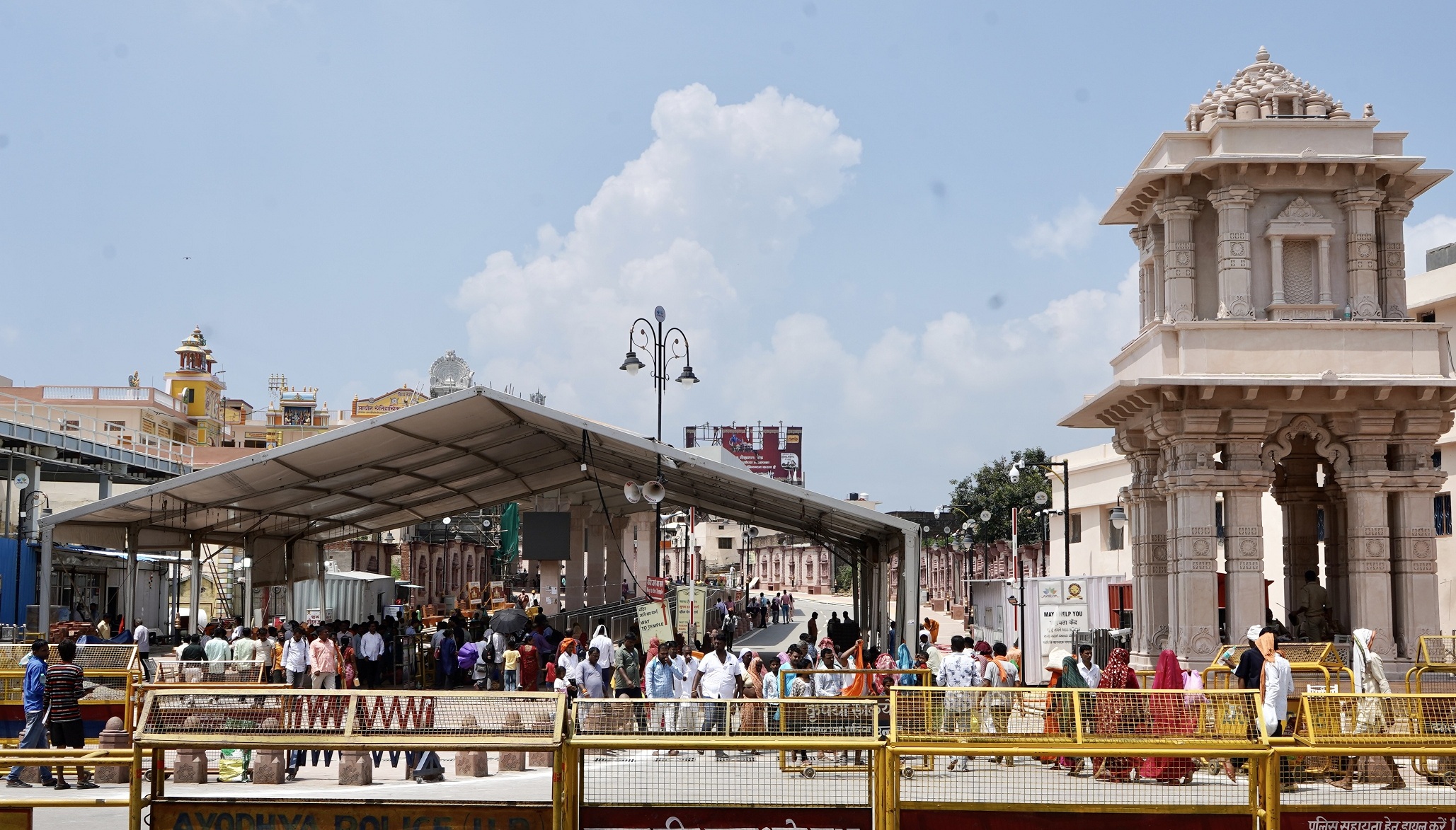
A short drive took us to Hotel Radisson, where we were booked for two nights and three days. After a quick lunch, we left for the Ram temple. I had taken an extra-wide angle lens to capture the temple in all its glory. Only when we started did we realise that the temple was half an hour's drive from the hotel. The driver warned us that we might be dropped at a point where the police had erected a barricade.
Fortunately, the police allowed the vehicle to cross the barricade, and we were dropped at the huge temple gates, still under construction. I was shocked to learn that no cameras, including mobile phones, were allowed inside. This was the same temple where three to four dozen Doordarshan camera units had functioned when Modi sat before the holy fire and followed the priests' instructions.
The aversion to cameras is not new. I remember the late Chandan Mitra, who had gone to Ayodhya to report the demolition, telling us that the cameramen deserved the bashing they received. He went on to found a newspaper and become a Rajya Sabha member.
Have you ever seen pictures of the Babri Masjid being demolished in various stages or how the area was flattened? No cameraman was there to record it. They were all bashed up and driven out by the Karsevaks. Mobile phones did not exist then.
There were four lines, two for entry and two for exit, barricaded on both sides by stainless steel bars. One could only move forward. Most of the people in the queue were women from nearby villages. They moved quietly while young men and women, dressed in special saffron clothes, shouted "Jai Shri Ram" slogans. In North India, Hindus used to greet each other with "Ram Ram." Another form of greeting was "Siya Ram," which included Sita. It was the BJP that valorised this simple greeting.
A policeman informed us that we could store our personal belongings, including mobile phones and camera, in a locked cabin, with a key provided for our use. The service was free. The man who attended to us could barely speak, as his mouth was full of "khaini," a mixture of tobacco and lime.
There was another counter for depositing footwear. The temple was still a long way from there. It was difficult to walk, as the surface was not properly tiled or cemented. There were sandy patches that made the walk uncomfortable, though I had spent most of my childhood barefoot, except when attending Bharat Scouts parades and camps. Nonetheless, I had no choice but to continue walking.
Suddenly, the temple appeared right before us. A few flights of stairs led to the interior. We did not know why the movement had stopped once we entered a large circular hall. We could hear "Aarti" chanting. When people began shouting "Jai Shri Ram", I caught a glimpse of the Ram idol at a short distance, sculpted by a person who was recently denied a US visa. Light reflected off its luminous eyes. A few seconds later, we were asked to leave. The "Darshan" was over.
I understood why the sanctum sanctorum leaked during the rains—it wasn't waterproofed because another floor was yet to be built. I found it incongruous that just outside the most sacred area, workers were busy drilling the walls and pillars to carve figures from Hindu sacred texts.
I couldn't help but agree with Ravindran when he said that only 25 per cent of the work was done. We didn't realise we were exaggerating until driver Tiwari, an ardent BJP supporter who had visited the temple several times, estimated that not even 10 per cent of the work was completed. I understood why the knowledgeable Hindus hadn't attended the consecration of a temple still under construction.
As we waited outside for the car, we saw a beautiful temple built by the Birlas, just 300 meters from the Ram temple gate. There wasn't a single visitor there.
The next day, we planned to visit Hanumangarhi. Unfortunately, a VIP was in Ayodhya, and the main road was blocked for their convenience. We had to catch an autorickshaw halfway and then walk to the site, which was actually close to the temple gate. We could have visited it the previous day. We walked and walked, only to be told that the Hanuman temple wouldn't open until after 2 pm because of the VIP. We took a few pictures and returned.
We had to walk over 4 kilometres to reach the place where our car was parked. I couldn't help but curse the VIP culture. From there, we went to Faizabad to see the Saryu River, where a distraught Ram took Jal samadhi. There are many temples overlooking the river, which was in spate. A young man who owned a cow wanted me to feed the animal to receive its blessings. He spent quite some time persuading me. I finally gave him 20 rupees, and when he insisted on 10 rupees more, Sarada obliged.
For 30 rupees, we received the blessings of a cow for all the trouble we took to visit Ayodhya. However hard I tried to forget the Babri Masjid, the image of karsevaks demolishing the centuries-old mosque haunted me. Our inquiries revealed there was no progress in constructing the mosque despite the court's order for the allotment of five acres far away from the temple. A study in contrast indeed!
.jpg)
.png) Cedric Prakash
Cedric Prakash
 ICPA
ICPA
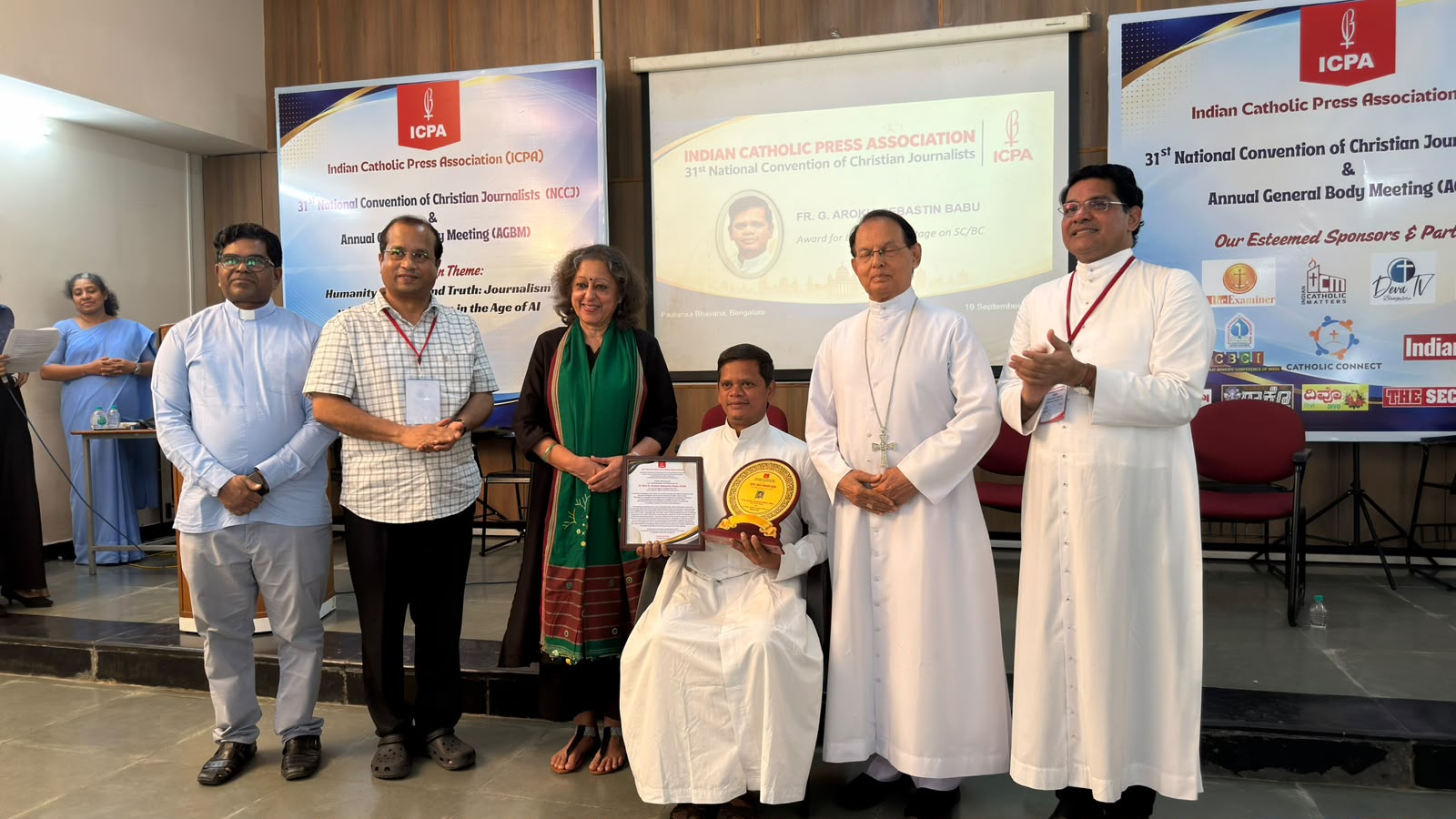 ICPA
ICPA
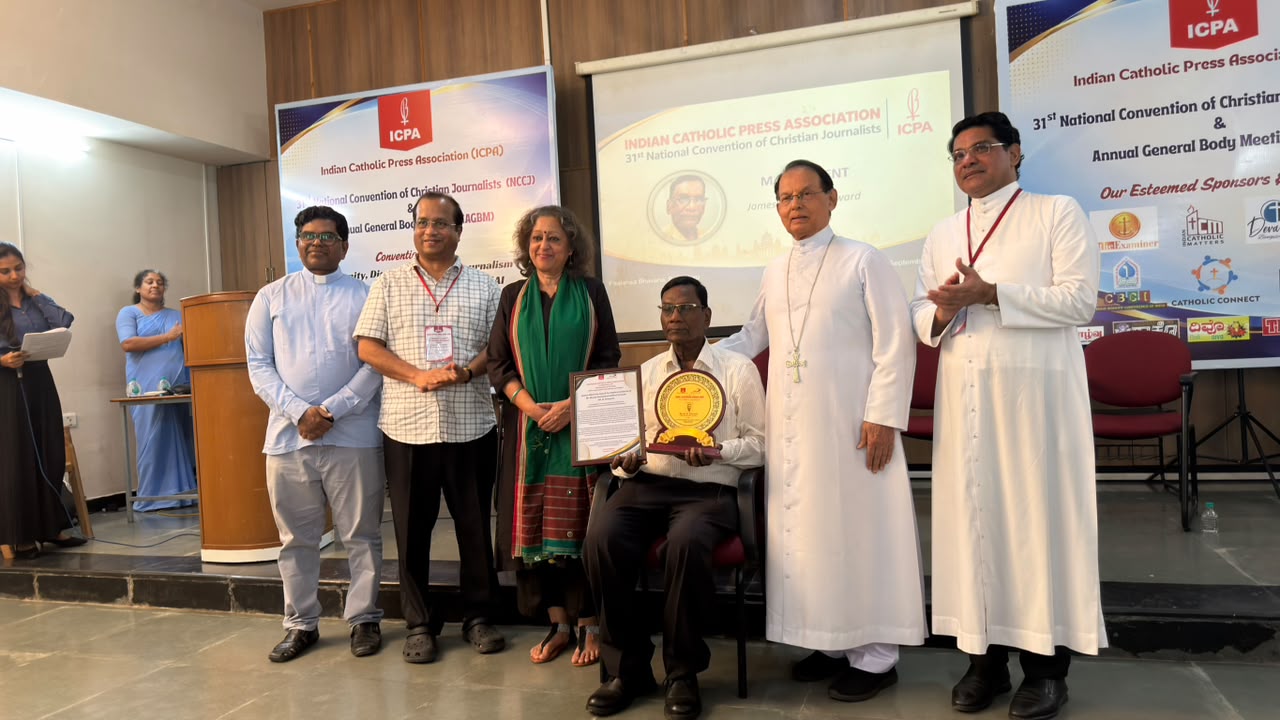 ICPA
ICPA
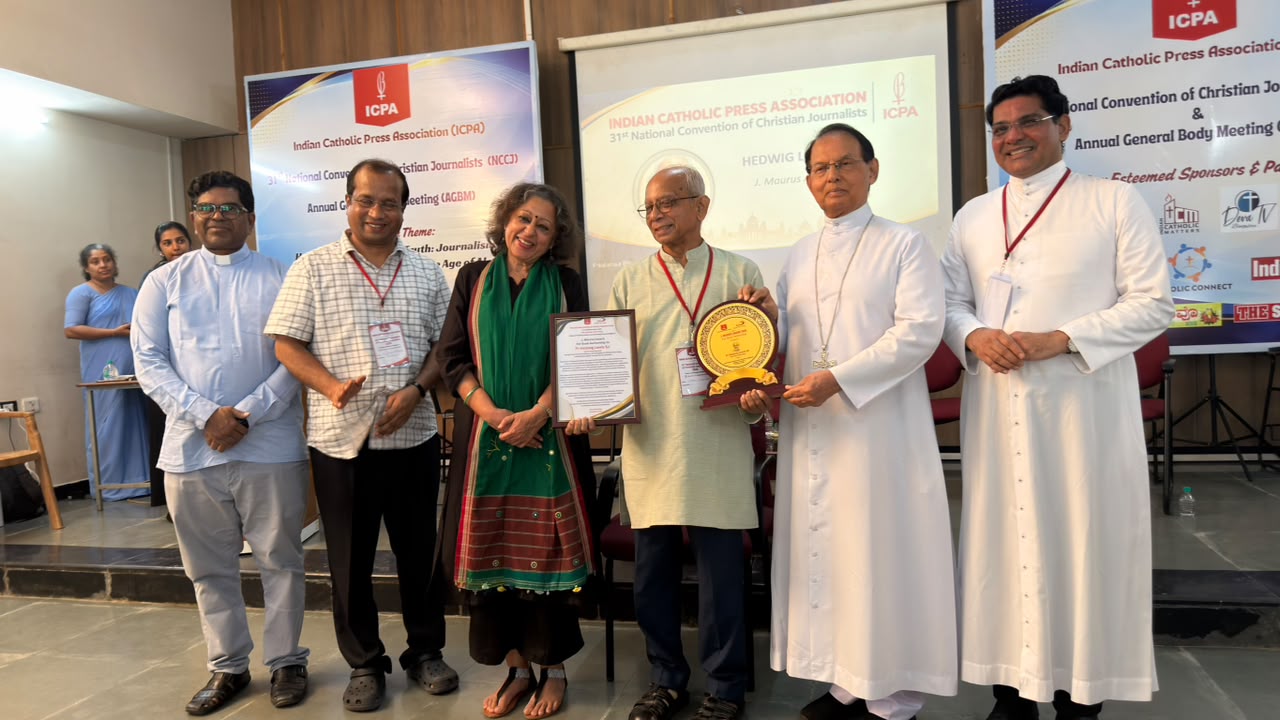 ICPA
ICPA
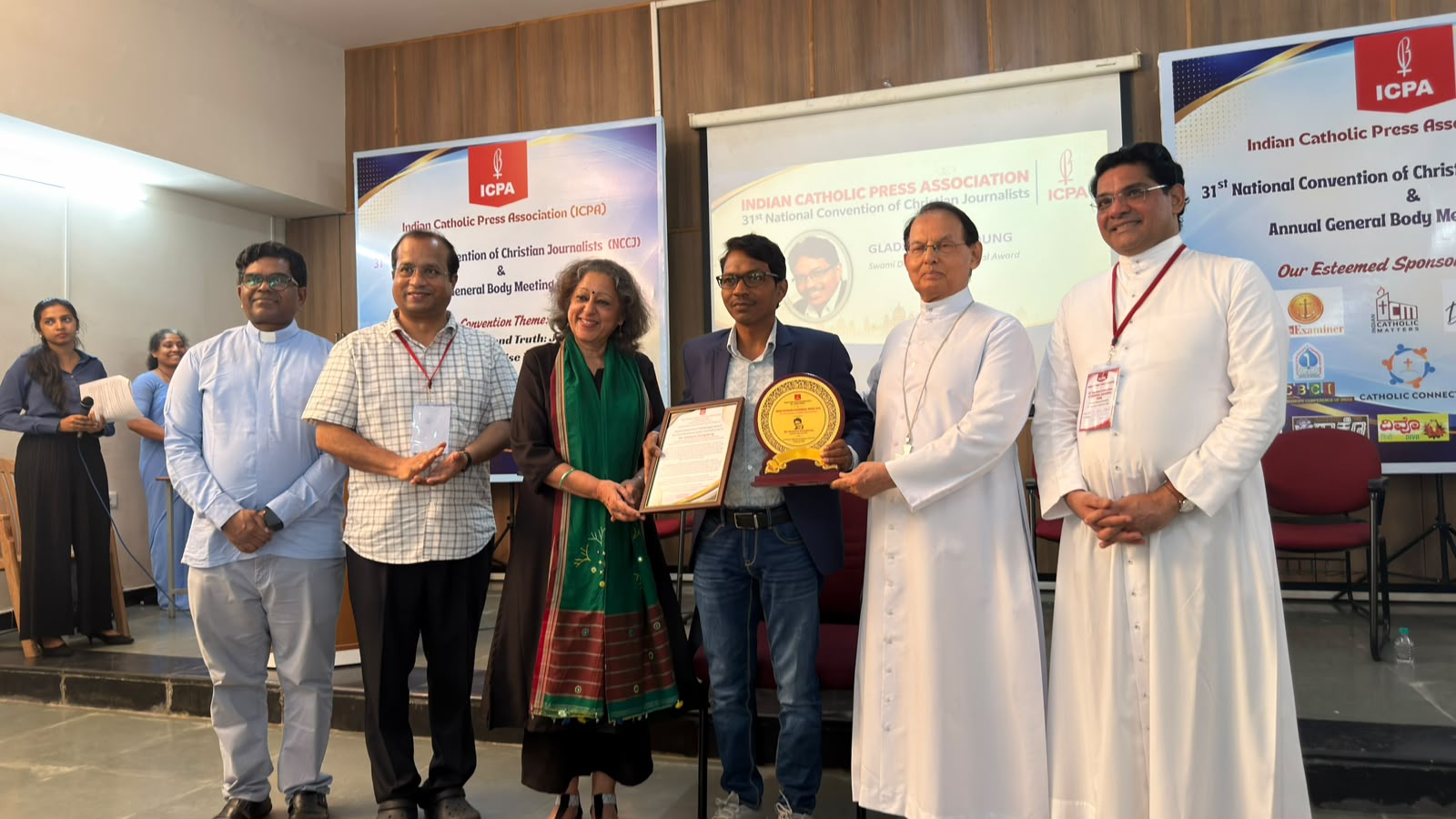 ICPA
ICPA
 ICPA
ICPA
.jpg) A. J. Philip
A. J. Philip
.jpg)
.png) Jacob Peenikaparambil
Jacob Peenikaparambil
.jpg)
.png) John Dayal
John Dayal