

.png) Joseph Jerald SJ
Joseph Jerald SJ
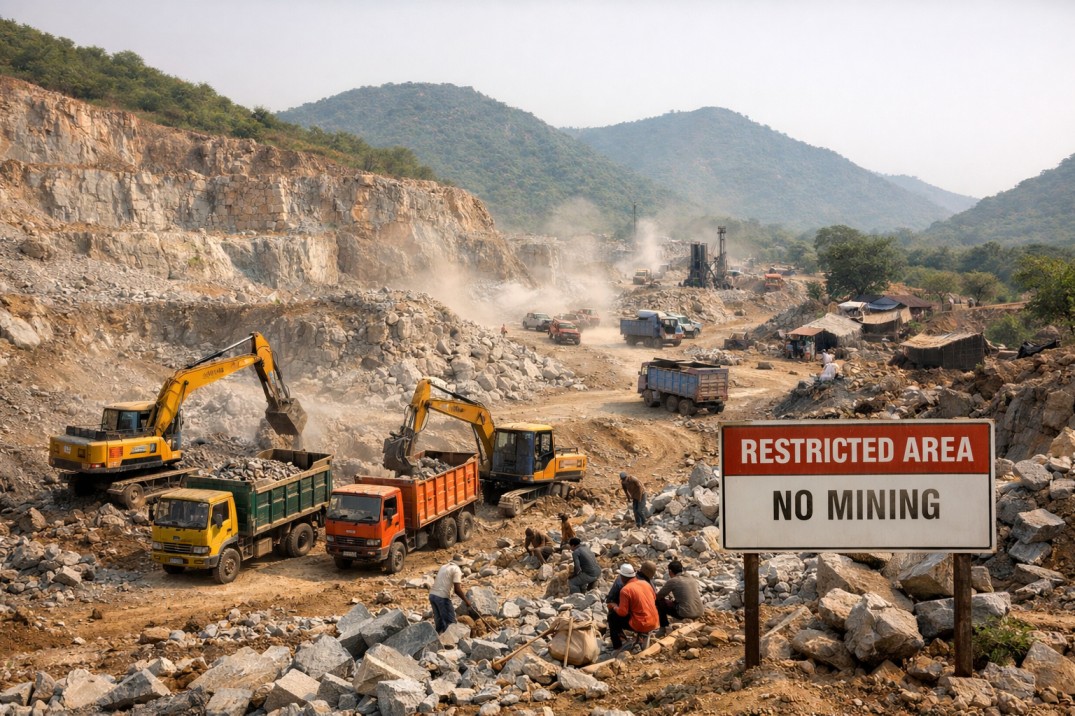
The Aravalli Hills, the oldest fold mountain range in India and among the oldest on Earth, trace their origins to nearly two billion years ago. Once comparable in height to the Himalayas, they now stretch about 700–800 kilometres from Delhi to Gujarat. Often described as the "green lungs of North India," the Aravallis play a vital ecological role—filtering air pollution in the Delhi–NCR, blocking dust from the Thar Desert, slowing desertification, moderating local climate, recharging groundwater (in the lower slope areas), and supporting diverse ecosystems. The range also serves as the source of several important rivers, notably the Sabarmati and the Luni, which sustain wildlife, agriculture, and human settlements in arid and semi-arid regions.
Life on the Slopes: Ecology, Minerals, and Survival
The forests and scrublands of the Aravalli harbour distinctive flora, including Dhok trees that dominate the lower slopes, as well as medicinal species such as Gugal and Salai. These habitats support diverse fauna, including the Indian leopard, striped hyena, elongated tortoise, and Indian rock python. At the same time, the range contains economically significant mineral resources, including zinc, lead, silver, tungsten, copper, and other rare minerals.
Civilisation, Culture, and Continuity
Beyond its ecological and geological importance, the Aravalli range also holds substantial economic, cultural, and historical value. It supports tourism through iconic forts such as Kumbhalgarh and Chittorgarh, renowned temples including Dilwara and Ambaji, and a range of eco-tourism sites, generating livelihoods and revenue in otherwise arid regions. Culturally, the Aravallis are a cradle of ancient civilisation.
Scholarly research further highlights the deep historical significance of the Aravalli range. Studies such as The Spine of Haryana: Ecological and Historical Significance of Aravalli Hills, published in the International Journal of Innovative Science and Research Technology, note that the Tosham hills within the Aravallis host several Indus Valley Civilisation sites. Sacred landscapes such as Mount Abu and Galtaji continue to function as major pilgrimage centres, sustaining spiritual traditions and local economies across generations.
From Legal Protection to Legal Exposure
Besides these long-standing yet often overlooked silent contributions of the Aravalli, the Supreme Court's November 20, 2025, verdict on the Aravalli range has sparked widespread concern and unrest among environmentalists, conservation scientists, and communities that depend directly on the hills for water, livelihoods, and ecological security. The ruling has intensified anxieties over the future of the Aravallis, bringing renewed attention to questions of land use, mining, conservation priorities, and the balance between development and environmental protection in one of India's most fragile and densely populated regions.
Mining, Silence, and the Cost of Inaction
An article, 'Forgotten wildlife of Aravalli hills', in The Tribune, dated June 29, 2019, highlights a series of tragic events on the Gurugram–Mewat Aravalli fringes that expose how habitat loss and water scarcity are driving wildlife into villages, escalating human–animal conflict due to mining and encroachment.
In a statement reported by The Indian Express on December 23, 2025, Union Environment Minister Bhupender Yadav reiterated the government's commitment to conservation, stating that only 0.19 per cent of the Aravalli range would be allowed for "essential mining," with no new leases granted without a detailed scientific assessment. However, environmental experts working on the ground question the adequacy of these assurances.
Neelam Ahluwalia, an environmentalist working across Haryana, Rajasthan, and Gujarat, told The Federal that the concept of "local relief" is arbitrary and unscientific, weakening long-standing legal protections for the Aravallis. Drawing on extensive field observations, she noted widespread licensed and illegal mining, drying rivers, and groundwater depletion reaching depths of 1,000 to 2,000 feet in several areas.
The consequences are stark in Haryana, where two of the state's seven Aravalli districts have been severely degraded by licensed mining. In Charkhi Dadri, only one hill remains protected, while in Bhiwani, most hills have been reduced to rubble—raising concerns that a uniform 100-metre definition could accelerate ecological loss across the Aravalli range.
This pressure is compounded by the rapid expansion of illegal mining. An investigation by The Print reported that Rajasthan has recorded more than 27,000 cases of illegal mining in the Aravalli region since 2020, yet FIR's were registered in only about 11 per cent of these instances, highlighting inaction by the forces.
A Times of India article (December 16, 2025) exposes systematic illegal mining devastating the Aravalli range near Bhilwara, Rajasthan, based on a drone-volumetric survey by whistleblower Pradeep Singh and environmentalist Kishore Kumwat. Drone survey uncovered 57 lakh tonnes of illegal mining across 64 hectares (permitted 11 hectares) near Bhilwara.
When Law Redefines Ecology
Besides rampant mining violations devastating Aravalli wildlife corridors—driving leopards into villages like Mandawar and Lala Kherli, sparking deadly conflicts, road kills, and air pollution from dust—the Supreme Court's November 2025 verdict (now stayed) poses a major new risk by narrowing the hill definition to 100-meter elevation, potentially exposing lower slopes and foothills to quarrying. These "wastelands" are actually life-support systems that recharge groundwater, block Thar desertification, and filter NCR smog. Their loss could fracture habitats for hyenas, tortoises, and dhok forests while worsening water crises. The stay offers breathing room, but without robust enforcement, Aravalli's ecological shield remains perilously thin.
Choosing the Future
The slow destruction of the Aravallis is not a policy accident; it is a choice. A choice to value stone over water, short-term revenue over long-term survival, and silence over science. Hills reduced to legal definitions and labelled "wastelands" are, in reality, the ecological spine holding back desertification, water collapse, and climate extremes for millions. Court stays and official assurances may delay the damage, but they do not stop it. Without public pressure, scientific enforcement, and political accountability, the Aravallis will continue to be mined away—quietly, legally, irreversibly. This is no longer just an environmental issue; it is a test of whether India will protect its future or excavate it.
.jpg)
.png) Cedric Prakash
Cedric Prakash
.jpg) Elsa Lycias Joel
Elsa Lycias Joel
.jpg)
 A. J. Philip

.png) Jacob Peenikaparambil
Jacob Peenikaparambil
.jpg)
.png) John Dayal
John Dayal
.jpg)
.jpg)
.png) Joseph Maliakan
Joseph Maliakan
.png)
.png) Robert Clements
Robert Clements
.jpg) Cedric Prakash
Cedric Prakash
 ICPA
ICPA