

 A. J. Philip
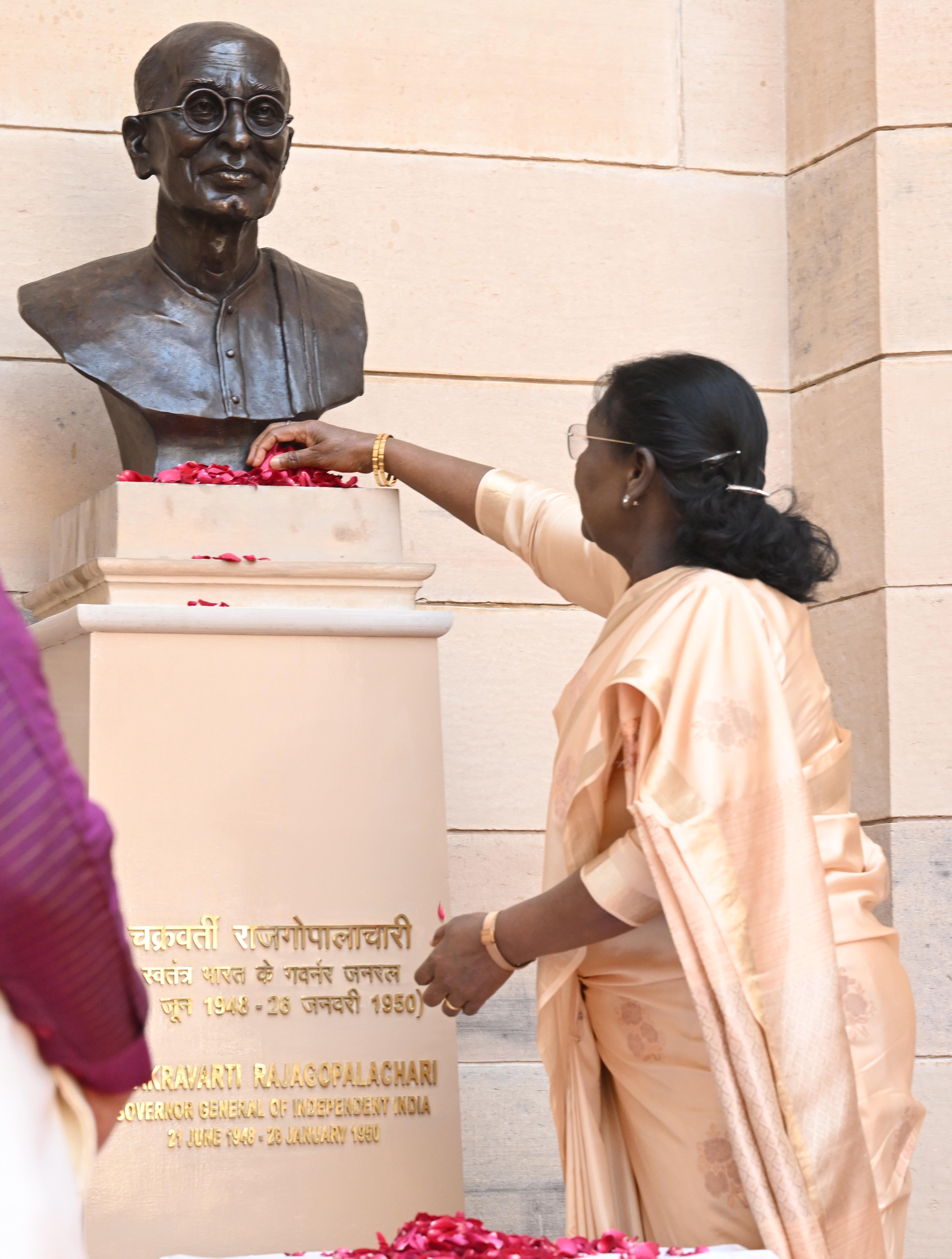
On February 23, 2026, a quiet but symbolically loaded ceremony unfolded within the sprawling precincts of Rashtrapati Bhavan. The last British-era statue was removed from its pedestal. In its place appeared the bust of C Rajagopalachari — Rajaji to admirers — the first and only Indian to serve as Governor-General after Independence. The unveiling, performed by President Droupadi Murmu in the presence of Vice-President CP Radhakrishnan, was presented as another step in India's march toward "decolonising the mind."
The venue itself carries layers of irony. The grand complex, once the Viceroy's House, was designed to embody imperial permanence. Yet its first Indian occupant was Rajaji himself, who took office in 1948 as the last Governor-General. The position was abolished when India became a republic on January 26, 1950, replacing the Crown's representative with an elected President under a sovereign Constitution. Since then, the 340-room complex — more imposing in scale than the White House — has been the official residence of India's Head of State.
A message from Prime Minister Narendra Modi read at the ceremony framed the moment as part of a larger civilisational project: "Every act that frees our nation from a colonial approach economically, culturally, and mentally is a tribute to leaders like Rajaji." He reiterated his government's preference for nomenclature drawn from "civilisational vocabulary," citing the renaming of Durbar Hall as Gantantra Mandap, Ashok Hall as Ashoka Mandap, and Mughal Gardens as Amrit Udyan.
Not everyone applauded. Matt Ridley, great-grandson of architect Edwin Lutyens, expressed sadness on seeing his ancestor's name removed from the pedestal. Posting a photograph of himself beside the statue, he lamented what he saw as the erasure of history. He did not know that the removal of the name was merely the prelude to removing the bust altogether.
After the ceremony, Rajaji's grandson CR Kesava spoke with emotion, praising the Prime Minister for ensuring that his grandfather was "finally getting his due." His enthusiasm, however, seemed curiously selective. A simple search reveals hundreds of institutions, roads, parks, and colonies across India named after Rajaji — not only in Tamil Nadu, where he served as Chief Minister, but also in the national capital.
Consider Rajaji Marg in Lutyens' Delhi, postal code 110011, a leafy avenue connecting power corridors near India Gate and Connaught Place. Its very existence suggests that the statesman has hardly been neglected in public memory. Yet Kesavan's ecstasy over a modest bust replacing that of Lutyens hints less at historical justice and more at the compulsions of contemporary politics. As a party functionary, he must applaud the script handed to him.
The ceremony featured the full rendition of Vande Mataram. Rajaji, one suspects, might have recoiled at hearing all its stanzas sung at an official function in a secular republic. In 1937, the Congress had unanimously decided — on the advice of Rabindranath Tagore — to adopt only the first two stanzas of Bankim Chandra Chatterjee's composition for public use, mindful of its sectarian imagery.
He might have found equal amusement in the practice of rendering both the national song and the national anthem at the same event — an excess of patriotism that often betrays insecurity rather than confidence.
No serious student of history disputes Rajaji's stature. He was widely regarded as the conscience-keeper of Mahatma Gandhi, a statesman whose moral clarity often tempered political expediency. It is, therefore, a small mercy that his bust in Rashtrapati Bhavan faces Gandhi's likeness rather than that of VD Savarkar, whose ideological legacy remains deeply contested.
Kesavan's claim that freedom fighters began receiving recognition only after 2014 invites scrutiny. One struggles to name even a single leader of the Rashtriya Swayamsevak Sangh who played a significant role in the freedom struggle. Its founder, KB Hedgewar, began his political life in the Congress but distanced himself from mass movements after establishing the RSS. The organisation's cadres, by and large, stayed away from confrontations with colonial authority.
To portray the removal of Lutyens' bust as an act of decolonisation is historically unsound. Lutyens was not a coloniser; he was an architect — arguably among the greatest of his era — commissioned to design a new imperial capital when the British decided to shift power from Calcutta to Delhi. Unlike today's enthusiasm for renaming, the British undertook the far more ambitious project of building an entirely new city.
Edwin Lutyens(1869–1944) was one of the most influential architects of the 20th century and the principal designer of New Delhi. Commissioned to plan the new imperial capital, he combined classical symmetry with Indian motifs, drawing inspiration from Buddhist, Mughal, and regional traditions.
The dome of the Viceroy's House echoes the Great Stupa at Sanchi, while chhatris, jaalis, and red sandstone link the complex to subcontinental aesthetics. Lutyens avoided Victorian excess, creating an architectural language that was neither wholly British nor purely Indian, but a carefully negotiated synthesis reflecting geography, climate, and cultural memory.
Lutyens spent nearly two decades shaping New Delhi — designing the Viceroy's House, Parliament House, India Gate, and ceremonial avenues like Rajpath (now Kartavya Path) and Janpath. While laying out Rajpath, he encountered a small mosque that locals feared would be demolished. Instead, he redesigned the avenue and surrounding landscape so that the structure would remain undisturbed — a quiet testament to coexistence that survives to this day.
The famed Mughal Gardens within the Viceroy's House drew inspiration from the gardens of Srinagar and other Mughal landscapes. Lutyens named them accordingly — not as a colonial imposition but as an acknowledgement of India's own garden traditions. The recent renaming may satisfy contemporary politics, but it cannot alter the historical lineage embedded in its design.
The replacement of one bust with another is, in itself, a minor act. Nations constantly reinterpret their pasts. Yet when symbolic gestures are presented as civilisational ruptures, they invite scrutiny. Are we recovering history — or selectively editing it? Are we honouring Rajaji — or using him for elections, round the corner in Tamil Nadu? Rajaji believed in reasoned debate, constitutionalism, and the uneasy but necessary coexistence of India's many identities.
As the sun set over the sandstone domes of Rashtrapati Bhavan that February evening, the new bust caught the fading light. It stood not merely on a pedestal of stone, but on layers of memory — imperial ambition, nationalist struggle, constitutional transformation, and now, the politics of remembrance.
The question is not whether Rajaji deserves honour. He does. The question is whether honouring one legacy requires diminishing another. That debate, like the avenues of Lutyens' Delhi, stretches far beyond a single pedestal.
Look at the irony. Lutyens' statue was allowed to remain at Rashtrapati Bhavan, the very edifice he designed as the Viceroy's House. Lutyens also designed the British Embassy in Washington and built extensively in Spain. Should those structures, too, be razed in righteous indignation? If architecture must be tried for the sins of empire, then half the world's capitals would resemble archaeological sites.
Modi might have made a more original statement by constructing a new presidential residence rather than inheriting an imperial one. He has often expressed distaste for the Mughals, yet every August 15, he addresses the nation from the ramparts of the Red Fort, built by the Mughal emperor Shah Jahan. The symbolism is unavoidable. Perhaps renaming is simpler than rebuilding. Since the Red Fort carries no overt Mughal name, it survives untouched. Otherwise, it might have shared the fate of the Sardar Patel Stadium, rechristened as the Narendra Modi Stadium.
Modi's friend, Donald Trump, is not immune to the lure of nomenclatural immortality. In Washington, there is talk in his circle of attaching his name to a memorial—an echo in marble of political vanity. America has its own traditions and guardrails, but the temptation to stamp one's legacy in stone appears universal. Democracies may change leaders, yet leaders everywhere seem reluctant to let go of granite.
A word about Rajaji—would be in order. His retelling of the Mahabharata, first published by Bharatiya Vidya Bhavan in 1958, remains a model of lucid prose and moral clarity. It was an abridged English rendering of Vyasa's epic, intended to make the civilisational inheritance accessible to modern readers. Rajaji considered this work, along with his Ramayana, to be his greatest service to his countrymen. There was no renaming in this endeavour—only reinterpretation, not erasure but engagement.
Rajaji also founded the Swatantra Party, which appealed more to princes and property owners than to the masses. As a young Marxist, I found the booklets of the Forum of Free Enterprise surprisingly enlightening. They argued for market reforms, limited government, and individual liberty—heresies in a time intoxicated by socialism.
Decades later, when PV Narasimha Rao unveiled economic reforms that altered India's trajectory, one could trace their intellectual lineage back to those unfashionable pamphlets. Ideas, unlike statues, do not need pedestals; they travel quietly through time.
After so much renaming, I will not be surprised if Delhi itself is rechristened. Praveen Khandelwal, BJP MP from Chandni Chowk, has written to Home Minister Amit Shah urging that Delhi be renamed "Indraprastha." He cites literary tradition, archaeology, and excavations at Purana Quila, where Painted Grey Ware pottery and ancient settlement layers have been found, linking the site to the era described in the Mahabharata.
In the Mahabharata, Indraprastha was the resplendent capital established by the Pandavas after their reconciliation with the Kauravas. Built on the arid land of Khandavaprastha, it was transformed into a city of dazzling opulence with the help of the divine architect Maya. Its Sabha, or royal court, was famed for illusions—floors that looked like water and water that looked like crystal—confounding even the proud Duryodhana.
Indraprastha symbolised rightful sovereignty, moral kingship, and the promise of dharma-based rule. Yet it was also the stage for the fatal game of dice that led to exile and, ultimately, the Kurukshetra war. In that sense, Indraprastha embodies both the zenith of power and the fragility of human fortune. To invoke it today is to summon not merely a name, but an entire moral universe—glorious, tragic, and cautionary.
I will not be surprised if Modi approves the recommendation. After all, myth and memory are potent political instruments.
There was once an MP from East Delhi who urged that Aurangzeb Road be renamed after APJ Abdul Kalam. Thus, Aurangzeb, who ruled for half a century when India's economy accounted for nearly a quarter of the world's GDP, was deemed less worthy of commemoration than the "People's President." The only commonality between them was their religion—history reduced to a footnote of identity.
Nor is this the first invocation of the Mahabharata in civic rechristening. Gurgaon became Gurugram, ostensibly to honour Dronacharya, the martial preceptor of the Kuru princes. The epic also recounts how Dronacharya demanded Ekalavya's thumb as guru dakshina, crippling a prodigious talent to preserve Arjuna's supremacy.
Now, Kerala will become Keralam. The Left Democratic Front proposed it; the Union government is happy to oblige. Unlike the transformation of Bombay State into Maharashtra and Gujarat, or Mysore into Karnataka—changes aligned with linguistic identity—the shift from Kerala to Keralam is largely phonetic. "Keralam" is how Malayalam speakers refer to their land.
Yet language has its own stubborn logic. "Kerala cuisine" rolls off the tongue; "Keralam cuisine" stumbles. In Malayalam itself, "Keralathinte Peru" softens the final "m," quietly mocking bureaucratic precision. Political adversaries may quarrel over ideology, but in the art of renaming, they find rare harmony.
The late General SK Sinha once collected a crore signatures to demand that Patna be renamed Pataliputra. Prime Minister Rajiv Gandhi obligingly addressed him at "Pataliputra," overlooking that only Parliament can rename a state capital. Symbolism triumphed over statute.
As we expend energy on such exercises, China races ahead with artificial intelligence and advanced manufacturing. We, meanwhile, boast of the Pushpak Viman—forgetting that it belonged to Ravana, not Rama. Civilisations are not judged by the antiquity of their myths but by the vitality of their present.
In the end, a nation's greatness lies not in repainting signboards but in renewing institutions; not in chiselling fresh names into stone but in carving justice into public life. History deserves study, not sanitisation. If we must compete with the world, let it be in innovation, education, and equity—not in the endless sport of name-calling.
.jpeg) A. J. Philip
A. J. Philip
.jpg)
.png) Jacob Peenikaparambil
Jacob Peenikaparambil
.jpg)
.png) John Dayal
John Dayal
.jpg)
 Pachu Menon
.jpg)

.png)
.png)
.png) Robert Clements
Robert Clements
.jpg)