

.png) John Dayal
John Dayal
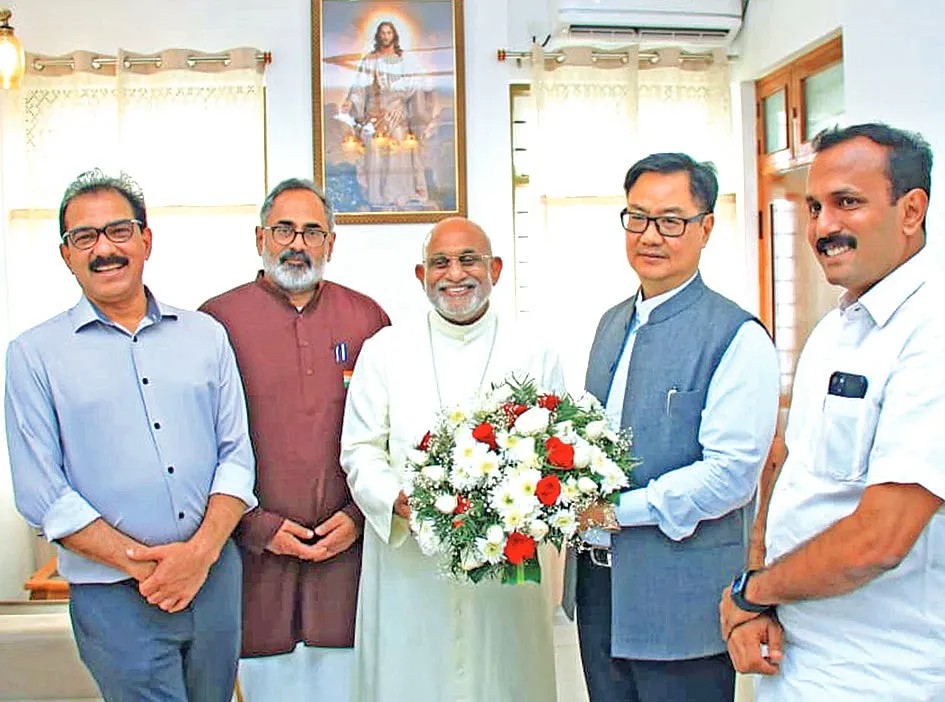
Syro-Malabar Major Archbishop Raphael Thattil may have set a cat among the pigeons with his appeal to the government to declare the Christian community a Micro Minority, but a commission headed by a retired high court judge could well offer poorer Christians of Kerala more substantial relief.
Earlier this February, the Kerala cabinet finally spoke on the Justice JB Koshy Commission report that had generated rumours, leaks, and frustration within the state's Christian institutions. Two years after the jurist submitted it to the government, it was announced that the report would be published soon.
The government also said it would revise how Latin Catholic community certificates are issued to the poorer group of Christians in the state, would establish free coaching centres for competitive exams, and reinstate a significant student grant.
The commission was established by the Left Democratic Front (LDF) government in November 2020 and tasked with investigating educational, economic, and welfare issues impacting Kerala's Christian communities.
Christians are a significant political demographic, accounting for 18.4% of the population according to the 2011 census, totalling approximately 61.40 lakh people. This initiative has been perceived as an important policy decision to address inequalities.
Under Prime Minister Narendra Modi, the Bharatiya Janata Party has been wooing the community, particularly the more affluent and entitled Syro-Malabar religious leadership, to win important seats in central Kerala.
Justice JB Koshy, a retired judge of the Kerala High Court, led the commission, which received around 4,87,000 representations from churches, organisations, and individuals before the report was finalised in May 2023.
The complaints were not about broad shortcomings in "minority welfare," but rather highlighted specific disparities in access to public employment, the limitations of existing reservation categories, and vulnerabilities in coastal and hill areas where livelihoods depend on fishing, small-scale farming, and plantation work.
After it was submitted to the government, the report remained secret despite public demands. Chief Minister Pinarayi Vijayan said in early January 2026 that the government had acted on "220 recommendations" across 17 departments, but this did not satisfy the people. Church organisations and lay groups protested that, as the affected community, they had not even been permitted to review the report.
This concern intensified as the report, while officially secret, began to surface in the media at the beginning of the new year. These reports detailed specific recommendations, often attributed to documents circulated within community networks or anonymous sources.
The New Indian Express, which is the major English language newspaper in the state together with The Hindu, reported on proposals for "special recruitment" and an increase in reservation for backward Christian groups, including a formula for distributing any increase among Latin Catholics, Anglo-Indians, Nadars, and groups classified under the state's "Socially and Educationally Backward Classes" for Christians.
It was suggested that the sudden governmental focus on the report was a catalyst for "blowback" ahead of elections, as small electoral shifts in as many as 50 Assembly constituencies could have significant consequences.
The commission had stressed that Kerala's Christians are not a homogeneous group, and welfare policies treating them as a single "advanced" minority overlook areas of deprivation.
The commission's emphasis on Latin Catholics, converted Christians, and Dalit Christians reflects longstanding divisions within Kerala's Christian community—between coastal and inland economies, the historic privilege of Syrian Christians, and communities reliant on fishing and labour, as well as those whose "caste status" continues to influence everyday discrimination even after conversion.
Education is a primary focus of the report. Cabinet decisions announced on February 24 included the restoration of the e-grant scholarship for students admitted through merit-based community quota seats. This administrative change directly impacts families living near the poverty line.
The cabinet also approved the establishment of free coaching centres for competitive exams in remote, hilly, and coastal areas, acknowledging that access to coaching, alongside academic performance, increasingly determines entry into public sector jobs and professional courses.
Additionally, a symbolic recommendation that has now been incorporated into policy is the directive that new government educational institutions in Kerala will not be named based on religion. This decision is framed as a secular measure but also appears as a preemptive strategy against anticipated backlash—that a Christian-focused commission could lead to the "communalisation" of education.
The government seems to be indicating that it will tackle socio-economic disadvantages without transforming public institutions into sectarian entities.
In the politically charged area of reservation and representation, the New Indian Express indicated that the commission recommended raising the reservation for backward Christian communities in education from 4-6%, with an internal allocation structure. If enacted, this would represent one of the most significant adjustments to Kerala's already complex reservation framework in years, as any increase for one group typically places pressure on others within the same "backward classes" category.
The chief minister's office, in its January statement reported by The Print, claimed that the government had reviewed all 284 primary recommendations and 45 sub-recommendations, with 220 having been acted upon.
The Church and community organisations have not accepted this assertion at face value. The Thrissur Archdiocese Jagratha Samithi has accused the government of dishonesty and linking the timing to the upcoming assembly elections. It has pointed out that requests for the report under the Right to Information Act were denied on the grounds that it was under cabinet consideration.
Groups have also approached the Kerala High Court to demand the publication of the report, labelling the government's public claims as an affront to the community.
Underlying the protests is a deeper concern: if the state selectively implements recommendations, it may produce visible, attention-grabbing initiatives while leaving unresolved the most challenging issues—representation in government jobs, internal disparities, and caste-related exclusions. In effect, the state could transform a structural review into an electoral strategy.
A particularly sensitive recommendation frequently mentioned in reports about the commission pertains to Dalit Christians. Dalit Christians experience "dual discrimination": caste stigma continues to exist in society, yet legal protections associated with the Scheduled Caste status do not transfer across religious conversions under current legal frameworks.
Even in Kerala, which often positions itself as a model of social progress, caste remains a tangible reality. Any efforts at the state level to advocate for SC status for Christian converts face constitutional and judicial limitations beyond Kerala's jurisdiction, making the commission's language and the government's response closely monitored across India.
The welfare proposals introduce another dimension, as they directly impact the relationship between the state and the Church.
The New Indian Express reported that the commission suggested a welfare fund for Sunday school teachers and religious instruction, modelled after support extended to madrasa teachers. For Church leaders, this could signify acknowledgement; however, it might also open the door for government oversight of catechism and internal religious education.
Another contentious issue is the Latin Catholic certificate matter—technical in nature but socially charged in practice. The cabinet decision on February 24 eliminated the use of 1947 as an eligibility cut-off for Latin Catholic community certificates, a rule criticised as arbitrary and challenging to apply to real family histories.
For those who have fought for years over community status, this is far from a minor detail. It affects eligibility for reservations and welfare programs and can determine whether a student is admitted under a specific category or excluded.
The February 24 cabinet package also included a decision to increase the upper age limit for Kerala Public Service Commission exams for general category candidates from 36 to 40, with a corresponding increase for eligible categories—another initiative that, while not limited to Christians, aligns with the report's focus on enhancing access to public employment for disadvantaged groups.
The cabinet also approved a group insurance scheme for homes impacted by natural disasters, including coverage for many Below Poverty Line families—again not specific to Christians but pertinent to coastal and hilly communities frequently affected by climate and disaster risks.
The state government "dragged its feet" for over two years before abruptly prioritising the report in early January 2026.
Politically, the commission has become a proxy conflict over the Christian vote. Kerala's Christian electorate is not a monolithic entity, but in districts with substantial Christian populations—such as Ernakulam, Thrissur, Pathanamthitta, and parts of Kottayam—it can be pivotal.
The Indian Express's "Decode Politics" analysis positioned the Koshy report at the heart of renewed competition for Christian outreach, with the BJP and the Marxists hoping to sway a sufficient segment of the Christian vote to clinch sensitive seats.
.jpeg)
 A. J. Philip
.jpg)
.png) Jacob Peenikaparambil
Jacob Peenikaparambil
.jpg) John Dayal
John Dayal
.jpg)
 Pachu Menon
.jpg)

.png)
.png)
.png) Robert Clements
Robert Clements
.jpg)