

.png) Joseph Maliakan
Joseph Maliakan
In his second encyclical, Laudato Si': On Care for Our Common Home (2015), Pope Francis offers a sustained moral critique of consumerism, unrestrained economic expansion, and ecological indifference. Lamenting environmental degradation, climate change, biodiversity loss, and the erosion of social cohesion, he calls for "swift and unified global action." Rejecting a reductive interpretation of human "dominion" over the earth, Francis advances an integral vision of creation as a "universal family" marked by radical interdependence. Social and environmental crises, he argues, are not discrete phenomena but dimensions of a single, complex emergency requiring holistic resolution.
A central theme of the encyclical is the ethical ambivalence of technological progress. Scientific innovation and economic growth, when severed from moral responsibility, risk turning destructive. Technological power, Francis cautions, cannot regulate itself in the absence of a corresponding development in conscience, values, and accountability. Ecological renewal, therefore, demands not only technical solutions but a profound transformation of human attitudes and structures of responsibility.
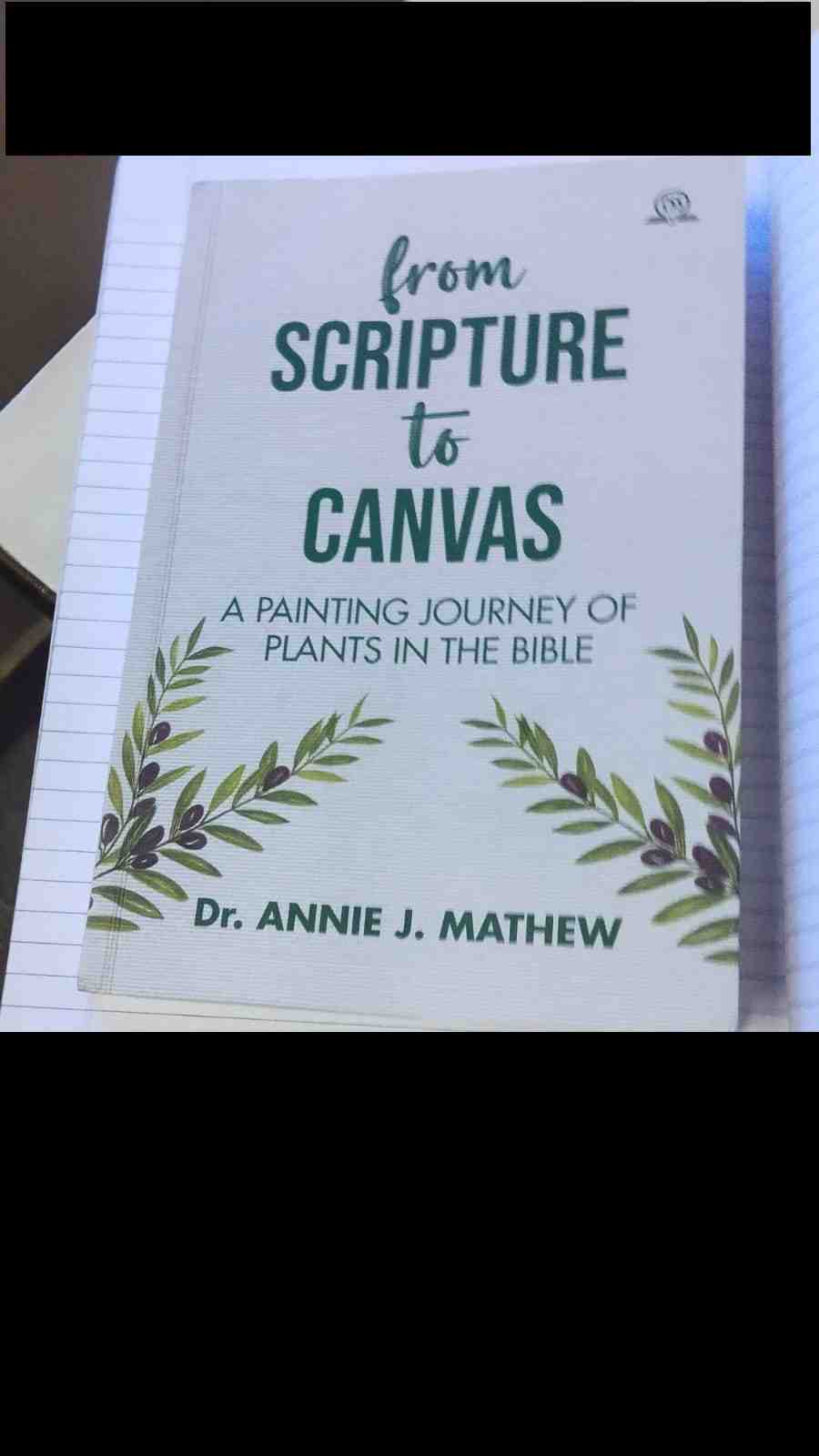
It is within this theological and ecological horizon that Annie J. Mathew's 101 Plants in the Bible may be situated. The volume represents an interdisciplinary engagement with Scripture through the lens of botany and visual art. Before the advent of print culture, biblical narratives were transmitted and interpreted through iconography, frescoes, and other visual media; sacred art functioned catechetically in largely non-literate societies. Masterpieces such as Michelangelo's ceiling of the Sistine Chapel, executed between 1508 and 1512, exemplify the pedagogical and theological power of visual representation within Christian tradition. Mathew's work participates in this lineage by rendering scriptural flora through carefully executed watercolour illustrations.
The book catalogues 101 plant species referenced in the Bible, integrating botanical description, artistic representation, and exegetical sensitivity. As noted in the foreword by Metropolitan Bishop Dr Theodosius Mar Thoma, the author—former Head of the Department of Botany at St. Thomas College, Kozhenchery—brings to the project the combined competencies of a scientist, an artist, and an attentive reader of Scripture. The result is not merely a devotional aid but a scholarly resource that illuminates the ecological texture of the biblical world.
The flora of the Holy Land, encompassing deserts, valleys, plains, and hill regions, is remarkably diverse, with approximately 2,600 species recorded. Biblical references, however, concentrate on plants central to agrarian life, ritual practice, and poetic symbolism. Cereals, millets, pulses, fruits, and vegetables form the agricultural backbone of ancient society, while timber, fibres, oils, and resins sustained construction, textile production, medicine, and liturgical observance. Majestic trees—cedar, pine, and date palm—feature prominently in descriptions of royal and temple architecture associated with the reigns of David and Solomon, underscoring the integration of ecology, economy, and worship.
Particularly significant are the seven species emblematic of the land: wheat, barley, vine, fig, pomegranate, olive, and date palm. Botanical knowledge also informs specific ritual prescriptions, such as the sacred incense described in Exodus (30:23–24), composed of myrrh, frankincense, cassia, galbanum, and cinnamon, and the composite bread commanded to the prophet Ezekiel (4:9), prepared from wheat, barley, lentils, millet, and fitches. Such passages attest to the intimate interweaving of plant life with subsistence, symbolism, and spirituality.
Mathew's illustrations emphasise morphological clarity to facilitate identification. English nomenclature follows The Open Bible (King James Version, 1983), while Malayalam equivalents are derived from the Sathyavedapusthakam (1999). Extending to 216 pages, the volume is published by Christava Sahitya Samithi, Thiruvalla, and is priced at ?600.
At a time when ecological degradation poses existential challenges, 101 Plants in the Bible serves as a reminder that scriptural faith is deeply rooted in the natural world. By recovering the botanical imagination of the Bible, the work implicitly reinforces the ethical imperative articulated in Laudato Si': care for creation is inseparable from the integrity of human spiritual and social life.
.jpeg)
 A. J. Philip
.jpg)
.png) Jacob Peenikaparambil
Jacob Peenikaparambil
.jpg)
.png) John Dayal
John Dayal
.jpg)
 Pachu Menon
.jpg)

.png)

.png)
.png) Robert Clements
Robert Clements
.jpg)